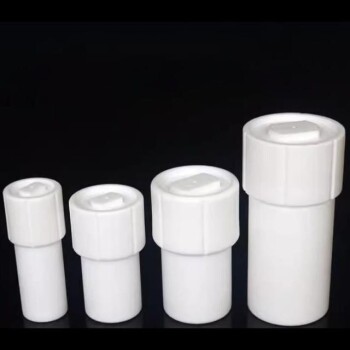
High-pressure digestion tanks and PTFE liners are the fundamental facilitators of the hydrothermal environment required for material synthesis. In the production of composites like niobium pentoxide and molybdenum dioxide, these components create a hermetically sealed reaction chamber that maintains precursors under high temperatures (e.g., 225°C) and autogenous pressure. This specific environment enables the controlled reaction and nucleation of precursors within acidic solutions, directly dictating the final morphology and crystallinity of the composite products.
The synergy between the structural strength of the digestion tank and the chemical inertness of the PTFE liner allows for the creation of subcritical conditions that enhance precursor solubility and drive the precise assembly of complex nanostructures.
The Role of the High-Pressure Digestion Tank
The digestion tank, often referred to as a hydrothermal autoclave, serves as the primary pressure vessel for the synthesis process.
Creating Subcritical Conditions
The sealed nature of the tank allows reaction solvents to reach a subcritical state. In this state, the solubility and reactivity of precursor components are significantly enhanced compared to standard atmospheric conditions.
Facilitating Autogenous Pressure
As the temperature increases within the sealed vessel, autogenous pressure is generated. This pressure is critical for driving the ion exchange and in-situ growth necessary to form stable crystal structures, such as niobium and molybdenum composites.
Controlling Nucleation and Growth
The stable, high-energy environment within the tank facilitates uniform nucleation at the molecular level. This allows for the oriented growth of crystals, which is essential for achieving specific morphologies like ultrathin nanosheets or hollow structures.
The Critical Function of PTFE Liners
While the outer tank provides structural integrity, the Polytetrafluoroethylene (PTFE) liner is responsible for the chemical environment's stability.
Corrosion Resistance in Acidic Media
Synthesis of niobium and molybdenum often involves acidic aqueous solutions that would aggressively corrode metal vessels. The PTFE liner acts as an impenetrable barrier against acids, bases, and organic solvents.
Ensuring Product Purity
By isolating the reaction from the metal walls of the digestion tank, the PTFE liner prevents metal ion contamination. This ensures that the final composite material maintains high purity and its intended electrical or catalytic properties.
Facilitating Clean Recovery
The non-stick properties of PTFE prevent the synthesized primary products from adhering to the container walls. This allows for higher yields and easier recovery of the primary composite products after the reaction is complete.
Understanding the Trade-offs and Limitations
While highly effective, using PTFE-lined digestion tanks requires a careful balance of operational parameters.
Temperature Constraints
PTFE has a physical limit; it generally cannot exceed 240°C to 250°C without deforming or releasing toxic fumes. If a synthesis requires higher temperatures, alternative liners like PPL (Polyphenylene polymers) or gold-plated vessels must be considered.
Thermal Lag
The thickness of the PTFE liner creates thermal insulation, meaning the internal temperature of the precursor solution may lag behind the oven temperature. Precise calibration is required to ensure the precursors reach the exact temperature needed for nucleation.
Pressure Risks
Because the pressure is autogenous (self-generated by heat), it can be unpredictable if the solvent's filling ratio is too high. Exceeding recommended volume limits can lead to catastrophic failure of the seal or the outer vessel.
How to Apply This to Your Project
Selecting the right equipment configuration depends entirely on your specific material goals.
- If your primary focus is material purity: Ensure your PTFE liners are meticulously cleaned and dedicated to specific chemistry types to avoid cross-contamination.
- If your primary focus is specific morphology: Focus on the precise control of the temperature-time profile within the digestion tank to manage the rate of oriented nucleation.
- If your primary focus is high-yield synthesis: Optimize the filling ratio of the PTFE liner (typically 60-80%) to maximize volume without compromising the safety of the pressure seal.
The successful synthesis of advanced composites relies on the precise intersection of high-pressure engineering and chemical-resistant containment.
Summary Table:
| Component | Primary Role | Key Benefits |
|---|---|---|
| High-Pressure Tank | Structural Pressure Vessel | Facilitates autogenous pressure and subcritical states for uniform nucleation. |
| PTFE Liner | Chemical Barrier | Provides corrosion resistance against acids and prevents metal ion contamination. |
| Synergy | Controlled Synthesis | Enables precise growth of complex nanostructures like Nb2O5 and MoO2 composites. |
| Operational Limits | Safety & Precision | Requires temperature monitoring (<250°C) and optimized filling ratios (60-80%). |
Elevate Your Synthesis Precision with KINTEK
Achieving the perfect crystal morphology and chemical purity requires equipment that can withstand the rigors of hydrothermal environments. KINTEK specializes in high-performance laboratory solutions, offering a comprehensive range of high-temperature high-pressure reactors and autoclaves paired with premium PTFE liners, ceramics, and crucibles.
Whether you are developing advanced composites like niobium pentoxide or conducting cutting-edge battery research, our equipment ensures safety, durability, and repeatable results. Beyond reactors, explore our full portfolio, including muffle furnaces, hydraulic presses, and cooling solutions tailored for modern material science.
Ready to optimize your lab's performance? Contact our technical experts today to find the ideal equipment configuration for your specific research needs!
References
- Evangeline C. Wheeler‐Jones, Richard I. Walton. A Composite of Nb<sub>2</sub>O<sub>5</sub> and MoO<sub>2</sub> as a High‐Capacity High‐Rate Anode Material for Lithium‐Ion Batteries. DOI: 10.1002/batt.202200556
This article is also based on technical information from Kintek Solution Knowledge Base .
Related Products
- Custom PTFE Teflon Parts Manufacturer for Microwave Digestion Tank
- Portable High Pressure Laboratory Autoclave Steam Sterilizer for Lab Use
- Customizable High Pressure Reactors for Advanced Scientific and Industrial Applications
- Stainless High Pressure Autoclave Reactor Laboratory Pressure Reactor
- High Pressure Laboratory Autoclave Reactor for Hydrothermal Synthesis
People Also Ask
- Why are PTFE containers required for PCT leaching tests? Ensure Chemical Inertness and Analytical Precision
- Why use high-quality PTFE containers for CO2 reduction electrolytes? Eliminate silicon contamination and ensure data.
- Why is PTFE Mandatory for Hydrofluoric Acid (HF) Handling? Ensure Safety and Data Integrity in Corrosion Testing
- Why is a PTFE container required for acid leaching of silicon nanosheets? Ensure High Purity and Safety
- Why are polytetrafluoroethylene (PTFE) containers essential for assessing the corrosion resistance of glassified waste?