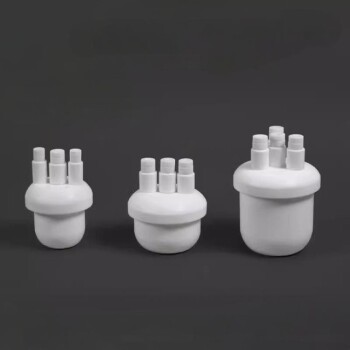
Multi-neck reactors are the architectural foundation of advanced chemical synthesis. They provide a centralized platform for multi-functional integration, allowing researchers to manage complex thermal and chemical variables simultaneously without compromising system integrity. By utilizing standardized ground-glass joints, these vessels transform a simple container into a sophisticated, closed-loop reaction environment.
The core advantage of multi-neck reactors lies in their ability to support simultaneous monitoring and control within a hermetically sealed system. This integration is critical for maintaining process stability under specialized conditions like high vacuum or inert gas protection.
The Engineering Logic of Multi-Neck Integration
Parallel Functional Entry Points
Multi-neck reactors allow for the concurrent installation of essential components such as temperature sensors, condensers, and dropping funnels. This parallel setup ensures that each tool has a dedicated port, preventing the need to interrupt the reaction to swap instruments.
Dynamic Process Regulation
By housing a stirring paddle alongside addition funnels, the system enables precise control over mass transfer and heat distribution. This configuration is vital for exothermic reactions where the rate of reagent addition must be tuned in real-time based on internal temperature data.
Real-Time Environmental Monitoring
The ability to dedicated a neck specifically to a thermowell or probe ensures that the data collected is accurate and responsive. This eliminates the lag associated with external monitoring and allows for immediate adjustments to heating or cooling mantles.
The Role of High-Sealing Interfaces
Maintaining Atmospheric Isolation
High-sealing ground-glass joints are the primary defense against atmospheric contamination. These interfaces are precision-engineered to create a gas-tight seal, which is indispensable when working with air-sensitive catalysts or moisture-reactive reagents.
Facilitating High-Vacuum Operations
For processes like vacuum distillation or moisture removal, the integrity of the sealing interface determines the ultimate base pressure of the system. Precision-ground joints minimize leak rates, allowing the reactor to maintain the deep vacuum levels required for high-purity separations.
Structural Versatility via Standardized Joints
The use of standardized joint sizes (such as 24/40 or 29/32) allows for modular flexibility across different experiments. Researchers can quickly reconfigure the reactor's "loadout" by swapping out glassware, ensuring the system evolves alongside the project's needs.
Understanding the Trade-offs and Constraints
Mechanical Stress and Geometry
As the number of necks increases, the structural complexity of the glass increases, making the vessel more susceptible to thermal shock. Overloading the necks with heavy condensers or stirring motors can also create mechanical leverage that risks fracturing the glass joints.
Maintenance and Seizing Risks
Ground-glass joints require meticulous maintenance to prevent "frozen" or seized connections, especially when working with caustic chemicals. While greasing joints improves the seal, it introduces a potential source of contamination into the reaction mixture.
Cleaning and Cross-Contamination
The intricate geometry of a multi-neck flask makes thorough cleaning more challenging than a single-neck vessel. Residual chemicals trapped in the "shoulders" of the necks can compromise subsequent batches if not addressed with aggressive solvent cleaning or base baths.
Implementing Multi-Neck Systems in Your Workflow
When selecting a reactor configuration, the choice should be driven by the specific demands of your chemical process and the level of environmental control required.
- If your primary focus is air-sensitive synthesis: Prioritize reactors with high-precision ground joints and use inert gas manifolds to maintain positive pressure at all ports.
- If your primary focus is process optimization: Utilize the multiple necks to integrate automated dosing pumps and digital temperature probes for high-fidelity data logging.
- If your primary focus is high-viscosity mixing: Ensure the central neck is large enough to accommodate heavy-duty stirring shafts while leaving peripheral necks free for reflux and monitoring.
By mastering the integration of functional components through secure sealing interfaces, you ensure that your chemical systems remain both highly controlled and infinitely adaptable.
Summary Table:
| Feature | Technical Advantage | Research Benefit |
|---|---|---|
| Parallel Entry Ports | Concurrent installation of sensors, condensers, & funnels | Multi-functional integration without breaking seals |
| Ground-Glass Joints | Precision-engineered gas-tight sealing | Supports deep vacuum and inert gas protection |
| Modular Architecture | Standardized joint sizes (e.g., 24/40) | Flexible configuration for evolving experimental needs |
| Central Stirring Port | Direct alignment for stirring paddles | Uniform mass transfer and heat distribution |
Elevate Your Synthesis Precision with KINTEK
Unlock the full potential of your complex chemical systems with KINTEK’s precision-engineered laboratory solutions. Whether you require multi-neck reactors, high-temperature high-pressure reactors, or autoclaves, our equipment is designed to ensure maximum process stability and atmospheric integrity.
Beyond reactors, KINTEK offers a comprehensive range of tools including:
- Thermal Processing: Muffle, tube, and vacuum furnaces.
- Material Preparation: Crushing, milling, and hydraulic presses (pellet, isostatic).
- Sample Management: Electrolytic cells, cooling solutions (ULT freezers), and high-quality ceramic crucibles.
Ready to optimize your lab's efficiency and research outcomes? Contact our experts today to find the perfect configuration for your specific workflow needs!
References
- Nan Cheng, Zhenhai Liang. Effects of Molybdenum Doping on the Enhanced Electrocatalytic Nitrogen Reduction Reaction Performance of CeO<sub>2</sub> Nanorods: Theoretical and Experimental Investigations. DOI: 10.1002/cplu.202300023
This article is also based on technical information from Kintek Solution Knowledge Base .
Related Products
- Customizable Laboratory High Temperature High Pressure Reactors for Diverse Scientific Applications
- Customizable High Pressure Reactors for Advanced Scientific and Industrial Applications
- Visual High-Pressure Reactor for In-Situ Observation
- Custom PTFE Teflon Parts Manufacturer for Three-Necked Round Bottom Flask
- Multi Heating Zones CVD Tube Furnace Machine Chemical Vapor Deposition Chamber System Equipment
People Also Ask
- How do high-pressure and high-temperature reactors ensure the effective treatment of lignocellulosic wastewater in WAO?
- What equipment is required for high-pressure high-temperature reactions? Master Extreme Chemistry Safely
- How do you control high pressure in a reactor? A Guide to Safe & Stable Operation
- Why is argon better than nitrogen for inert atmosphere? Ensure Absolute Reactivity & Stability
- How does initial oxygen pressure affect the wet oxidation of pharmaceutical sludge? Master Your Oxidation Depth