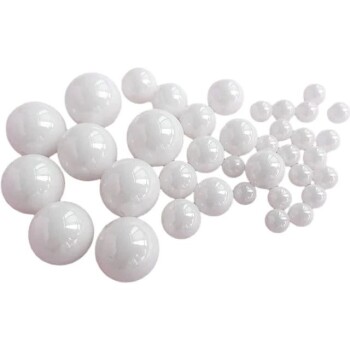
Alumina grinding balls are preferred for processing Magnesium Aluminate Spinel composites because they deliver a unique combination of high mechanical hardness and chemical compatibility. Their physical durability provides the necessary kinetic energy to crush powder materials effectively, while their chemical composition ensures that any material lost from the balls due to wear does not act as a foreign contaminant.
Core Takeaway: The definitive advantage of using alumina media is "compatible contamination." Since alumina is already a primary component of the composite, wear debris integrates into the formulation rather than compromising the material's purity or stability.
The Critical Advantage of Purity
Eliminating Foreign Contamination
In every grinding process, the grinding media inevitably experiences wear due to friction and impact.
If you were to use steel or zirconia beads, the resulting debris would introduce iron or zirconium impurities into your ceramic powder.
By using high-purity alumina balls, you ensure that the inevitable wear particles are chemically identical to a primary component of the Magnesium Aluminate Spinel composite.
Ensuring Performance Stability
The introduction of foreign impurities can drastically alter the thermal and electrical properties of high-performance ceramics.
By matching the grinding media to the material composition, you preserve the high purity of the final product.
This alignment guarantees that the resulting Magnesium Aluminate Spinel and Aluminum Titanate composite ceramics maintain consistent performance characteristics.
Mechanical Efficiency in Processing
Generating High Kinetic Energy
Alumina balls possess excellent hardness and wear resistance.
This physical robustness allows them to transfer significant kinetic energy during the milling process.
This energy is essential for effectively crushing raw powder materials down to the desired particle size.
Breaking Down Hard Agglomerates
Ultrafine powders, such as Magnesium Aluminum Spinel, frequently experience agglomeration after calcination due to high surface energy.
A planetary ball mill utilizing alumina balls—typically at a 7:1 ball-to-material ratio—applies the mechanical force necessary to shatter these hard agglomerates.
Improving Sintering Outcomes
When agglomerates are effectively broken down, the dispersibility of the powder significantly improves.
Uniform dispersion is critical for preventing uneven shrinkage during the sintering process.
Without this uniform grinding, the final ceramic component could suffer from structural defects or dimensional inaccuracies.
Understanding the Trade-offs
Managing Stoichiometry
While alumina wear is not "foreign" contamination, it does add extra alumina to your mixture.
If the wear rate is excessive, it can shift the chemical balance (stoichiometry) of the Magnesium Aluminate Spinel, potentially resulting in an alumina-rich composite.
Monitoring Media Quality
Not all alumina balls are created equal; lower-quality balls may have higher wear rates or contain binders that act as impurities.
It is essential to verify that the specific grade of alumina media matches the purity requirements of your composite material.
Making the Right Choice for Your Goal
To ensure the highest quality processing for Magnesium Aluminate Spinel composites, consider the following:
- If your primary focus is extreme purity: Select high-purity alumina grinding media to ensure that any wear debris integrates seamlessly without introducing foreign elements.
- If your primary focus is structural integrity: Ensure you utilize a sufficient ball-to-material ratio (such as 7:1) to generate the force required to break down hard agglomerates and prevent sintering defects.
By aligning your grinding media with your material composition, you turn a potential source of contamination into a neutral process variable.
Summary Table:
| Feature | Benefit for Magnesium Aluminate Spinel |
|---|---|
| Chemical Compatibility | Wear debris is alumina-based, acting as a "compatible contaminant" that preserves material purity. |
| High Hardness | Provides the kinetic energy required to crush hard calcined powders and break down agglomerates. |
| Dispersion Quality | Improves powder uniformity, preventing uneven shrinkage and defects during the sintering process. |
| Wear Resistance | Minimizes stoichiometry shifts by ensuring low and predictable media wear rates. |
| Kinetic Efficiency | Optimized for planetary ball milling at 7:1 ratios to reach ultrafine particle sizes. |
Elevate Your Material Purity with KINTEK Precision Solutions
Don’t let foreign impurities compromise the integrity of your high-performance ceramics. KINTEK specializes in providing premium laboratory equipment and high-purity consumables designed for the most demanding research environments.
Whether you require crushing and milling systems equipped with high-purity alumina grinding media, or advanced high-temperature furnaces and hydraulic presses to complete your sintering workflow, our comprehensive portfolio ensures consistent, repeatable results. Our experts understand the nuances of Magnesium Aluminate Spinel processing and can help you select the ideal ball-to-material ratios and media grades for your specific application.
Ready to optimize your milling process? Contact KINTEK today to discover how our high-quality grinding solutions and specialized laboratory equipment can enhance your lab's efficiency and product performance.
References
- Gorkem Cevikbas, B. Büyük. An investigation of aluminum titanate-spinel composites behavior in radiation. DOI: 10.1063/1.4914220
This article is also based on technical information from Kintek Solution Knowledge Base .
Related Products
- Laboratory Jar Ball Mill with Alumina Zirconia Grinding Jar and Balls
- High Purity Alumina Granulated Powder for Engineering Advanced Fine Ceramics
- Laboratory Jar Mill with Agate Grinding Jar and Balls
- Laboratory Ball Mill Jar Mill with Metal Alloy Grinding Jar and Balls
- Advanced Engineering Fine Ceramics Low Temperature Alumina Granulation Powder
People Also Ask
- What are the primary functions of using a ball mill for BZCY72 powder? Achieve High Purity and Enhanced Sintering
- In what way does a laboratory ball mill affect material properties when modifying PHBV/pulp fiber composites?
- Why is a laboratory ball mill required for ultra-fine fly ash? Unlock Nano-Scale Adsorption Power
- What is the function of a laboratory ball mill in the preparation of AMMCs? Optimize Dispersion & Grain Refinement
- What is the function of a laboratory ball mill in the pretreatment of waste tire char (WTC)? Optimize Material Reactivity