The primary reason ceramic sampling tubes and PTFE filter elements are paired for high-temperature flue gas collection is their complementary resistance to extreme thermal and chemical stress. Ceramic components provide the necessary structural and chemical stability within the furnace, while PTFE elements ensure the physical purity of the gas before it reaches sensitive analytical sensors. This combination prevents sample contamination and protects expensive equipment from catastrophic failure.
To successfully analyze high-temperature flue gas, you must solve two problems simultaneously: surviving the heat and removing abrasive solids. Ceramic tubes handle the extraction from 1300 °C zones without reacting, while PTFE filters capture fine particulates to safeguard downstream instruments like mass spectrometers.
The Role of Ceramics in High-Heat Extraction
Superior Thermal Stability and Structural Integrity
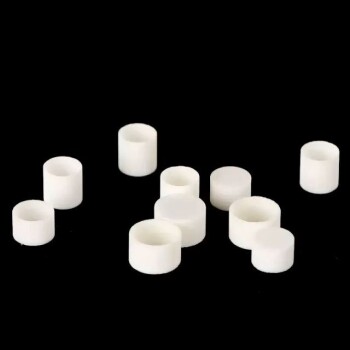
High-purity ceramic sampling tubes are utilized because they can extend directly into reaction zones reaching up to 1300 °C. Unlike metals, which may soften or melt, ceramics maintain their shape and structural integrity under extreme thermal loads.
This stability allows them to serve as reliable conduits, ensuring the gas flow remains consistent and the sampling point remains precise within the furnace.
Chemical Inertness for Sample Purity
A critical requirement in flue gas analysis is ensuring the sample does not react with the sampling probe itself. Ceramics possess excellent chemical inertness, meaning they will not catalyze secondary reactions or leach contaminants into the gas stream.
By acting as a neutral isolation chamber, these tubes ensure that the chemical composition of the flue gas arriving at the detector is an exact representation of the environment inside the furnace.
The Function of PTFE in Precision Filtration
Intercepting Solid Impurities and Char
Once the gas is extracted, it often contains high concentrations of char, fly ash, and other particulates. PTFE precision filter elements are deployed to efficiently intercept these solids, leveraging their microporous structure to trap particles as small as 0.45 microns.
Removing these solids is essential to prevent "plugging," where accumulated dust blocks the narrow capillaries of the analytical system.
Ensuring Analytical Accuracy and Instrument Safety
Sensitive instruments, such as mass spectrometers, are highly vulnerable to damage from solid impurities. If abrasive particles enter the ionization chamber or detector, they can cause physical erosion or significant signal noise.
PTFE's high chemical compatibility ensures the filter doesn't introduce new variables, resulting in clear gas samples and highly accurate data regarding pollutant concentrations.
Understanding Technical Trade-offs and Limitations
Managing Material Brittleness and Thermal Shock
While ceramics are heat-resistant, they are inherently brittle and susceptible to cracking if subjected to sudden temperature changes. Operators must ensure a gradual heating or cooling ramp to prevent thermal shock from destroying the sampling tube.
Physical handling must also be precise, as even minor mechanical impacts can lead to structural failure of the ceramic probe.
Navigating Temperature Disparities Between Components
It is vital to recognize that PTFE has a much lower temperature threshold than ceramic. While the ceramic tube resides in the 1300 °C zone, the gas must be sufficiently cooled before it reaches the PTFE filter element to avoid melting the polymer.
This requires a system design that accounts for the thermal gradient between the extraction point and the filtration stage.
How to Apply This to Your Project
When designing your flue gas sampling system, consider your specific analytical goals to determine the best material configuration.
- If your primary focus is instrument longevity: Prioritize high-efficiency PTFE filters with a 0.45-micron rating to prevent any possibility of particulate bypass into your mass spectrometer.
- If your primary focus is extreme temperature monitoring: Ensure your ceramic tubes are rated for at least 1300 °C and feature a high-purity alumina content to maximize thermal shock resistance.
- If your primary focus is chemical trace analysis: Verify that all sampling components, from the probe to the filter housing, are chemically inert to prevent the adsorption of target gas molecules.
Selecting the right combination of ceramic and PTFE components ensures that your data remains accurate while your most expensive hardware stays protected.
Summary Table:
| Component | Key Benefit | Max Temperature | Primary Function |
|---|---|---|---|
| Ceramic Tube | Thermal Stability & Inertness | Up to 1300°C | Heat-resistant extraction & sample purity |
| PTFE Filter | Precision Filtration (0.45µm) | Low (requires cooling) | Particulate removal & instrument protection |
Optimize Your Flue Gas Analysis with KINTEK
Ensure the accuracy of your high-temperature research with high-purity consumables and precision laboratory equipment. At KINTEK, we specialize in providing the robust tools needed for extreme environments—from ceramic sampling tubes and PTFE products to high-temperature muffle furnaces, CVD systems, and high-pressure reactors.
Whether you are monitoring pollutants or analyzing reaction kinetics, our comprehensive range of equipment and consumables ensures you prevent equipment failure and maintain sample integrity.
Ready to upgrade your laboratory's precision? Contact KINTEK today to find the perfect high-temperature solution for your application.
References
- Coskun Yildiz, Bernd Epple. Release of Sulfur and Chlorine Gas Species during Combustion and Pyrolysis of Walnut Shells in an Entrained Flow Reactor. DOI: 10.3390/en16155684
This article is also based on technical information from Kintek Solution Knowledge Base .
Related Products
- Boron Nitride (BN) Ceramic Tube
- High Temperature Aluminum Oxide (Al2O3) Protective Tube for Engineering Advanced Fine Ceramics
- Custom PTFE Teflon Parts Manufacturer for PTFE Bottle Oil Fume Sampling Tube
- Carbon Graphite Boat -Laboratory Tube Furnace with Cover
- Custom PTFE Teflon Parts Manufacturer for Sampling Solution Sample and Dry Powder Spoons
People Also Ask
- Why are Boron Nitride Tubes selected as reaction vessels for Na3SbS4? Ensure Purity in High-Temp Synthesis
- What is the maximum temperature for a ceramic tube? Find the Right Material for Your High-Temp Needs
- What is the temperature resistance of a ceramic tube? It Depends on the Material—Find the Right Fit
- What is the temperature range of a ceramic tube? Select the Right Material for Your High-Temp Needs
- What are ceramic tubes used for? Essential Components for Extreme Heat & Electrical Insulation