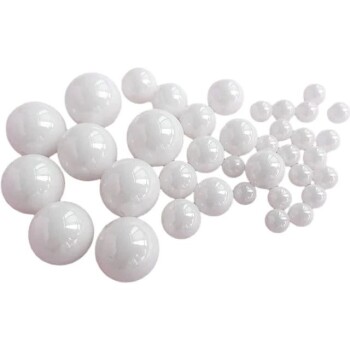
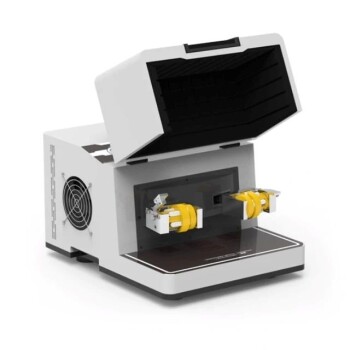
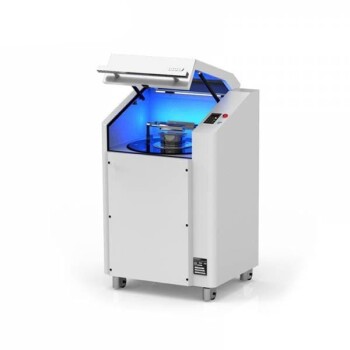
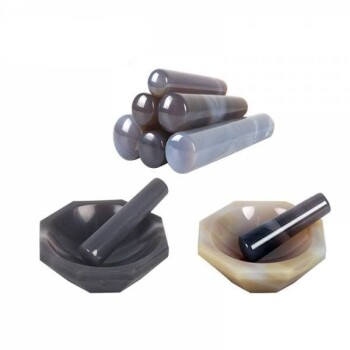
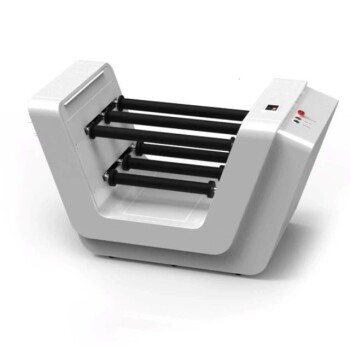
The selection of zirconia grinding kits for LATP synthesis is driven by the critical need for chemical purity and mechanical efficiency. These kits leverage extreme hardness to refine coarse powders to the micron level without introducing metallic contaminants that would degrade the electrolyte's performance.
Core Takeaway Zirconia grinding media provide the high impact energy necessary to increase the specific surface area of LATP powders for better sintering, while simultaneously acting as a chemically inert barrier against metallic impurity contamination.
The Critical Need for Purity
Preventing Metallic Contamination
Chemical inertness is the primary reason for choosing zirconia over materials like stainless steel. LATP (Li1.5Al0.5Ti1.5(PO4)3) is highly sensitive to impurities.
Standard steel grinding jars shed microscopic metallic debris due to wear. This introduces conductive impurities that can ruin the insulating properties and electrochemical stability of the solid electrolyte. Zirconia eliminates this risk entirely.
Ensuring Chemical Stability
Zirconia is chemically stable and unreactive. It does not react with the LATP precursors or the synthesized powder, even under the heat and pressure generated during ball milling.
This stability preserves the precise stoichiometry of the LATP formulation. Maintaining the exact chemical composition is vital for achieving the target ionic conductivity.
Optimizing Physical Characteristics
Refining Particle Size
The primary mechanical goal of ball milling LATP is refining pre-sintered coarse powders down to the micron level.
Zirconia is extremely hard and dense. This allows it to deliver the kinetic energy required to fracture the LATP particles effectively, breaking them down to the necessary fineness.
Enhancing Sintering Activity
The reduction in particle size directly leads to an increased specific surface area.
Higher surface area creates more contact points between particles. This increased "sintering activity" is crucial for the subsequent densification step, allowing the material to fuse into a dense, highly conductive ceramic pellet.
Mechanics of the Milling Process
High Impact Energy
Zirconia possesses high density compared to softer media like agate. This density translates into higher impact energy during the tumbling or planetary motion of the mill.
This energy is necessary to shorten reaction times and break through tough agglomerates or impurity layers that may exist on the particle surfaces.
Wear Resistance
The extreme hardness of zirconia ensures exceptional wear resistance. The grinding media itself retains its shape and mass over prolonged milling cycles.
This durability ensures consistent grinding performance over time, preventing fluctuations in the final particle size distribution.
Optimizing the Process: Pitfalls to Avoid
The Trap of Uniform Media Size
A common mistake is using a single size of grinding ball (e.g., only 10mm balls). This can lead to inefficient milling and voids in the grinding jar where powder hides.
To maximize efficiency, you should utilize a media gradation strategy. As noted in comparative solid-state electrolyte processing, combining diameters (such as 5mm, 8mm, and 10mm) optimizes the distribution of impact forces.
Balancing Impact vs. Contamination
While zirconia minimizes metallic contamination, it is not indestructible. Over-milling at excessive speeds can theoretically introduce zirconia wear debris.
However, because zirconium is often chemically compatible with LATP structures (or less detrimental than iron), this trade-off is generally acceptable compared to the catastrophic effects of metallic iron contamination.
Making the Right Choice for Your Goal
To ensure the successful synthesis of LATP solid electrolytes, apply the following principles to your equipment selection:
- If your primary focus is High Ionic Conductivity: Prioritize zirconia to completely eliminate metallic impurities that block lithium-ion pathways.
- If your primary focus is Sintering Density: Ensure your milling protocol runs long enough to achieve micron-level fineness, which drives the densification process.
- If your primary focus is Process Efficiency: Use a mix of grinding ball diameters (e.g., small, medium, and large) to ensure uniform particle distribution and faster grinding.
Ultimately, zirconia is the industry standard because it is the only material that balances the mechanical violence required for grinding with the chemical delicacy required for electrolyte purity.
Summary Table:
| Feature | Benefit for LATP Synthesis |
|---|---|
| Extreme Hardness | Achieves micron-level particle refinement for better sintering density. |
| Chemical Inertness | Prevents metallic contamination that degrades electrochemical stability. |
| High Density | Provides the high impact energy needed to break down tough agglomerates. |
| Wear Resistance | Ensures consistent results and long-term durability of grinding media. |
| Material Compatibility | Minimizes detrimental chemical reactions with the LATP precursor. |
Elevate Your Solid-State Electrolyte Research with KINTEK
Precision in LATP synthesis starts with the right equipment. KINTEK specializes in high-performance laboratory solutions, providing the zirconia grinding jars and media you need to ensure zero metallic contamination and optimal particle size distribution.
Our extensive portfolio supports your entire battery research workflow, including:
- Crushing & Milling Systems: High-density zirconia kits and planetary ball mills.
- Thermal Processing: High-temperature muffle and vacuum furnaces for precise sintering.
- Electrochemical Tools: Electrolytic cells, electrodes, and specialized battery research consumables.
- Sample Preparation: Hydraulic pellet presses for creating dense ceramic pellets.
Don't let impurities compromise your ionic conductivity. Contact KINTEK today to discover how our high-purity consumables and precision machinery can streamline your material synthesis and deliver superior results.
Related Products
- Laboratory Jar Ball Mill with Alumina Zirconia Grinding Jar and Balls
- Precision Machined Zirconia Ceramic Ball for Engineering Advanced Fine Ceramics
- Laboratory Jar Mill with Agate Grinding Jar and Balls
- Laboratory Ball Mill Jar Mill with Metal Alloy Grinding Jar and Balls
- Laboratory Micro Tissue Grinding Mill Grinder
People Also Ask
- What are the primary functions of using a ball mill for BZCY72 powder? Achieve High Purity and Enhanced Sintering
- In what way does a laboratory ball mill affect material properties when modifying PHBV/pulp fiber composites?
- Why is a laboratory ball mill required for ultra-fine fly ash? Unlock Nano-Scale Adsorption Power
- What is the function of a laboratory ball mill in the preparation of AMMCs? Optimize Dispersion & Grain Refinement
- What is the function of a laboratory ball mill in the pretreatment of waste tire char (WTC)? Optimize Material Reactivity