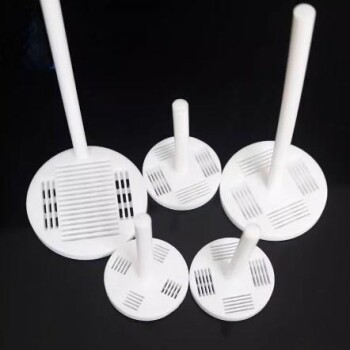
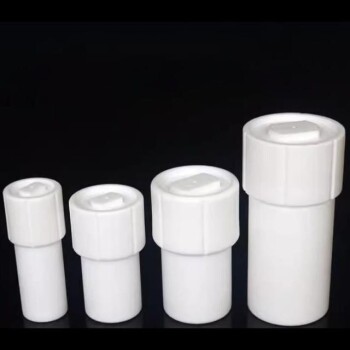
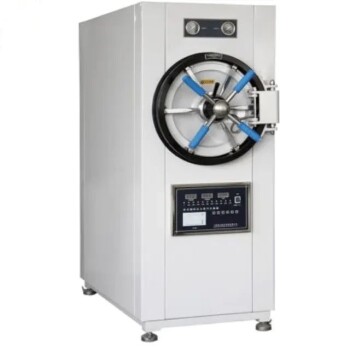
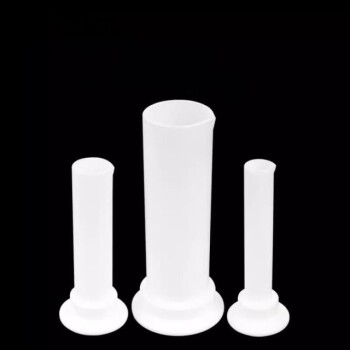
A Teflon-lined autoclave is essential because it creates a sealed, high-pressure environment that allows solvents to reach subcritical or supercritical states without corroding the vessel or contaminating the sample. This specific apparatus enables the rapid dissolution and recrystallization of precursors at temperatures well above their atmospheric boiling points, which is critical for forming high-quality porous TiO2 nanostructures.
Core Insight: The necessity of the Teflon-lined autoclave lies in its dual ability to withstand the extreme pressure required for crystal nucleation while providing an inert chemical barrier against the harsh, often alkaline, conditions needed to shape TiO2 morphology.
Creating the Optimal Thermodynamic Environment
Achieving Subcritical and Supercritical States
The primary function of the autoclave is to maintain high temperatures and high pressures simultaneously.
By sealing the reaction, the system allows fluids to exist in subcritical or supercritical states.
In this environment, solvents acquire unique properties that standard heating cannot achieve, facilitating reactions that are impossible at atmospheric pressure.
Accelerating Reaction Kinetics
This high-pressure environment significantly accelerates reaction rates.
Precursors that are difficult to dissolve under standard conditions undergo rapid dissolution and subsequent recrystallization.
This speed and energy facilitate the nucleation and growth of TiO2 crystals, which is the foundational step in creating defined nanomaterials.
Controlling Morphology and Crystallinity
Enhancing Structural Regularity
The autoclave environment allows for precise control over the material's internal structure.
The hydrothermal treatment significantly improves the crystallinity and structural regularity of the TiO2.
This results in a more stable and robust material compared to those synthesized via simpler precipitation methods.
Targeting Specific Crystal Facets
One of the most advanced benefits of this method is the ability to expose specific reactive planes.
The conditions promotes the growth of specific exposed facets, such as the 010 or 101 planes.
These specific facets are crucial for catalytic applications, as they often dictate how the material interacts with other molecules.
Facilitating Complex Geometries
The process is particularly beneficial for synthesizing complex architectures.
It enables the formation of layered or hollow nanostructures, nanowires, and nanobelts.
By adjusting the filling degree and pressure, researchers can maximize the specific surface area, which is vital for porous materials used in photocatalysis.
Ensuring Purity and Equipment Safety
Resistance to Alkaline Corrosion
Hydrothermal synthesis of TiO2 often requires strong alkaline solutions (such as high-concentration sodium hydroxide).
The Teflon lining provides excellent resistance to strong alkaline corrosion.
Without this lining, the harsh chemicals would corrode the steel vessel, potentially destroying the equipment and ruining the experiment.
Preventing Sample Contamination
Purity is paramount in nanomaterial synthesis.
The inert nature of Teflon prevents metal ion contamination from the steel walls of the autoclave.
This ensures that the final TiO2 micron-scale wire structures are chemically pure and perform predictably in ecological or catalytic applications.
Understanding the Trade-offs
The "Black Box" Limitation
While the sealed environment is necessary for pressure, it creates a "black box" scenario.
You cannot observe the reaction as it happens; you can only analyze the end product.
This requires careful experimental design and iterative testing to dial in parameters like time and temperature.
Safety and Filling Ratios
The high-pressure capability brings inherent safety risks if managed poorly.
You must precisely adjust the filling degree of the solvent.
Overfilling can lead to dangerous pressure spikes, while underfilling may fail to generate the required vapor pressure for the specific morphology you desire.
Making the Right Choice for Your Goal
To maximize the effectiveness of your hydrothermal treatment, align your process parameters with your specific end-goal:
- If your primary focus is Photocatalytic Activity: Prioritize parameters that expose specific facets (like 010 or 101) to enhance surface reactivity.
- If your primary focus is Material Purity: Ensure the Teflon liner is inspected for scratches or defects to guarantee zero metal ion leaching during alkaline treatments.
- If your primary focus is Surface Area: Experiment with lower filling degrees and variable temperatures to induce the formation of porous, hollow, or layered nanostructures.
By leveraging the inert, high-pressure capabilities of a Teflon-lined autoclave, you transform simple precursors into highly crystalline, morphologically distinct TiO2 nanomaterials.
Summary Table:
| Feature | Benefit for TiO2 Nanomaterials |
|---|---|
| Teflon Lining | Provides inert chemical resistance against strong alkaline corrosion and prevents metal contamination. |
| High-Pressure Seal | Enables solvents to reach subcritical/supercritical states for rapid precursor dissolution. |
| Temperature Control | Promotes superior crystallinity and the growth of specific reactive crystal facets (e.g., 010, 101). |
| Morphology Control | Facilitates the creation of complex architectures like nanowires, nanobelts, and hollow structures. |
| Safety & Stability | Manages internal vapor pressure safely to ensure consistent, repeatable experimental results. |
Elevate Your Nanomaterial Synthesis with KINTEK
Precision is non-negotiable when synthesizing high-performance TiO2 nanostructures. KINTEK specializes in premium laboratory equipment designed to withstand the most demanding hydrothermal conditions. Our range includes:
- High-Temperature & High-Pressure Reactors and Autoclaves (Teflon & PPL lined)
- Crushing and Milling Systems for precursor preparation
- Furnaces & Heating Solutions (Muffle, Tube, Vacuum, and CVD)
- PTFE Products and High-Purity Ceramics
Whether you are targeting specific crystal facets or maximizing surface area for photocatalysis, KINTEK provides the reliability and purity your research demands. Contact us today to optimize your lab setup!
References
- Donna A. Chen, Adam F. Lee. Synthetic strategies to nanostructured photocatalysts for CO<sub>2</sub>reduction to solar fuels and chemicals. DOI: 10.1039/c5ta01592h
This article is also based on technical information from Kintek Solution Knowledge Base .
Related Products
- Custom PTFE Teflon Parts Manufacturer for Centrifuge Tube Racks
- Custom PTFE Teflon Parts Manufacturer PTFE Beaker and Lids
- Custom PTFE Teflon Parts Manufacturer for Cleaning Racks
- Custom PTFE Teflon Parts Manufacturer Corrosion Resistant Cleaning Rack Flower Basket
- Custom Machined and Molded PTFE Teflon Parts Manufacturer for Laboratory ITO FTO Conductive Glass Cleaning Flower Basket
People Also Ask
- Why is slender PTFE tubing necessary for flow control in multi-channel catalyst aging? Ensure Equal Gas Distribution
- Why are PTFE containers required for PCT leaching tests? Ensure Chemical Inertness and Analytical Precision
- Why are PTFE containers necessary for selective HF etching of MAX phases? Ensure Safe & Pure MXene Synthesis
- What role do PTFE containers play in trace metal detection? Ensure Analytical Precision in Photocatalysis Studies
- Why is a PTFE container required for acid leaching of silicon nanosheets? Ensure High Purity and Safety