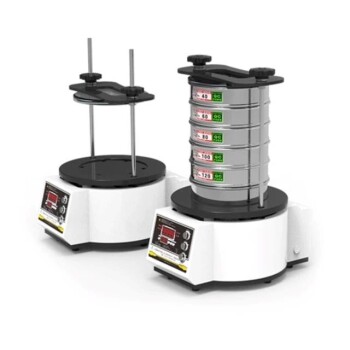
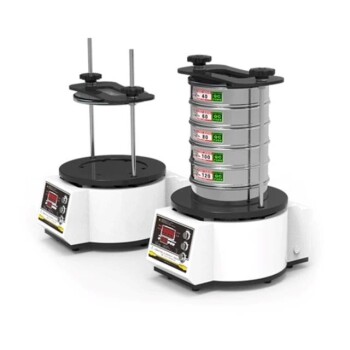
The use of an 80-mesh sieve is a critical control step for Ammonium Perrhenate (NH4ReO4).
This specific sieving process is utilized to break down large agglomerates and standardize the initial particle size of the raw material. By ensuring the rhenium source matches the particle size of other components, such as molybdenum oxide, manufacturers can achieve superior mixing uniformity and ensure a consistent gas-solid reaction during the reduction process.
Core Takeaway: Sieving Ammonium Perrhenate through an 80-mesh screen is a foundational preparation step that eliminates particle size disparities. This uniformity is essential for preventing material segregation and ensuring that the subsequent chemical reduction occurs evenly throughout the entire batch.
Optimizing the Material Foundation
Breaking Down Agglomerates
Raw Ammonium Perrhenate particles are naturally prone to agglomeration, forming large blocks during storage or transport. Using an 80-mesh standard sieve effectively removes these blocks, converting the bulk material into a free-flowing powder.
Standardizing Particle Size
The 80-mesh screen acts as a physical gatekeeper, ensuring that no particle exceeds a specific diameter. This standardization is vital because it creates a predictable surface area-to-volume ratio across the entire material batch.
Improving Powder Flowability
Uniform particles exhibit better flow characteristics, which is essential for consistent feeding into the reduction furnace. Without this step, clumps can cause uneven material distribution, leading to "slugging" or mechanical blockages in automated systems.
Ensuring Reaction Consistency
Matching Precursor Dimensions
In many metallurgical processes, NH4ReO4 is mixed with other powders like molybdenum oxide. Sieving ensures the rhenium source's particle size matches the molybdenum powder, which is the primary factor in achieving a homogeneous mixture.
Preventing Material Segregation
If particles are mismatched in size, they tend to segregate or layer during mixing and transport. By using an 80-mesh sieve, the components stay integrated, ensuring that every portion of the mixture contains the correct ratio of elements.
Stabilizing the Gas-Solid Reaction
Reduction in a furnace is a gas-solid reaction where hydrogen typically interacts with the powder surface. If particle sizes vary wildly, smaller particles may over-react (overheat) while larger chunks remain unreduced at the core, leading to an impure final product.
Understanding the Trade-offs
The Risk of Material Loss
While sieving ensures quality, it can lead to material loss if a significant portion of the raw material is over-sized. This requires a feedback loop where oversized "overs" are gently milled and re-sieved to maintain high yield without compromising purity.
Potential for Static Charge
Fine sieving of metal salts can sometimes induce electrostatic charges in the powder. If not managed through proper grounding or environmental controls, this static can actually cause re-agglomeration immediately after the sieving process.
Mechanical Wear of the Mesh
The accuracy of the 80-mesh standard depends entirely on the integrity of the wire cloth. Over time, abrasive materials can stretch or tear the mesh, allowing larger particles through and defeating the purpose of the quality control step.
How to Apply This to Your Process
Effective material preparation is the difference between a high-yield run and a batch failure. To maximize the benefits of the 80-mesh sieving process, consider the following objectives:
- If your primary focus is Chemical Purity: Use high-grade stainless steel sieves to prevent cross-contamination during the breaking of agglomerates.
- If your primary focus is Mixing Uniformity: Ensure that all secondary powders (like molybdenum) are sieved through the same 80-mesh specification to prevent gravitational segregation.
- If your primary focus is Reduction Efficiency: Monitor the moisture content of the NH4ReO4 prior to sieving, as damp powder will clog the mesh and lead to inconsistent particle sizing.
By mastering the initial particle distribution of Ammonium Perrhenate, you secure the predictability and excellence of the entire reduction lifecycle.
Summary Table:
| Key Benefit | Impact on Process | Technical Objective |
|---|---|---|
| Break Agglomerates | Converts blocks into free-flowing powder | Improve material flowability |
| Size Standardization | Creates predictable surface area-to-volume ratios | Stabilize gas-solid reactions |
| Precursor Matching | Ensures rhenium source matches other powder sizes | Achieve homogeneous mixing |
| Segregation Prevention | Prevents layering during mixing and transport | Maintain uniform batch ratios |
Elevate Your Material Preparation with KINTEK Precision
Consistency in the reduction process begins with precise particle control. At KINTEK, we specialize in providing the high-performance laboratory equipment you need to ensure every batch meets the highest standards of purity and uniformity.
Whether you are processing Ammonium Perrhenate or complex metal powders, our comprehensive portfolio offers the reliable solutions your lab demands:
- Sieving & Milling: High-accuracy standard sieves, sieving equipment, and crushing systems to eliminate agglomerates.
- Advanced Furnaces: A wide range of muffle, tube, and vacuum furnaces designed for stable reduction and heat treatment.
- Powder Processing: Hydraulic presses and essential consumables like crucibles and high-purity ceramics.
Ready to optimize your reduction efficiency? Contact our technical experts today to discover how KINTEK’s laboratory solutions can streamline your workflow and enhance your final product quality.
References
- Zeng Yi, Jun Sun. Effect of Mo Oxides on the Phase Composition and Characteristics of Mo-10Re Pre-Alloyed Powders Co-Reduced with NH4ReO4. DOI: 10.3390/ma16175936
This article is also based on technical information from Kintek Solution Knowledge Base .
Related Products
- Custom PTFE Teflon Parts Manufacturer for PTFE Mesh F4 Sieve
- Three-dimensional electromagnetic sieving instrument
- Vibratory Sieve Shaker Machine Dry Three-Dimensional Vibrating Sieve
- Laboratory Test Sieves and Sieving Machines
- Laboratory Vibratory Sieve Shaker Machine Slap Vibrating Sieve
People Also Ask
- What are the primary reasons for selecting PTFE as a matrix? Enhance Composites with Carbon Nanotube Reinforcement
- How is PTFE utilized for insulation in Alloy 22 corrosion setups? Ensure Signal Purity & Accuracy
- Is PTFE corrosion resistant? Discover the Ultimate Chemical Resistance for Your Lab
- What are the specific applications of PTFE in micro-batch slug flow systems? Enhance Your Microfluidic Reaction Purity
- What is the mesh size of a sieve? A Guide to Particle Size and Sieve Selection