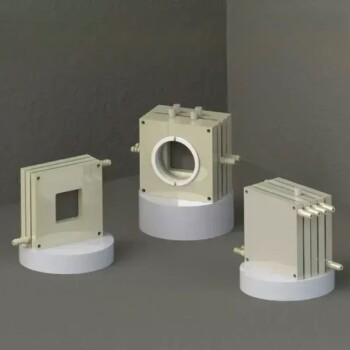
The implementation of a zero-gap configuration is a critical hardware optimization that fundamentally alters the efficiency profile of Copper-Chlorine cycle electrolyzers. By ensuring the electrodes make direct contact with the ion exchange membrane, this design eliminates the physical gap typically occupied by the electrolyte, thereby drastically reducing the system's internal resistance.
In the context of Copper-Chlorine electrolysis, the zero-gap configuration is the bridge between theoretical chemistry and industrial viability. It directly minimizes ohmic resistance to lower cell voltage, maximizing energy conversion efficiency for large-scale hydrogen production.
The Mechanics of Efficiency
The significance of the zero-gap design lies in how it manages the flow of energy within the cell.
Eliminating the Electrolyte Gap
In traditional electrolyzer designs, a gap filled with electrolyte exists between the electrodes and the membrane.
The zero-gap configuration removes this distance entirely. It forces the electrodes to touch the ion exchange membrane directly.
Minimizing Ohmic Resistance
The primary enemy of efficiency in electrolysis is ohmic resistance.
The electrolyte gap in older designs acts as a resistor, impeding the flow of ions. By eliminating this gap, the zero-gap configuration removes a major source of resistance from the circuit.
Reducing Cell Voltage
Resistance dictates the voltage required to drive the reaction.
Because the ohmic resistance is minimized, the cell requires significantly less voltage to operate. This reduction in voltage is the direct, measurable benefit of the hardware change.
Implications for Industrial Scale
The shift to a zero-gap configuration is not just about electrical metrics; it is about the feasibility of mass production.
Enhancing Energy Conversion
Lower voltage requirements translate directly to better energy utilization.
Less energy is wasted as heat due to resistance, and more is converted into the chemical energy of hydrogen. This boosts the overall energy conversion efficiency of the system.
Enabling Compact Design
The reference highlights this as a "compact industrial design."
By removing unnecessary spacing, the physical footprint of the unit is optimized. This is a prerequisite for scaling the technology from the lab to an industrial plant.
Understanding the Engineering Implications
While the zero-gap configuration offers superior performance, it represents a shift in engineering focus.
The Precision Requirement
This design is described as a "hardware optimization."
Achieving a true zero-gap setup requires precise manufacturing. The components must be engineered to maintain consistent contact without damaging the membrane.
Reliance on Membrane Integrity
The performance of the entire system hinges on the electrode-membrane interface.
Because the contact is direct, the quality and durability of the ion exchange membrane become even more critical to the system's longevity.
Making the Right Choice for Your Goal
The zero-gap configuration is the standard for modern, efficient hydrogen production in this cycle.
- If your primary focus is Operational Efficiency: This configuration is essential because it minimizes voltage waste and maximizes energy conversion.
- If your primary focus is Industrial Scalability: This design is required to achieve the compact footprint and hardware optimization needed for large-scale production.
Optimizing the physical interface between the electrode and membrane is the single most effective hardware strategy for reducing energy consumption in Copper-Chlorine electrolyzers.
Summary Table:
| Feature | Traditional Configuration | Zero-Gap Configuration |
|---|---|---|
| Electrode-Membrane Interface | Separated by electrolyte gap | Direct physical contact |
| Internal Ohmic Resistance | High (due to electrolyte gap) | Significantly minimized |
| Operating Cell Voltage | Higher (increased energy loss) | Lower (optimized power usage) |
| Energy Conversion Efficiency | Lower | Maximized efficiency |
| Physical Footprint | Bulky, non-optimized | Compact industrial design |
Maximize Your Research Efficiency with KINTEK’s Advanced Electrolytic Solutions
Transitioning to high-performance hydrogen production requires more than just a theoretical design; it demands precision-engineered hardware. KINTEK specializes in providing state-of-the-art electrolytic cells and electrodes specifically designed to meet the rigorous demands of modern energy research.
Whether you are scaling up a Copper-Chlorine cycle or optimizing battery and fuel cell components, our comprehensive portfolio—including high-temperature reactors, precise crushing systems, and specialized consumables like PTFE and ceramics—ensures your lab is equipped for industrial-grade results.
Ready to reduce your system’s resistance and enhance energy conversion? Contact us today to find the perfect hardware for your application!
References
- G.F. Naterer, Jurij Avsec. Clean hydrogen production with the Cu–Cl cycle – Progress of international consortium, I: Experimental unit operations. DOI: 10.1016/j.ijhydene.2011.08.012
This article is also based on technical information from Kintek Solution Knowledge Base .
Related Products
- Customizable PEM Electrolysis Cells for Diverse Research Applications
- Quartz Electrolytic Electrochemical Cell for Electrochemical Experiments
- Copper Sulfate Reference Electrode for Laboratory Use
- PTFE Electrolytic Cell Electrochemical Cell Corrosion-Resistant Sealed and Non-Sealed
- Reference Electrode Calomel Silver Chloride Mercury Sulfate for Laboratory Use
People Also Ask
- What are the risks of improper voltage control in an electrolysis cell? Avoid Costly Damage and Inefficiency
- What are the opening configurations for the non-sealed and sealed versions of the electrolysis cell? Optimize Your Electrochemical Setup
- What is an electrolysis cell? A Guide to Driving Chemical Reactions with Electricity
- What parameters must be strictly controlled during the electrolysis process? Ensure Precision and Efficiency
- What are the precautions for heating or sterilizing an electrolysis cell? Avoid Damaging Sensitive Components