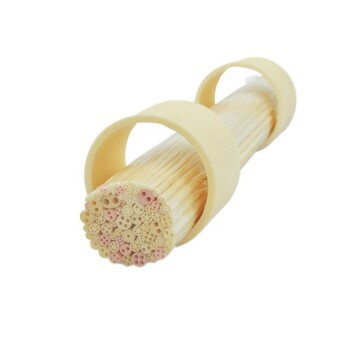
The use of high-purity quartz tubes for vacuum sealing is essential because they create a controlled micro-reaction environment that isolates the nickelate thin film from atmospheric interference. This setup allows for the precise maintenance of reaction vapor pressure at elevated temperatures, ensuring that a reducing agent—typically calcium hydride ($\text{CaH}_2$)—can effectively remove specific oxygen atoms from the precursor film to achieve the desired phase transformation.
Vacuum-sealed quartz tubes provide the chemically inert, high-temperature vessel necessary to facilitate the delicate "topological" removal of oxygen, converting perovskite nickelates into superconducting infinite-layer structures without collapsing the crystal lattice.
Creating a Controlled Micro-Reaction Environment
Isolation from Atmospheric Contaminants
Topological reduction is highly sensitive to the presence of external oxygen and moisture, which can halt the reduction process or cause unwanted secondary phases. Vacuum sealing the sample within a quartz tube ensures that the reaction occurs in a pure, oxygen-free environment.
Optimizing Vapor Pressure
By sealing the thin film and the reducing agent in an evacuated space, the system maintains a specific reaction vapor pressure when heated. This pressure is critical for ensuring efficient and consistent contact between the $\text{CaH}_2$ vapor and the precursor film, which drives the chemical transformation.
Facilitating the Topological Transformation
Selective Oxygen Removal
The goal of this process is to remove "apical" oxygen atoms from the nickelate lattice (e.g., transforming $\text{Nd}{0.8}\text{Sr}{0.2}\text{NiO}3$ to $\text{Nd}{0.8}\text{Sr}_{0.2}\text{NiO}_2$). The quartz tube environment allows the reducing agent to target these specific atoms while leaving the rest of the structural framework intact.
Maintaining Structural Integrity
Without the precise thermal and chemical control provided by the sealed tube, the delicate transition to the infinite-layer structure could fail. The quartz vessel allows for the uniform heat distribution required to prevent the crystal lattice from collapsing during the oxygen extraction.
Material Advantages of High-Purity Quartz
Thermal Stability and Chemical Inertness
High-purity quartz can withstand the elevated temperatures (typically around 300°C for nickelates, but capable of over 1000°C) required for crystal growth and reduction. Its chemical inertness ensures that no impurities from the tube itself leach into the reaction or react with the metallic precursors.
Vacuum Integrity
Quartz tubes are capable of maintaining ultra-high vacuum levels, which is necessary to remove air and moisture before the sealing process. This high-vacuum threshold prevents atmospheric interference with mass spectrometry signals and ensures high signal-to-noise ratios during monitoring.
Understanding the Trade-offs and Pitfalls
Mechanical Fragility
While quartz is thermally robust, it is physically brittle and susceptible to thermal shock if cooled too rapidly. Additionally, if the internal vapor pressure becomes too high during a reaction, the tube may rupture, leading to sample loss and equipment damage.
Purity vs. Cost
Using lower-grade quartz can introduce trace elements like hydroxyl groups or metal ions into the reaction environment. These impurities can act as unintentional dopants or catalysts, leading to inconsistent superconducting properties in the final nickelate film.
How to Apply This to Your Project
Recommendations Based on Your Goal
- If your primary focus is maximizing superconducting phase purity: Ensure the quartz tube is evacuated to a high vacuum (at least $10^{-3}$ Torr or better) before sealing to eliminate all traces of moisture.
- If your primary focus is structural characterization: Use high-purity quartz to prevent any external chemical migration that could alter the stoichiometry of your thin film during long heating cycles.
- If your primary focus is safety and repeatability: Implement a slow cooling ramp-down after the reduction process to avoid cracking the quartz tube due to thermal stress.
By leveraging the unique properties of high-purity quartz, you can achieve the precise atomic-level engineering required to unlock the potential of nickelate superconductors.
Summary Table:
| Feature | Role in Topological Reduction | Impact on Thin Film |
|---|---|---|
| Chemical Inertness | Prevents leaching of impurities | Ensures phase purity and stoichiometry |
| Vacuum Integrity | Isolates from oxygen & moisture | Prevents lattice collapse and oxidation |
| Thermal Stability | Withstands high reduction temps | Enables precise CaH2 vapor pressure |
| Structural Control | Maintains micro-environment | Facilitates selective oxygen removal |
Precision Equipment for Advanced Superconductor Research
Ready to achieve the perfect infinite-layer structure? KINTEK provides the specialized laboratory equipment and high-purity consumables essential for the topological reduction of nickelate thin films.
Our comprehensive range includes:
- High-Purity Quartz & Ceramic Consumables: Crucial for maintaining vacuum integrity and chemical inertness during reduction.
- Advanced Furnaces: Including tube, vacuum, and atmosphere furnaces for precise thermal control.
- High-Pressure Reactors & Autoclaves: Supporting complex phase transformations and material synthesis.
Whether you are optimizing CaH2 vapor pressure or scaling up thin-film production, KINTEK offers the reliability and technical support your research demands. Contact KINTEK today to upgrade your lab setup!
References
- Haoran Ji, Jian Wang. Rotational symmetry breaking in superconducting nickelate Nd0.8Sr0.2NiO2 films. DOI: 10.1038/s41467-023-42988-8
This article is also based on technical information from Kintek Solution Knowledge Base .
Related Products
- 1200℃ Split Tube Furnace with Quartz Tube Laboratory Tubular Furnace
- High Purity Pure Graphite Crucible for Evaporation
- Laboratory Rapid Thermal Processing (RTP) Quartz Tube Furnace
- High Temperature Resistant Optical Quartz Glass Sheet
- High Temperature Alumina (Al2O3) Furnace Tube for Engineering Advanced Fine Ceramics
People Also Ask
- What functions does a laboratory high-temperature tube furnace perform? Master Catalyst Synthesis & Carbonization
- What roles does a high-temperature tube furnace play in the synthesis of N/O co-doped carbon? Master Precise Doping
- How does a high-temperature tube furnace influence 253MA steel? Master Microstructure & High-Temp Creep Resistance
- Why is a high-temperature tube furnace required for the production of biochar from tobacco straw? Expert Pyrolysis Guide
- What are the primary applications of muffle and tube furnaces in photocatalysts? Optimize Metal Loading & Support Synthesis