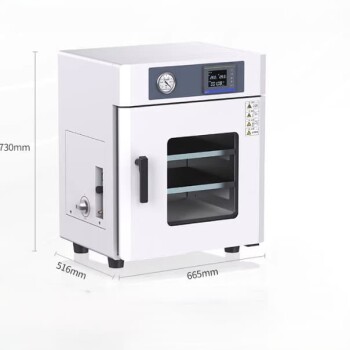
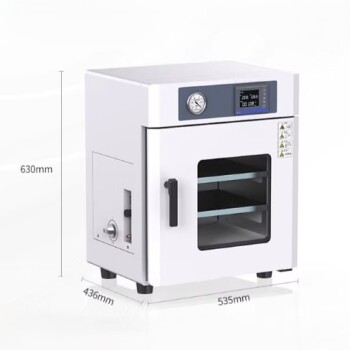
The use of a vacuum oven is mandatory for treating Lithium Manganese Silicate (Li2MnSiO4) cathode sheets to achieve deep desiccation and solvent removal without chemically degrading the material. By maintaining high temperatures (typically 120°C) under negative pressure for extended periods (up to 24 hours), this process eliminates microscopic impurities that would otherwise cause immediate electrolyte decomposition and battery failure.
The Integrity of the Cell Depends on Dryness Lithium-ion chemistries operate under a zero-tolerance policy for moisture. The vacuum oven serves as the final firewall, ensuring the electrode is chemically inert and physically dry to prevent fatal side reactions inside the sealed battery.
The Critical Mechanisms of Vacuum Drying
Complete Elimination of Residual Solvents
After the coating process, the cathode slurry contains binders and solvents, often N-methyl-2-pyrrolidone (NMP).
While initial drying removes the bulk of this liquid, trace amounts get trapped deep within the electrode structure. The vacuum environment lowers the boiling point of these organic solvents, forcing them to evaporate thoroughly from the material's micropores.
Deep Extraction of Trace Moisture
Lithium-ion batteries are extremely sensitive to water. Even microscopic levels of moisture remaining on the Li2MnSiO4 sheets can be catastrophic.
High-temperature vacuum treatment ensures that water molecules adsorbed onto the surface or trapped in the porous structure are forcibly desorbed. This level of dryness is virtually impossible to achieve in a standard atmospheric oven.
Prevention of Material Oxidation
Heating cathode materials to 120°C in the presence of air can lead to surface oxidation, altering the chemical state of the active material.
By creating a vacuum, you remove oxygen from the heating chamber. This allows you to apply the necessary thermal energy to dry the sheets without risking the oxidative degradation of the active lithium manganese silicate or the current collectors.
Implications for Battery Performance
Stopping Electrolyte Decomposition
If moisture remains in the cathode sheet, it reacts with the electrolyte immediately upon battery assembly.
This reaction often produces hydrofluoric acid (HF) and other byproducts that corrode the cathode active material. Vacuum drying eliminates the water source, thereby preventing this decomposition and preserving the interface between the electrode and the electrolyte.
Guaranteeing Cycle Stability
The primary reference highlights that cycle stability—the battery's ability to recharge repeatedly without losing capacity—is directly linked to this drying step.
By removing solvents and moisture, you prevent the internal side reactions that slowly consume active lithium ions over time. This ensures the battery maintains its capacity over a long service life.
Common Pitfalls to Avoid
Rushing the Duration
The process is time-intensive, often requiring 12 to 24 hours.
A common mistake is shortening this dwell time to increase manufacturing throughput. However, solvent removal from micropores is diffusion-limited; rushing this step leaves trapped volatile organic compounds (VOCs) that will outgas later, potentially causing the battery to swell or delaminate.
Ignoring Vacuum Depth
Simply heating the oven is insufficient; the depth of the vacuum is critical.
If the negative pressure is not low enough, the boiling point of the solvents will not drop sufficiently to ensure complete evaporation at 120°C. This risks leaving residues that degrade electrochemical performance.
Making the Right Choice for Your Goal
To optimize your cathode preparation process, consider which performance metric is your priority:
- If your primary focus is Cycle Life: Prioritize the 24-hour duration to ensure deep moisture extraction, as trace water is the primary killer of long-term capacity.
- If your primary focus is Chemical Purity: Ensure the vacuum system is leak-proof to prevent oxygen ingress, which protects the specific oxidation state of the Manganese in the cathode.
- If your primary focus is Safety: Verify that the vacuum pressure is sufficient to fully evacuate NMP residues, preventing internal pressure buildup and swelling during battery operation.
Deep vacuum drying is not merely a cleaning step; it is a chemical stabilization process that defines the ultimate reliability of the battery.
Summary Table:
| Mechanism | Benefit to Li2MnSiO4 Cathodes | Technical Requirement |
|---|---|---|
| Solvent Removal | Eliminates trapped NMP from micropores | Vacuum reduces solvent boiling point |
| Moisture Extraction | Prevents HF formation & electrolyte decay | 120°C under negative pressure |
| Oxygen Exclusion | Prevents surface oxidation of Mn active sites | High-vacuum airtight chamber |
| Dwell Time | Ensures diffusion-limited VOC extraction | 12-24 hours recommended |
| Cycle Stability | Maintains capacity over long-term use | Complete removal of impurities |
Maximize Battery Reliability with KINTEK Advanced Vacuum Solutions
Don't let trace moisture or residual solvents compromise your Li2MnSiO4 research. KINTEK provides precision-engineered vacuum ovens, battery research tools, and high-temperature furnaces designed to meet the rigorous demands of electrode preparation. Our equipment ensures absolute chemical stability and deep desiccation for battery cathode sheets, protecting your materials from oxidation and ensuring superior cycle life.
Ready to elevate your battery manufacturing and material research?
Contact KINTEK Today to Find Your Lab Solution
Related Products
- 56L Vertical Laboratory Vacuum Drying Oven
- 23L Laboratory Vacuum Drying Oven
- Laboratory Scientific Electric Heating Blast Drying Oven
- Ultra-High Temperature Graphite Vacuum Graphitization Furnace
People Also Ask
- Why is a laboratory vacuum drying oven recommended for rice straw residues? Protect Your Biomass Integrity
- What role does a laboratory vacuum drying oven play in the preparation of modified multi-walled carbon nanotubes?
- What is the importance of using a laboratory vacuum drying oven? Preserving Slow-Release Microcapsule Integrity
- Why is a Laboratory Vacuum Drying Oven recommended for PBAT microspheres? Protect Sensitive Polymer Integrity
- What role does a laboratory vacuum drying oven play in processing nanoparticle powder samples? Protect Sample Integrity