The Pursuit of a Flawless Material
Imagine you're an engineer tasked with creating a complex ceramic component. Your primary concern is internal integrity. You need a part with perfectly uniform density, free from the hidden stresses and potential fracture points that plague conventional pressing methods.
You discover Cold Isostatic Pressing (CIP), a process that promises perfection. It applies pressure equally from all directions, like an object at the bottom of the ocean. It seems like the ultimate solution for material uniformity.
But this pursuit of one kind of perfection forces a compromise on another. The reality of CIP is a fundamental trade-off between flawless internal structure and the practicalities of form, speed, and finishing.
The Paradox of the Flexible Mold
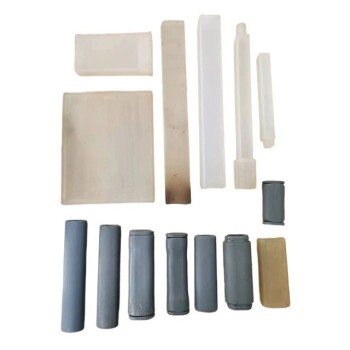
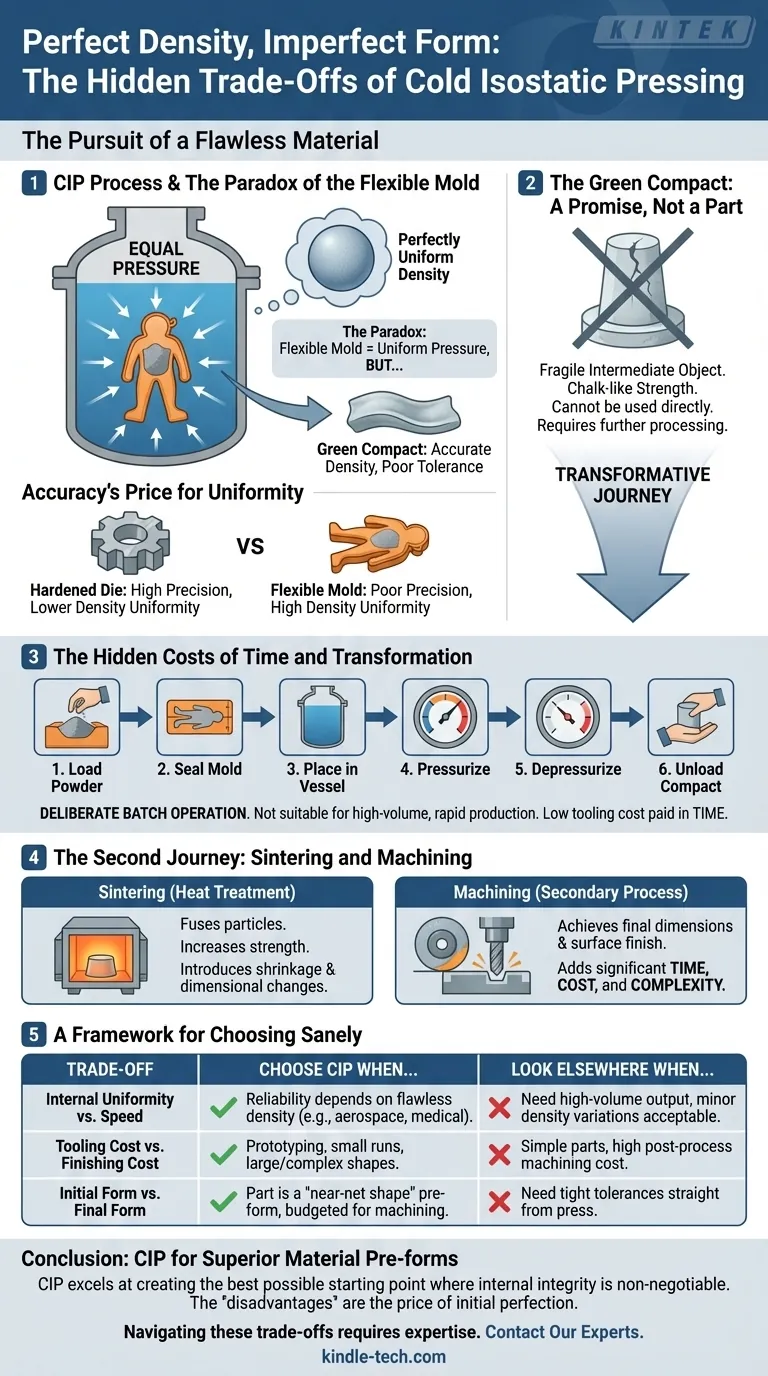
The magic of CIP lies in its use of a flexible, elastomer mold submerged in a fluid. As pressure is applied to the fluid, the mold collapses around the powder, compacting it with perfect uniformity.
This is also its primary limitation.
Accuracy's Price for Uniformity
A flexible mold, by its very nature, cannot hold rigid dimensions. Unlike a hardened steel die that stamps out parts with high repeatability, the elastomer mold deforms slightly differently with each cycle.
The result is a "green compact" with poor dimensional tolerance. You have achieved a homogenous internal state, but at the cost of a precise external shape. You’ve solved one problem by creating another.
The Green Compact: A Promise, Not a Part
The component that emerges from the CIP vessel is known as a green compact. While dense, it has the mechanical strength of a piece of chalk. It is a fragile, intermediate object—a promise of a final part, not the part itself.
This green state means the part cannot be used for any application. It must embark on a second, transformative journey to gain its strength and final form.
The Hidden Costs of Time and Transformation
The CIP process is not a race; it's a deliberate, multi-stage batch operation. This methodical pace is a stark contrast to the rapid-fire production of other compaction methods.
The cycle involves:
- Loading powder into the mold.
- Sealing the mold.
- Placing it in the pressure vessel.
- Pressurizing the system.
- Depressurizing the system.
- Unloading the fragile compact.
This sequence makes CIP inherently unsuitable for high-volume manufacturing where seconds-per-part is the key metric. The low cost of its flexible tooling is paid for with the currency of time.
The Second Journey: Sintering and Machining
The chalk-like green compact must first be sintered—a high-temperature process that fuses the powder particles, giving the part its final strength. But this process introduces its own variables, often causing further shrinkage and dimensional changes.
After sintering, the now-strong but still-imprecise part almost always requires secondary machining. Grinding, milling, or lathing is needed to achieve the final required dimensions and surface finish. This adds significant time, cost, and complexity to the overall workflow.
A Framework for Choosing Sanely
Understanding these disadvantages isn't a reason to dismiss CIP. It's a reason to use it intelligently. The decision hinges on knowing what you are willing to trade.
| Trade-Off | Choose CIP When... | Look Elsewhere When... |
|---|---|---|
| Internal Uniformity vs. Speed | Your application's reliability depends entirely on flawless, homogenous material density (e.g., aerospace, medical). | You need high-volume output and can tolerate the minor density variations of die pressing. |
| Tooling Cost vs. Finishing Cost | You are creating prototypes, small runs, or large/complex shapes where a steel die would be prohibitively expensive. | Your parts are simple, and the high cost of post-process machining outweighs tooling savings. |
| Initial Form vs. Final Form | The part is a "near-net shape" pre-form, and you have already budgeted for extensive post-sintering machining. | You need parts with tight tolerances straight out of the press with minimal finishing. |
CIP excels at producing superior material pre-forms, not finished parts. Its beauty lies in creating the best possible starting point for components where internal integrity is non-negotiable. The "disadvantages" are simply the price of that initial perfection.
Navigating these complex manufacturing trade-offs requires more than just a datasheet; it requires deep expertise in material processing. If you're weighing the options for your lab or production line, understanding the full lifecycle of your component is critical. Contact Our Experts
Visual Guide
Related Products
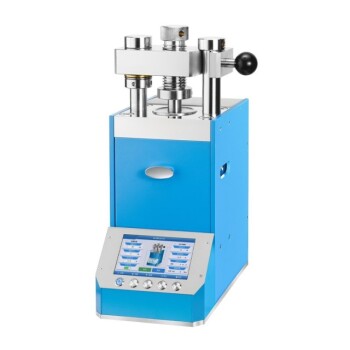
- Automatic Lab Cold Isostatic Press CIP Machine Cold Isostatic Pressing
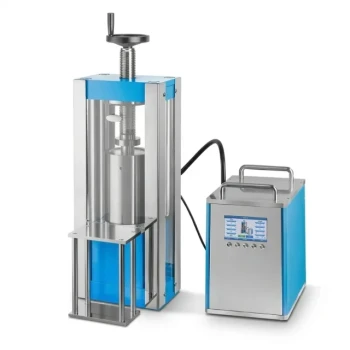
- Electric Split Lab Cold Isostatic Press CIP Machine for Cold Isostatic Pressing
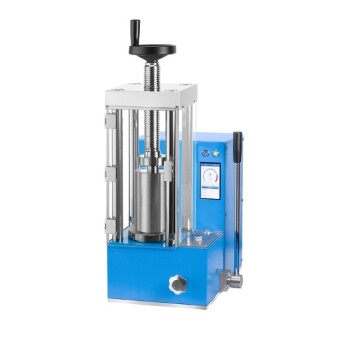
- Electric Lab Cold Isostatic Press CIP Machine for Cold Isostatic Pressing
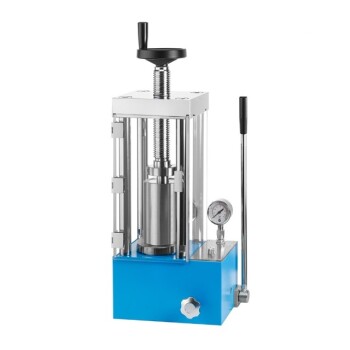
- Manual Cold Isostatic Pressing Machine CIP Pellet Press
- Isostatic Molding Pressing Molds for Lab