The Illusion of Solidity
When we press a powder into a shape, we create an illusion. We see a solid object, but inside, a hidden battle has been fought and lost.
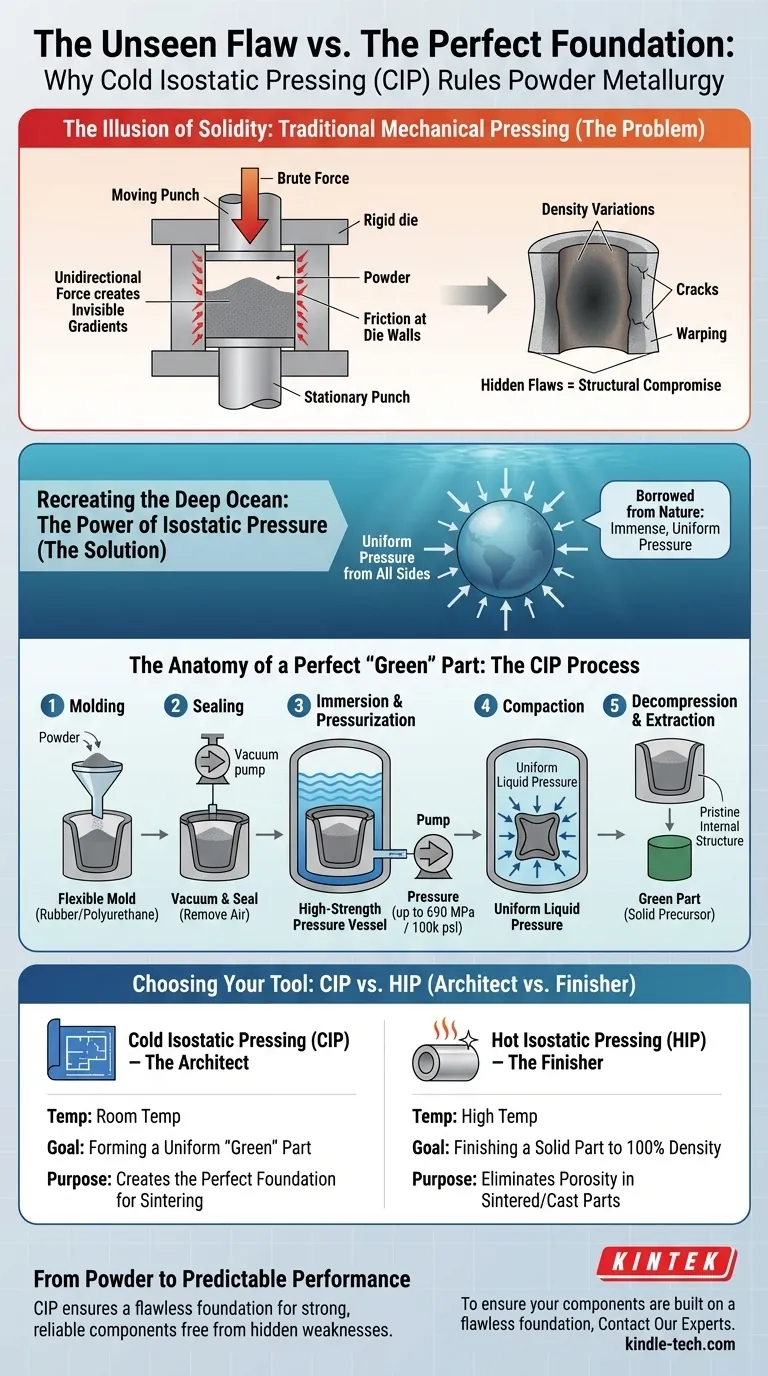
Traditional mechanical pressing, which applies force from one or two directions, is a brute-force approach. It compacts the material, but it also creates invisible gradients of stress and density. Friction along the die walls causes particles to drag, creating areas that are less dense than the core.
This isn't just a minor imperfection. It's a blueprint for failure. These unseen flaws can become cracks during sintering, warp a final component under stress, or create a catastrophic point of weakness. The part looks solid, but it's structurally compromised from the start.
Recreating the Deep Ocean in a Lab
The solution to this problem is not more force, but a different kind of force. It’s an idea borrowed from nature.
Imagine an object sinking into the Marianas Trench. The immense pressure of the water doesn't crush it from the top down; it squeezes it uniformly from every possible direction at once. This is isostatic pressure.
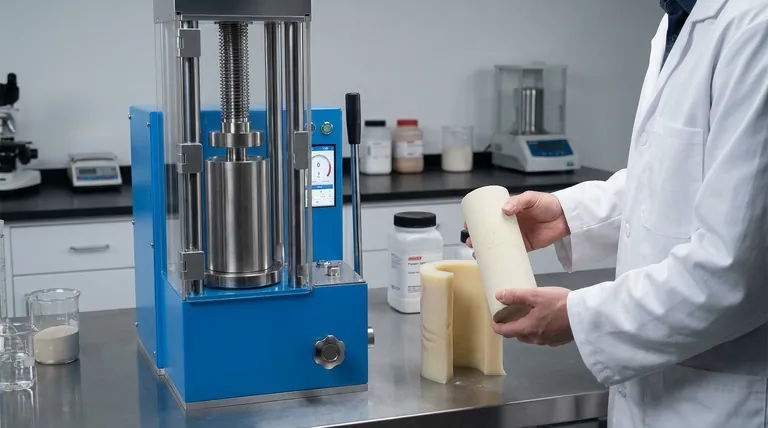
A Cold Isostatic Press (CIP) is a machine designed to perfectly replicate this phenomenon. It uses a liquid medium—typically water or oil—to exert immense, perfectly uniform pressure on a powdered material held within a flexible mold. It’s an engineer’s elegant solution, using fundamental physics to achieve what mechanical force cannot: perfection.
The Anatomy of a Perfect "Green" Part
The CIP process is a disciplined sequence designed to eliminate variables and control outcomes. Each step is critical to forming a flawless precursor, known as a "green" part.
- Molding: Powder is carefully loaded into a flexible, watertight mold made of polyurethane or rubber. This mold is the negative space of the final part.
- Sealing: The mold is sealed, often under vacuum, to remove any trapped air—the enemy of uniform compaction.
- Immersion & Pressurization: The sealed mold is placed inside a high-strength pressure vessel, which is then filled with liquid. An external pump raises the fluid pressure, sometimes exceeding 690 MPa (100,000 psi).
- Compaction: The liquid transmits this pressure perfectly and evenly through the flexible mold, compacting the powder particles from all sides simultaneously.
- Decompression & Extraction: The pressure is gently released, the mold is removed, and the solid green part is extracted.
The result is not a finished component. It's a dense, solid object with just enough strength to be handled and machined. More importantly, its internal structure is pristine—a perfect foundation for the final strengthening process of sintering.
The Tyranny of the Die Wall
The true genius of Cold Isostatic Pressing is best understood by what it prevents.
Why Unidirectional Pressing Fails
In a conventional press, the powder is fighting against the rigid walls of the die. This friction is the primary cause of density variation. The powder closest to the moving punch gets compacted most, while the powder near the stationary die walls lags behind. The resulting part is a mosaic of high- and low-density zones.
How Isostatic Pressure Wins
CIP eliminates the die wall problem entirely. The flexible mold simply acts as a container, and the liquid pressure medium flows around it, finding every surface. There is no directionality, no friction, and therefore, no internally-generated stress.
This is especially critical for parts with complex geometries—tubes, rods, or components with intricate internal channels—where uniform density is impossible to achieve with mechanical dies.
Choosing Your Tool: A Spectrum of Pressure and Heat
Isostatic pressing is not a single technology but a family of processes. Choosing the right one depends entirely on your goal: are you forming a part, or are you perfecting it?
| Process | Temperature | Primary Goal | Analogy |
|---|---|---|---|
| Cold Isostatic Pressing (CIP) | Room Temp | Forming a uniform "green" part from powder. | The Architect |
| Warm Isostatic Pressing (WIP) | Moderate (<500°C) | Forming specific powders that benefit from heat. | The Specialist |
| Hot Isostatic Pressing (HIP) | High Temp | Finishing a solid part to 100% density. | The Finisher |
- CIP is the architect. Its job is to create the perfect blueprint before the final firing (sintering).
- HIP is the finisher. It takes an already solid part (like a casting or a sintered CIP part) and uses both immense heat and pressure to eliminate the last remnants of porosity, achieving full theoretical density.
Confusing the two is a common mistake. You use CIP to build the foundation and HIP to apply the finishing touches for the most demanding applications.
From Powder to Predictable Performance
Ultimately, the choice to use Cold Isostatic Pressing is a choice for predictability. It’s a rejection of the idea that internal flaws are an acceptable byproduct of manufacturing. By starting with a green part that is as close to perfect as possible, you ensure the final sintered component is strong, reliable, and free from the hidden weaknesses that plague conventional methods.
For laboratories and R&D teams dedicated to material science, achieving this level of control is not a luxury; it is a necessity. The quality of your research and the performance of your innovations depend on the integrity of your foundational processes. That is why KINTEK provides high-performance Cold Isostatic Presses engineered for the precision and reliability that modern material development demands.
To ensure your components are built on a flawless foundation, Contact Our Experts.
Visual Guide
Related Products
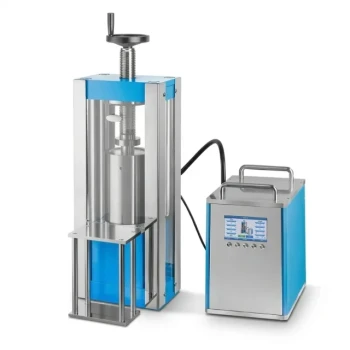
- Electric Split Lab Cold Isostatic Press CIP Machine for Cold Isostatic Pressing
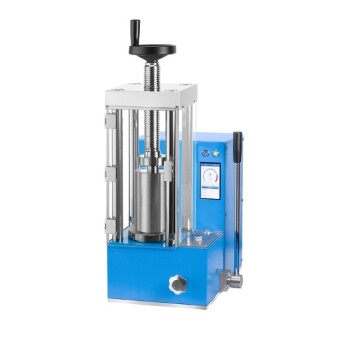
- Electric Lab Cold Isostatic Press CIP Machine for Cold Isostatic Pressing
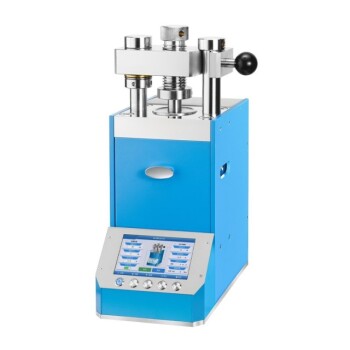
- Automatic Lab Cold Isostatic Press CIP Machine Cold Isostatic Pressing
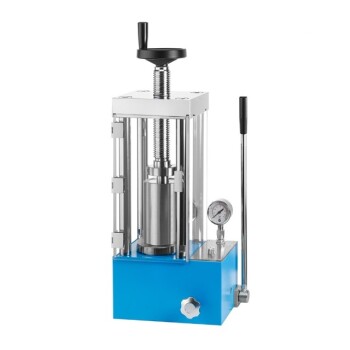
- Manual Cold Isostatic Pressing Machine CIP Pellet Press
- Warm Isostatic Press for Solid State Battery Research