The Flaw in Forcing It
When we think of "pressing" something, our intuition suggests a simple, linear act: applying force from one direction. We push down on a piston; we squeeze something in a vise.
This works, but it hides a fundamental flaw.
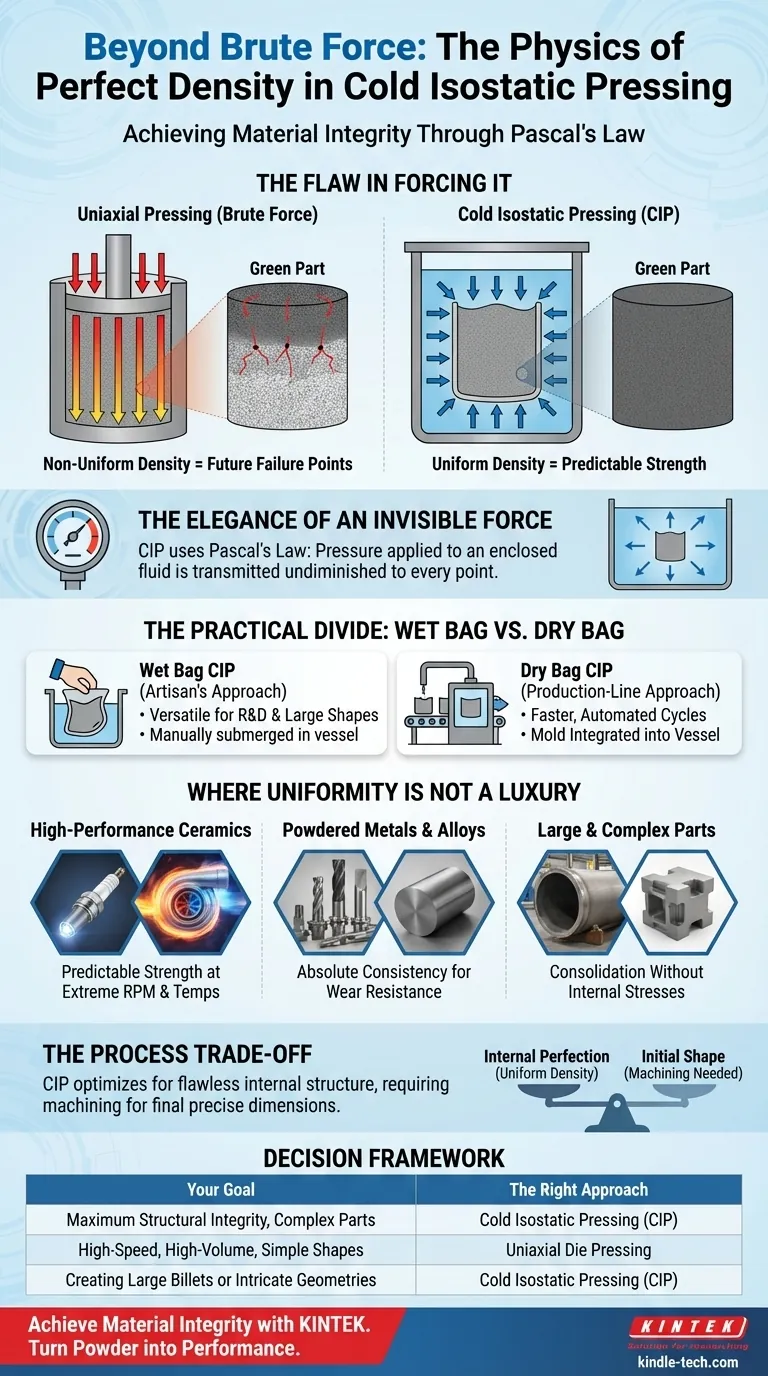
Imagine trying to compact a handful of fine powder into a dense, solid block using only a piston. The particles directly under the piston are crushed together, but the particles near the container walls experience friction. The pressure doesn't travel evenly. The result is a block that is dense on top but progressively weaker and less consolidated toward the bottom.
This is the hidden risk of non-uniform density—a built-in map of future failure points. For high-performance components, this is unacceptable.
The Elegance of an Invisible Force
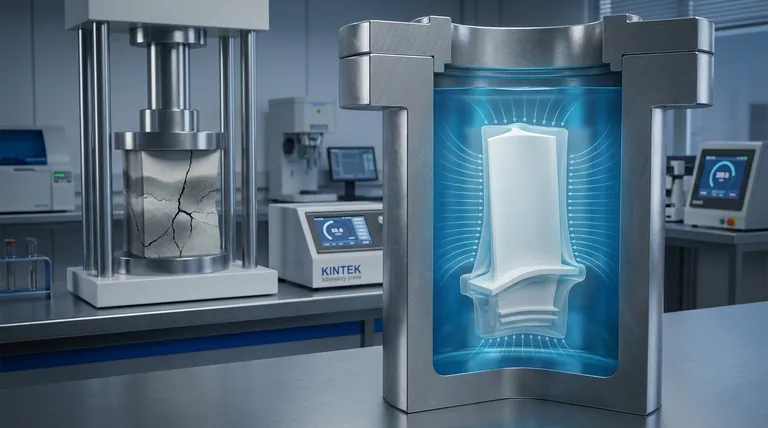
Cold Isostatic Pressing (CIP) offers a profoundly different, almost philosophical, solution. It doesn't rely on brute force from one direction. It surrounds the material with uniform pressure from all directions at once.
The process is a beautiful application of a core physics principle: Pascal's Law. It states that pressure applied to an enclosed fluid is transmitted undiminished to every point within the fluid.
In CIP, a powder-filled flexible mold is submerged in a liquid. When the liquid is pressurized, that pressure—be it 30,000 or 60,000 psi—is exerted equally on every single point of the mold's surface. There are no die walls to create friction, no "shadows" where the pressure is weaker.
The result is a "green" part with exceptionally uniform density.
Think of the white ceramic insulator on a spark plug, a classic CIP application. It must withstand thousands of volts and extreme temperature swings. A tiny density variation could become a micro-crack, and that crack could lead to electrical failure. CIP ensures the ceramic is uniformly strong, from its core to its surface.
The Practical Divide: Wet Bag vs. Dry Bag
While the principle is universal, its application is divided into two main approaches, creating a classic trade-off between versatility and speed.
-
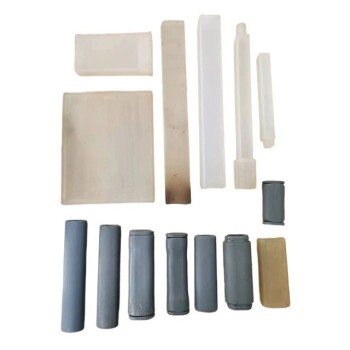
Wet Bag CIP: The powder-filled mold is sealed and manually submerged in the pressure vessel. This method is incredibly versatile, ideal for R&D, prototyping, and producing a wide variety of large or complex shapes. It is the artisan's approach.
-
Dry Bag CIP: The flexible mold is integrated into the pressure vessel itself. Powder is loaded in, pressurized, and ejected in a much faster, automated cycle. This is the production-line approach, built for speed and higher volumes.
Where Uniformity is Not a Luxury
The choice to use CIP is driven by applications where material integrity is non-negotiable. It's for components where a hidden flaw isn't a cosmetic blemish, but a catastrophic failure waiting to happen.
High-Performance Ceramics
For a silicon nitride turbocharger rotor spinning at over 100,000 RPM, a single point of low density is the origin of a fracture. CIP is used to form these components because uniform density equals predictable strength under immense stress.
Powdered Metals & Alloys
Creating solid billets from tungsten or carbide powders for cutting tools requires absolute consistency. Non-uniformity means the tool will wear unevenly and fail prematurely. CIP produces billets that can be machined into reliable, long-lasting tools.
Large and Complex Parts
For large tubes, blocks, or industrial tooling, uniaxial pressing is often impossible. CIP is the only practical way to consolidate massive volumes of powder into a single, dense form without introducing the internal stresses that would tear it apart during final sintering.
The Psychology of a Process Trade-Off
Choosing a manufacturing process is about more than just its technical specs; it's about what you are optimizing for and what risks you are willing to accept.
CIP optimizes for internal perfection at the expense of initial shape.
The primary advantage of CIP is the virtual elimination of density gradients. You are choosing to front-load the effort to guarantee material integrity. This prevents the costly and dangerous discovery of flaws that emerge later—during sintering, machining, or worse, during operation.
The trade-off is dimensional precision. A green part from CIP doesn't have the crisp, exact dimensions of one made in a hard-tooled die. It's a precisely consolidated "blank." The final shape must be achieved through machining, typically after sintering. This is a conscious decision: to prioritize a flawless internal structure over a perfect initial external form.
A Decision Framework
| When Your Goal Is... | The Right Approach Is... |
|---|---|
| Maximum structural integrity in complex parts | Cold Isostatic Pressing (CIP) is the clear choice for its uniform density. |
| High-speed, high-volume production of simple shapes | Uniaxial die pressing is often more cost-effective and faster. |
| Creating large billets or intricate geometries | Cold Isostatic Pressing (CIP) provides a practical path where other methods fail. |
Ultimately, CIP is not just another way to shape powder. It is a foundational technique for building high-performance materials from the particle up, ensuring that the final component is as strong on the inside as it appears on the outside.
Achieving this level of material integrity starts with equipment that delivers absolute control and repeatability. At KINTEK, we provide the specialized lab equipment and consumables that turn powder into performance. From R&D on advanced ceramics to pilot production of metal components, our solutions are designed to support the exacting demands of processes like Cold Isostatic Pressing.
If you're tackling challenges where material uniformity is the key to success, Contact Our Experts.
Visual Guide
Related Products
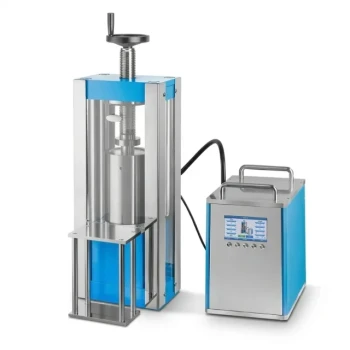
- Electric Split Lab Cold Isostatic Press CIP Machine for Cold Isostatic Pressing
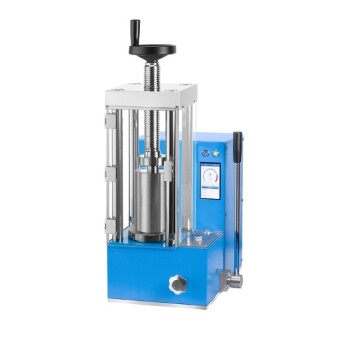
- Electric Lab Cold Isostatic Press CIP Machine for Cold Isostatic Pressing
- Automatic Lab Cold Isostatic Press CIP Machine Cold Isostatic Pressing
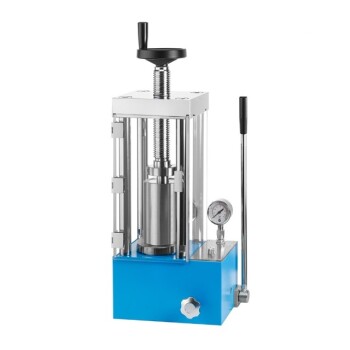
- Manual Cold Isostatic Pressing Machine CIP Pellet Press
- Warm Isostatic Press for Solid State Battery Research