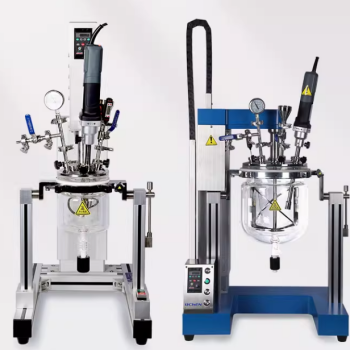
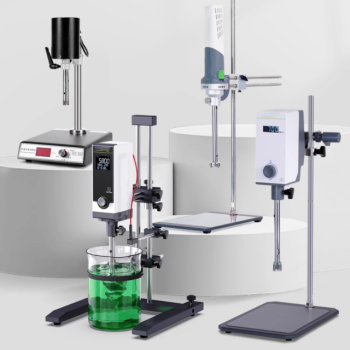
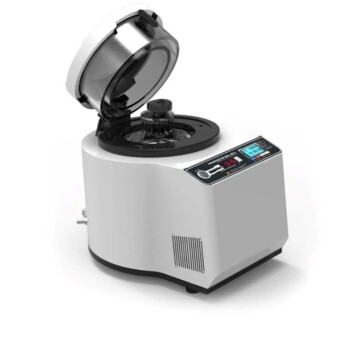
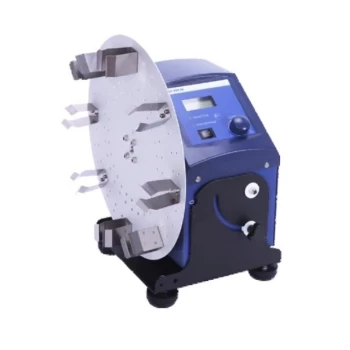
High-energy homogenizers facilitate the preparation of polymer-based composites like PVA/BNNT by applying intense mechanical shear forces or ultrasonic cavitation to break down nanoparticle clusters. This process ensures that Boron Nitride Nanotubes (BNNTs) are uniformly dispersed at a molecular level within the Polyvinyl Alcohol (PVA) matrix. By preventing agglomeration, these machines allow the formation of a continuous internal network, which is essential for achieving high performance, such as a thermal conductivity of 9.5 W m-1 K-1.
Core Takeaway: High-energy mixing is the critical bridge between raw nanomaterials and functional composites; it replaces manual stirring with physical intensification to overcome molecular attraction, ensuring a defect-free, high-conduction network within the polymer.
Overcoming Molecular Forces and Agglomeration
Breaking Van der Waals Accumulation
Nanoparticles like BNNTs naturally tend to clump together due to Van der Waals forces, forming "secondary agglomerates." High-energy homogenizers use extreme mechanical shear or high-power ultrasonics to forcefully pull these clusters apart, ensuring each individual nanotube is separated.
Achieving Molecular-Level Dispersion
Unlike conventional stirring, high-energy equipment operates at a scale that facilitates molecular-level contact between the reinforcement phase and the polymer matrix. This deep interaction is necessary to eliminate internal defects that would otherwise weaken the final material's structure.
Ensuring Slurry Uniformity
For composites like PVA/BNNT, the equipment creates a stable, uniform slurry where the functional fillers are suspended evenly. This consistency is vital for subsequent processing steps, such as film casting or fiber spinning, ensuring the finished product has homogeneous properties throughout.
Engineering the Internal Network
Establishing Thermal Conduction Pathways
The primary goal of using BNNTs in a PVA matrix is often to increase thermal conductivity. High-energy mixing allows the nanotubes to form a continuous heat conduction network; without this precise dispersion, the heat flow would be interrupted by gaps in the polymer matrix.
Enhancing Stress Transfer Efficiency
By ensuring uniform distribution, the equipment maximizes the interfacial adhesion between the BNNTs and the PVA. This strong bond improves the stress transfer efficiency, allowing the composite to withstand significantly higher mechanical loads than the base polymer alone.
Creating Three-Dimensional Cross-Linked Structures
The physical intensification process helps functionalized nanoparticles achieve the contact required to form three-dimensional cross-linked networks. This structure is what gives advanced composites their superior thermal stability and tensile strength compared to conventional materials.
Understanding the Trade-offs
Risk of Material Degradation
While high-energy mixing is necessary for dispersion, excessive exposure to high shear or ultrasonic energy can physically damage the nanotubes. Shortening the length of the BNNTs through "over-processing" can actually decrease the overall thermal and mechanical performance of the composite.
Heat Generation During Processing
High-energy homogenization converts mechanical work into heat, which can significantly raise the temperature of the polymer solution. If not carefully managed with cooling systems, this heat can lead to the thermal degradation of sensitive polymers like PVA or cause premature solvent evaporation.
Complexity and Scalability
Transitioning from laboratory-scale high-energy mixing to industrial production presents challenges in maintaining consistent energy density. Ensuring the same level of molecular dispersion in large batches requires specialized equipment and precise control over processing parameters.
How to Apply This to Your Project
Making the Right Choice for Your Goal
- If your primary focus is maximizing thermal conductivity: Prioritize ultrasonic homogenization to ensure the BNNTs form an unbroken, continuous conduction network without unnecessary physical breakage.
- If your primary focus is industrial-scale mechanical strength: Utilize high-speed mechanical shear mixers to achieve uniform dispersion across large volumes while maintaining the structural integrity of the polymer matrix.
- If your primary focus is preventing material defects: Implement a multi-stage mixing approach, starting with low-energy stirring followed by a final high-energy "polishing" step to eliminate microscopic agglomerates.
By strategically applying high-energy mixing, you transform a simple mixture into a high-performance composite defined by its molecular-level precision.
Summary Table:
| Feature | Impact on PVA/BNNT Composites | Key Outcome |
|---|---|---|
| Mechanical Shear/Cavitation | Breaks Van der Waals forces and nanoparticle agglomerates | Molecular-level dispersion |
| Internal Network Formation | Establishes continuous 3D heat conduction pathways | Up to 9.5 W m-1 K-1 thermal conductivity |
| Interfacial Adhesion | Maximizes stress transfer between BNNTs and PVA matrix | Enhanced mechanical tensile strength |
| Cooling Management | Prevents thermal degradation during high-energy mixing | Preservation of polymer integrity |
Elevate Your Material Science with KINTEK Precision
Unlock the full potential of your advanced composites with KINTEK’s industry-leading laboratory solutions. Whether you are dispersing BNNTs in a PVA matrix or developing next-generation functional materials, we provide the high-performance tools necessary for success.
KINTEK specializes in a comprehensive range of equipment, including:
- High-performance homogenizers and shakers for perfect molecular dispersion.
- Crushing, milling, and sieving systems to prepare your raw materials.
- High-temperature furnaces (muffle, vacuum, CVD) and high-pressure reactors for advanced synthesis.
- Precision hydraulic presses and essential consumables like PTFE and ceramic crucibles.
Don't let agglomeration or internal defects compromise your research. Partner with KINTEK for reliable, scalable, and high-precision equipment designed for the most demanding laboratory environments.
Ready to optimize your composite preparation? Contact our experts today to find the perfect equipment for your lab!
References
- Nanyang Wang, Yagang Yao. Self‐Catalytic Ternary Compounds for Efficient Synthesis of High‐Quality Boron Nitride Nanotubes. DOI: 10.1002/smll.202206933
This article is also based on technical information from Kintek Solution Knowledge Base .
Related Products
- High Performance Lab Homogenizer for Pharma Cosmetics and Food R&D
- High Shear Homogenizer for Pharmaceutical and Cosmetic Applications
- Laboratory High Throughput Tissue Grinding Mill Grinder
- Lab Sterile Slapping Type Homogenizer for Tissue Mashing and Dispersing
- Laboratory Disc Rotary Mixer for Efficient Sample Mixing and Homogenization
People Also Ask
- Why is a high-performance homogenizer essential for Fe3O4@C9 anode slurries? Boost Battery Performance & Stability.
- What is the primary function of high-performance homogenizers for SAPO-34 MMMs? Ensure Superior Gas Separation Efficiency
- How do lab stirrers & homogenizers ensure uniform distribution? Optimize Your Complex Multiphase Chemical Mixing
- What role does a laboratory homogenizer play in radioactive cesium detection? Ensure Accuracy in Wildlife Sampling
- How does a laboratory automatic masticator or homogenizer facilitate the processing of biofilm samples? Optimize Accuracy