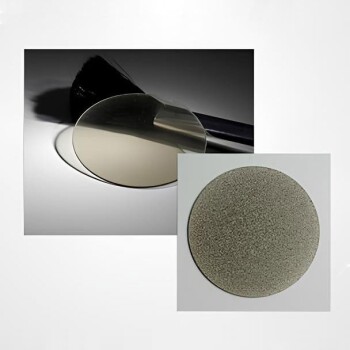
The hollow-type dielectric window offers superior performance over standard planar quartz windows, particularly in high-pressure plasma Chemical Vapor Deposition (CVD) processes. While planar windows struggle with plasma confining itself near the antenna, the hollow-type design forces a distributed generation of plasma, resulting in significantly improved uniformity across large surface areas.
By utilizing a structural design that generates high-density plasma within individual holes rather than a single surface sheet, hollow-type windows overcome the plasma confinement issues typical of planar designs. This results in superior uniformity and thickness control, which is critical for the large-scale synthesis of 2D materials.
The Limitation of Planar Windows
The Plasma Confinement Issue
In standard CVD configurations using planar quartz plates, a significant performance bottleneck occurs at high pressures. Under these conditions, the plasma tends to confine itself strictly near the antenna.
Consequences for Deposition
This localization creates an uneven plasma density profile. Because the plasma is not evenly distributed, the deposition process becomes non-uniform, leading to variations in film thickness and quality across the substrate.
How Hollow-Type Windows Optimize Performance
Geometric Redistribution
The hollow-type window creates a physical structure that alters how plasma is generated. Instead of a single sheet of plasma forming on the surface, the hollow structure enables the localized generation of high-density plasma within individual holes in the dielectric material.
The Interlacing Effect
These individual points of high-density plasma do not act in isolation. They interlace with one another, effectively merging to create a cohesive and uniform plasma distribution across the entire window area.
Overcoming High-Pressure Constraints
This mechanism effectively bypasses the tendency of plasma to hug the antenna at high pressures. By forcing the plasma into these distributed points, the window maintains uniformity even under operating conditions that would render a planar window ineffective.
Application in 2D Material Synthesis
Critical Thickness Control
For advanced materials such as graphene, hexagonal boron nitride (h-BN), and other 2D materials, thickness consistency is paramount. The hollow-type window ensures that the precursor materials are broken down and deposited evenly.
Enabling Large-Area Preparation
The improved distribution allows for the scaling of the CVD process. Because the plasma density is uniform across the window, manufacturers can achieve consistent results over large areas, which is a primary challenge in commercializing 2D material production.
Understanding the Trade-offs
Specificity of Application
The primary advantage of the hollow-type window is observed under high-pressure conditions where planar windows fail to distribute plasma effectively. In low-pressure regimes where plasma naturally diffuses more easily, the complex structure of a hollow window may offer diminishing returns compared to a simple planar plate.
Structural Complexity
Moving from a planar plate to a hollow structure introduces geometric complexity. While this solves the confinement issue, it suggests a more specialized component compared to the ubiquity and simplicity of standard planar quartz hardware.
Making the Right Choice for Your Process
Depending on your specific processing parameters and target materials, the choice of dielectric window will dictate your success.
- If your primary focus is large-area uniformity: Choose the hollow-type window. Its ability to interlace plasma points ensures consistent thickness for sensitive 2D materials like graphene.
- If your primary focus is operating at high pressures: Choose the hollow-type window. It is specifically engineered to prevent the plasma confinement near the antenna that plagues planar windows in these environments.
- If your primary focus is standard, low-pressure processing: A planar quartz window may remain a viable option, as the specific confinement issues addressed by the hollow design are less prevalent.
By moving to a hollow-type architecture, you transition from fighting plasma physics to leveraging them for superior material consistency.
Summary Table:
| Feature | Planar Quartz Window | Hollow-Type Dielectric Window |
|---|---|---|
| Plasma Distribution | Confined near antenna (Sheet-like) | Distributed & Interlaced (Multi-point) |
| Uniformity | Poor at high pressures | Superior across large surface areas |
| High-Pressure Performance | Limited by localization/uneven density | Optimized via localized high-density plasma |
| Best Application | Standard low-pressure processing | Large-area 2D materials (Graphene, h-BN) |
| Design Complexity | Simple, standard plate | Advanced geometric structure |
Elevate Your Thin Film Deposition with KINTEK Precision
Don't let plasma confinement compromise your material integrity. At KINTEK, we specialize in high-performance laboratory solutions—from advanced CVD and PECVD systems to specialized high-temperature furnaces and vacuum equipment.
Whether you are synthesizing large-area 2D materials like graphene or optimizing high-pressure plasma processes, our technical experts are here to provide the precise tools and consumables you need for consistent, scalable results.
Ready to optimize your lab's performance? Contact KINTEK today to explore our comprehensive range of CVD solutions and expert technical support!
References
- Golap Kalita, Masayoshi Umeno. Synthesis of Graphene and Related Materials by Microwave-Excited Surface Wave Plasma CVD Methods. DOI: 10.3390/appliedchem2030012
This article is also based on technical information from Kintek Solution Knowledge Base .
Related Products
- Microwave Plasma Chemical Vapor Deposition MPCVD Machine System Reactor for Lab and Diamond Growth
- 915MHz MPCVD Diamond Machine Microwave Plasma Chemical Vapor Deposition System Reactor
- Chemical Vapor Deposition CVD Equipment System Chamber Slide PECVD Tube Furnace with Liquid Gasifier PECVD Machine
- Cylindrical Resonator MPCVD Machine System Reactor for Microwave Plasma Chemical Vapor Deposition and Lab Diamond Growth
- RF PECVD System Radio Frequency Plasma-Enhanced Chemical Vapor Deposition RF PECVD
People Also Ask
- How does a microwave plasma reactor facilitate the synthesis of diamond? Master MPCVD with Precision Technology
- What are the advantages of a Microwave Plasma CVD reactor for MCD/NCD coatings? Precision Multilayer Diamond Engineering
- How do vacuum pumps and valves collaborate in MPCVD? Achieve Precise Pressure Control for Superior CNT Synthesis
- How does MPCVD work? A Guide to Low-Temperature, High-Quality Film Deposition
- What is microwave plasma chemical vapor deposition? A Guide to High-Purity Diamond Film Growth