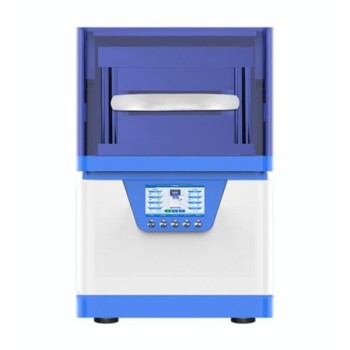
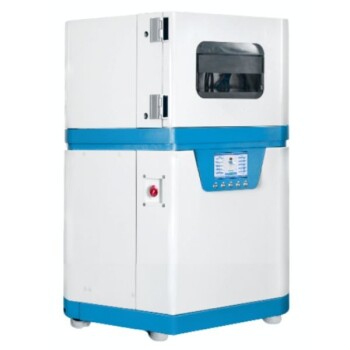
A programmable hot press serves as the central consolidation tool for creating NiO-YSZ anode supports. It functions by laminating multiple layers of tape-cast "green bodies" (unfired ceramic sheets) under precise conditions. By applying specific heat, pressure, and time profiles, it fuses these individual layers into a single, cohesive component with a strong metallurgical bond.
Core Takeaway: The hot press is essential for standardizing the internal structure of the anode. By eliminating density gradients through precise pressure control, it prevents the component from peeling apart (delamination) or changing shape (warping) during the critical sintering and reduction stages.
The Mechanics of Structural Integrity
Achieving a Metallurgical Bond
The primary goal of the hot press is lamination. It takes multiple distinct layers of NiO-YSZ tape-cast material and merges them.
Through the application of specific temperature and pressure, the machine forces the layers to interact at a microscopic level.
This creates a strong metallurgical bond, transforming a stack of loose sheets into a unified structural support.
Eliminating Density Gradients
One of the most common causes of failure in ceramic manufacturing is inconsistent density within the material.
The precise pressure control offered by a programmable hot press ensures force is distributed evenly across the anode surface.
This uniformity effectively eliminates density gradients within the green body, ensuring the material is homogeneous from edge to edge.
Preventing Downstream Manufacturing Failures
Countering Delamination
Without the high-quality lamination provided by the hot press, the layers of the anode support remain distinct and weak.
Weak bonds lead to interlayer delamination, where the layers separate or peel apart.
The hot press ensures the bond is strong enough to survive subsequent handling and processing steps without separating.
Avoiding Warping During Sintering
The benefits of the hot press extend into the thermal processing stages, specifically pre-sintering and reduction.
If a green body has density gradients, it will shrink unevenly when fired, causing the part to warp or distort.
By enforcing a uniform density upfront, the hot press ensures the anode support maintains its intended shape and flatness throughout the heating process.
Understanding the Process Variables
The Necessity of Parameter Precision
The programmable nature of the press is not a luxury; it is a technical requirement.
Success depends entirely on the correct combination of pressure, temperature, and time parameters.
If the pressure is too low, density gradients will remain; if the temperature or time is incorrect, the metallurgical bond may be insufficient.
The Risk of Incorrect Lamination
A failure to optimize these settings does not just result in a weak part; it results in a scrapped part.
The defects prevented by the hot press—warping and delamination—are generally irreversible once the sintering process begins.
Therefore, the programming of the press is the critical control point for the final quality of the anode support.
Making the Right Choice for Your Goal
To maximize the yield of high-quality NiO-YSZ anode supports, you must tailor the hot press cycle to the specific needs of your green body materials.
- If your primary focus is eliminating structural defects: Prioritize the precision of your pressure parameters to ensure density gradients are fully removed.
- If your primary focus is dimensional stability: Ensure your temperature and time settings are optimized to create a bond that resists warping during sintering.
The programmable hot press is the bridge between a delicate raw material and a robust, high-performance fuel cell component.
Summary Table:
| Feature | Role in NiO-YSZ Manufacturing | Key Benefit |
|---|---|---|
| Precise Pressure | Eliminates internal density gradients | Prevents warping during sintering |
| Thermal Control | Facilitates microscopic material fusion | Creates a strong metallurgical bond |
| Lamination | Merges multiple tape-cast green bodies | Eliminates interlayer delamination |
| Programmability | Standardizes heat and pressure profiles | Ensures repeatable, high-yield quality |
Elevate Your Fuel Cell Research with KINTEK Precision
Precision is the difference between a high-performance fuel cell and a scrapped component. KINTEK specializes in advanced laboratory equipment, including state-of-the-art programmable hot presses and isostatic presses designed specifically for the rigorous demands of NiO-YSZ ceramic processing.
Our comprehensive range of high-temperature furnaces, crushing and milling systems, and hydraulic presses empowers researchers and manufacturers to achieve perfect lamination, eliminate density gradients, and ensure dimensional stability in every anode support.
Ready to optimize your fuel cell manufacturing process? Contact KINTEK today to find the perfect thermal and pressure solutions for your lab!
References
- Selene Díaz-González, A.D. Lozano-Gorrı́n. RE0.01Sr0.99Co0.5Fe0.5O3 (RE = La, Pr, and Sm) Cathodes for SOFC. DOI: 10.3390/cryst14020143
This article is also based on technical information from Kintek Solution Knowledge Base .
Related Products
- Automatic Laboratory Heat Press Machine
- Touchscreen Automatic Vacuum Heat Press
- Automatic Heated Hydraulic Press Machine with Heated Plates for Laboratory Hot Press
- Heated Hydraulic Press Machine with Heated Plates Split Manual Laboratory Hot Press
- Automatic High Temperature Heated Hydraulic Press Machine with Heated Plates for Lab
People Also Ask
- What are the core advantages of using a laboratory hot press to produce Bi2Se3? Achieve 93% Density & High Conductivity
- Why is a laboratory hot press necessary for all-solid-state battery assembly? Reduce Impedance and Enhance Performance
- How does a three-stage pressure program affect rice husk particleboards? Optimize Bond Strength & Stability
- What is the primary function of a laboratory hot press in MEA assembly? Optimize Fuel Cell Bonding & Performance
- How does a laboratory hot press improve alloy performance? Optimize Liquid Phase Sintering for High-Strength Materials