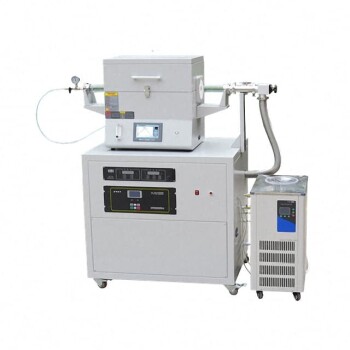
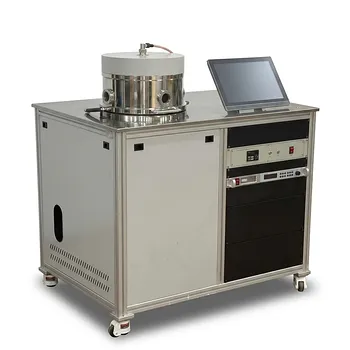
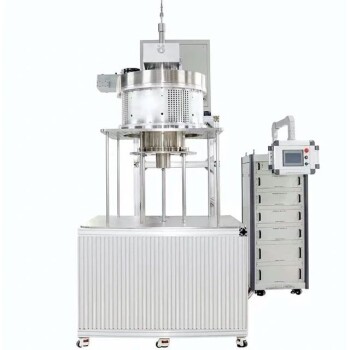
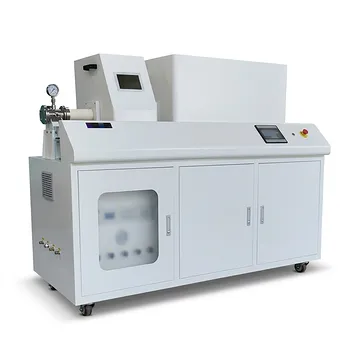
A tube Chemical Vapor Deposition (CVD) reactor facilitates N-CNT growth by creating a sealed, high-temperature micro-reaction environment explicitly designed for thermal decomposition. By heating the chamber to 900 °C and precisely introducing a mixture of Ar-H2 carrier gases and anhydrous acetonitrile vapor, the reactor induces catalytic chemical vapor deposition directly onto carbon paper fibers. This process converts the volatile precursor gases into solid nitrogen-doped carbon nanotubes (N-CNTs) anchored to the substrate.
Core Insight: The tube CVD reactor's primary value lies in its multi-stage programmable temperature control, which dictates the reaction kinetics. By manipulating heating rates and holding times in the presence of anhydrous acetonitrile, the system controls the nitrogen content and creates the specific "bamboo-like" morphology characteristic of N-CNTs.
Creating the Ideal Reaction Environment
Precise Thermal Regulation
The fundamental driver of this process is thermal energy. The tube reactor must achieve and maintain high temperatures, typically reaching up to 900 °C.
This heat provides the activation energy required to decompose the precursor gases. Without this intense, stable thermal environment, the chemical bonds in the vapor would not break down to form solid structures.
Atmosphere Control
The reactor creates a specific chemical atmosphere by excluding oxygen and introducing controlled gases. It utilizes an Ar-H2 carrier gas mixture to transport the necessary vapors through the tube.
This inert and reducing environment prevents the oxidation of the carbon paper substrate. It ensures that the chemical reactions occurring are strictly deposition and doping, rather than combustion.
Vapor Transport
To grow N-CNTs specifically, the system regulates the flow of anhydrous acetonitrile vapor.
Unlike simple carbon sources (like methane), acetonitrile contains both carbon and nitrogen. The reactor facilitates the transport of this dual-purpose precursor to the hot zone, where it decomposes to provide the building blocks for the nanotubes.
Mechanisms of Growth and Morphology
Catalytic Nucleation
The growth occurs on the surface of the carbon paper fibers, which are typically pre-treated with catalytic particles.
As the acetonitrile vapor contacts these heated catalyst sites, it undergoes directional decomposition. The catalyst lowers the energy barrier, allowing the carbon and nitrogen atoms to nucleate and form the nanotube structure from the gas phase to the solid phase.
Influencing Morphology
The reactor's ability to execute multi-stage programmable temperature control is critical for defining the physical structure of the nanotubes.
Specific heating rates and holding times determine the density of the coverage. These thermal profiles also directly influence the formation of the bamboo-like morphology, a structural trait common in nitrogen-doped nanotubes due to the incorporation of nitrogen into the graphitic lattice.
Understanding the Trade-offs
Thermal vs. Plasma Energy
While a tube CVD reactor is excellent for bulk synthesis and specific doping profiles, it relies purely on thermal energy. Unlike Plasma Enhanced CVD (PECVD), which uses an electric field to force vertical alignment, standard tube CVD growth is generally more random or entangled.
Parameter Sensitivity
The process is highly sensitive to the stability of the precursor flow. Variations in the anhydrous acetonitrile concentration can lead to inconsistent nitrogen doping levels. Furthermore, if the temperature ramps are not programmed correctly, the coverage density on the carbon paper may be patchy rather than uniform.
Making the Right Choice for Your Goal
To optimize the growth of N-CNTs on carbon paper, you must match your reactor settings to your specific material requirements.
- If your primary focus is Nitrogen Content: Prioritize the precise regulation of the anhydrous acetonitrile flow rate and the stability of the maximum temperature zone (900 °C).
- If your primary focus is Morphology Control: Adjust the programmable heating rates and holding times to fine-tune the bamboo-like structure and nanotube density.
- If your primary focus is Vertical Alignment: Acknowledge that a standard thermal tube reactor has limitations here; you may require an external field or a switch to PECVD for strict directional growth.
Effective N-CNT synthesis is less about the equipment hardware and more about the precision of your thermal and chemical programming.
Summary Table:
| Feature | Function in N-CNT Synthesis |
|---|---|
| Temperature Control | Reaches up to 900 °C to provide activation energy for precursor decomposition. |
| Atmosphere Management | Ar-H2 carrier gases prevent substrate oxidation and ensure stable vapor transport. |
| Precursor Regulation | Controls anhydrous acetonitrile flow to determine nitrogen doping levels. |
| Thermal Programming | Multi-stage heating rates define the 'bamboo-like' morphology and growth density. |
| Substrate Compatibility | Optimized for catalytic nucleation directly onto carbon paper fibers. |
Elevate Your Nanomaterials Research with KINTEK
Precision is the difference between a failed experiment and a breakthrough in material science. KINTEK specializes in high-performance laboratory equipment designed for the most demanding synthesis protocols. Whether you are developing next-generation energy storage or advanced catalysts, our comprehensive range of tube, vacuum, CVD, and PECVD furnaces provides the thermal stability and atmosphere control necessary for uniform N-CNT growth.
Beyond CVD systems, KINTEK offers a full suite of laboratory solutions including:
- High-Temperature High-Pressure Reactors & Autoclaves for advanced chemical synthesis.
- Crushing, Milling, and Sieving Equipment for precise substrate preparation.
- Electrolytic Cells & Battery Research Tools to test your developed materials.
- Essential Consumables such as high-purity ceramics, crucibles, and PTFE products.
Ready to optimize your carbon nanotube morphology and doping consistency? Contact our technical experts today to find the perfect reactor configuration for your laboratory.
References
- Ahmed Sodiq, Belabbes Merzougui. Enhanced electrochemical performance of modified thin carbon electrodes for all-vanadium redox flow batteries. DOI: 10.1039/d0ma00142b
This article is also based on technical information from Kintek Solution Knowledge Base .
Related Products
- Split Chamber CVD Tube Furnace with Vacuum Station Chemical Vapor Deposition System Equipment Machine
- Customer Made Versatile CVD Tube Furnace Chemical Vapor Deposition Chamber System Equipment
- Multi Heating Zones CVD Tube Furnace Machine Chemical Vapor Deposition Chamber System Equipment
- Chemical Vapor Deposition CVD Equipment System Chamber Slide PECVD Tube Furnace with Liquid Gasifier PECVD Machine
- Microwave Plasma Chemical Vapor Deposition MPCVD Machine System Reactor for Lab and Diamond Growth
People Also Ask
- What is the function of a tube furnace in CVD SiC synthesis? Achieving Ultra-Pure Silicon Carbide Powders
- What is a CVD tube furnace? A Complete Guide to Thin-Film Deposition
- What are the technical advantages of using a CVD tube furnace? Optimize Silicon-Carbon Battery Anodes
- What is the function of a high-temperature CVD tube furnace in 3D graphene foam prep? Master 3D Nanomaterial Growth
- How does a CVD tube furnace inhibit the sintering of silver supports? Boost Membrane Durability and Performance