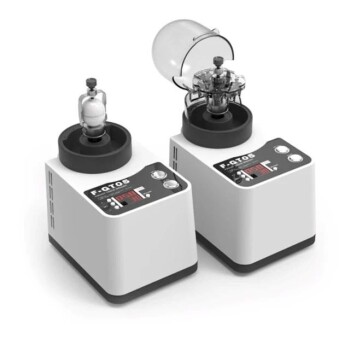
The vertical planetary ball mill serves as a high-energy reactor that uses non-equilibrium mechanical forces to integrate minerals and biochar at the molecular and structural levels. By applying simultaneous collision, shear, and compression, the mill reduces raw materials to micro-nano scales, ensuring a degree of homogenization and surface bonding that is unattainable through conventional stirring or mixing methods.
Core Takeaway: The vertical planetary ball mill facilitates the synthesis of mineral-biochar composites by combining physical particle size reduction with mechanochemical activation, effectively embedding mineral particles into the biochar matrix to create a high-performance material with superior adsorption and structural properties.
The Mechanisms of Mechanical Refinement
Achieving Micro-Nano Scale Particles
The high-speed rotation of the planetary system generates intense centrifugal forces, causing grinding media to impact the material with extreme velocity.
This process grinds minerals like palygorskite or diatomite and biochar precursors into micro-nano scale particles.
Reducing particle size to this level—often reaching a median diameter below 20 μm—dramatically increases the specific surface area available for chemical interaction and pollutant adsorption.
Opening Internal Pore Structures
Biochar often contains closed or "blind" pores that are inaccessible to contaminants in its raw state.
The mechanical fracture occurring within the mill breaks down the carbon walls of these internal voids.
This action significantly increases the total pore volume, allowing mineral particles to migrate into and bond within the internal architecture of the biochar.
Mechanochemical Activation and Surface Integration
Facilitating Surface Embedding and Attachment
The mill does not simply mix two substances; it forces the mineral particles to become physically embedded or attached to the biochar surface.
This creates a stable composite where the mineral and carbon phases are tightly integrated.
Such integration ensures that the resulting material exhibits synergistic adsorption properties, where the combined performance exceeds the sum of the individual components.
Inducing Chemical Bond Modification
High-energy milling provides enough localized energy to break chemical bonds on the carbon surface.
This process exposes active oxygen-containing functional groups, such as hydroxyl (-OH) and carboxyl (C-O) groups.
The introduction of these groups, alongside increased aromaticity, enhances the chemical reactivity of the composite, making it more effective at binding pollutants like arsenic or methylene blue.
Optimizing Material Homogeneity
Breaking Nanoparticle Agglomerates
Fine particles naturally tend to clump together due to van der Waals forces, which can ruin the performance of a composite.
The shear and impact forces generated by the planetary motion are essential for breaking up nanoparticle agglomerates.
This leads to a highly uniform dispersion of minerals within the biochar matrix, ensuring consistent performance across the entire batch of material.
Enabling Solid-Phase Reactions
In some synthesis paths, the mill acts as a site for mechanical alloying or in-situ chemical reactions.
The mechanical energy can trigger solid-phase reactions between the mineral and the carbon at room temperature.
This can lead to the formation of reinforcing phases or new chemical structures that improve the thermal stability and mechanical strength of the final composite.
Understanding the Trade-offs
Energy Intensity and Operational Costs
The primary drawback of using a vertical planetary ball mill is the high energy consumption required to generate the necessary rotational speeds.
For large-scale industrial applications, the cost of electricity and the wear and tear on grinding jars and balls can be significant.
Synthesizing materials via this route requires a careful balance between the desired particle size and the economic reality of the energy input.
Risk of Material Degradation and Contamination
Over-milling can lead to the excessive destruction of the biochar's carbon skeleton, potentially reducing its structural integrity.
There is also a risk of cross-contamination from the grinding media (e.g., steel or zirconia balls) entering the composite.
Process parameters, such as milling time and the ball-to-material ratio, must be strictly controlled to prevent these issues.
How to Apply This to Your Project
Making the Right Choice for Your Goal
To achieve the best results with a vertical planetary ball mill, the operational strategy should be tailored to the intended use of the composite.
- If your primary focus is enhanced adsorption: Prioritize longer milling times and high-energy settings to maximize surface area and the exposure of active functional groups.
- If your primary focus is mechanical reinforcement: Focus on breaking agglomerates and achieving a uniform dispersion of minerals within the matrix to ensure consistent physical properties.
- If your primary focus is cost-efficiency: Use the largest possible grinding media and optimized rotation speeds to achieve the minimum necessary particle size with the least energy expenditure.
By mastering the balance of mechanical force and chemical activation, you can transform simple biochar and minerals into advanced, high-value composite materials.
Summary Table:
| Mechanism | Impact on Material | Key Benefit |
|---|---|---|
| Micro-Nano Scaling | Reduces median diameter to < 20 μm | Dramatically increases specific surface area |
| Pore Opening | Breaks internal carbon walls | Allows mineral migration and internal bonding |
| Mechanochemical Activation | Modifies surface chemical bonds | Enhances reactivity and pollutant binding |
| Homogenization | Breaks nanoparticle agglomerates | Ensures uniform dispersion and consistent performance |
| Solid-Phase Reaction | Triggers reactions at room temperature | Improves thermal stability and mechanical strength |
Elevate Your Material Synthesis with KINTEK Precision
Unlock the full potential of your mineral-biochar research with KINTEK’s high-energy milling solutions. Our vertical planetary ball mills provide the precise mechanical force and mechanochemical activation required to synthesize high-performance composites with superior adsorption and structural integrity.
Why Choose KINTEK?
- Advanced Milling & Grinding: High-energy planetary mills, crushing systems, and sieving equipment.
- Comprehensive Thermal Solutions: Muffle, tube, vacuum, CVD, and PECVD furnaces.
- Precision Pressing: Hydraulic presses for pellets, hot pressing, and isostatic applications.
- Specialized Lab Tools: High-temperature reactors, autoclaves, and essential ceramics/crucibles.
Ready to optimize your laboratory efficiency and material quality? Contact our experts today to find the perfect equipment tailored to your specific research goals!
References
- Fei Jiang, Bin Gao. Remarkable synergy between sawdust biochar and attapulgite/diatomite after co-ball milling to adsorb methylene blue. DOI: 10.1039/d3ra01123b
This article is also based on technical information from Kintek Solution Knowledge Base .
Related Products
- Laboratory Horizontal Planetary Ball Mill Milling Machine
- High Energy Planetary Ball Mill for Laboratory Horizontal Tank Type Milling Machine
- High Energy Planetary Ball Mill Machine for Laboratory Horizontal Tank Type
- High-Energy Omnidirectional Planetary Ball Mill Milling Machine for Laboratory
- Laboratory Planetary Ball Mill Rotating Ball Milling Machine
People Also Ask
- What is the primary purpose of using a planetary ball mill for iridium powder? Achieve Microscopic Mixing Uniformity
- What is the primary function of a planetary ball mill for Al2O3-TiC/CaF2 powders? Achieving Microstructural Homogeneity
- What is the role of a planetary ball mill in sulfide-based solid-state batteries? Engineer High-Performance Cathodes
- What is the function of a planetary ball mill in MAX phase powder preparation? Unlock High-Purity Atomic Homogeneity
- Why are planetary ball mills used for intermetallic precursors? Achieve Precise Atomic-Level Mechanical Alloying