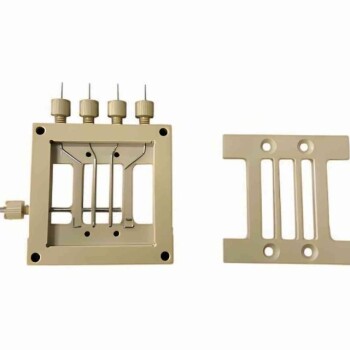
In the context of Reversible Solid Oxide Cell (RSOC) research, the electrolyzer system functions as the driver for the "charging" phase of the energy cycle. It mechanically reverses the standard fuel cell operation by utilizing electrical energy to split steam into hydrogen and oxygen, rather than consuming hydrogen to produce electricity.
The core value of the electrolyzer in this setting is its ability to simulate the energy storage phase. By enabling the transition between power generation (fuel cell mode) and fuel production (electrolysis mode), researchers can measure the cyclic efficiency and material stability required for large-scale energy solutions.
The Mechanics of Reverse Operation
Simulating Energy Storage
The primary function of the electrolyzer system in RSOC research is to validate the technology's capability to store energy.
In a standard fuel cell, chemical energy is converted into electricity. The electrolyzer reverses this by taking electrical input—potentially from renewable sources—and converting it back into chemical energy in the form of hydrogen.
Splitting Steam
To achieve this reverse operation, the system is designed to handle steam electrolysis.
The electrolyzer applies a current to split water vapor (steam) into its constituent parts: hydrogen and oxygen. This process is critical because the hydrogen produced serves as the "battery," waiting to be converted back into electricity when the system reverts to fuel cell mode.
Evaluating System Viability
Measuring Cyclic Efficiency
A major focus of RSOC research is determining how much energy is lost when switching between modes.
The electrolyzer system allows laboratories to run continuous cycles of charging (electrolysis) and discharging (fuel cell mode). By monitoring inputs and outputs during these cycles, researchers can calculate the round-trip efficiency of the entire system.
Assessing Material Stability
Materials often behave differently when subjected to the oxidizing environment of a fuel cell versus the reducing environment of an electrolyzer.
The electrolyzer system enables researchers to stress-test these materials during the transition phases. This reveals how well the cell structure withstands the physical and chemical strains of repeated mode switching, which is fundamental to long-term durability.
Understanding the Challenges in Testing
The Stress of Transitions
While the concept of reversibility is elegant, the practical application involves significant material stress.
One of the key trade-offs evaluated using the electrolyzer system is the balance between high performance and longevity. Pushing the electrolyzer for maximum hydrogen production can accelerate degradation, compromising the stability of the cell when it switches back to power generation.
Complexity of Dual-Mode Optimization
Optimizing a system for two opposite reactions is inherently difficult.
A material that is highly efficient at splitting steam in electrolyzer mode may not be the most efficient at generating power in fuel cell mode. The research utilizes the electrolyzer system to find the optimal middle ground where losses in both operational modes are minimized.
Making the Right Choice for Your Goal
If your primary focus is Grid-Scale Storage: Prioritize the electrolyzer’s ability to maximize hydrogen production efficiency, as this defines the capacity of your energy "reserve."
If your primary focus is Material Longevity: Focus on the cyclic stability data provided by the electrolyzer tests to ensure the hardware can withstand thousands of transitions between modes without degrading.
The electrolyzer system is the critical tool that transforms a theoretical concept of reversible energy into a verifiable, scalable storage solution.
Summary Table:
| Research Metric | Role of Electrolyzer System in RSOC | Importance for Researchers |
|---|---|---|
| Energy Storage | Converts electrical energy into hydrogen (chemical energy) | Validates the "charging" phase of the energy cycle |
| Cyclic Efficiency | Facilitates continuous switching between SOEC and SOFC modes | Measures round-trip energy loss for grid-scale feasibility |
| Material Stability | Subjects components to alternating redox environments | Tests long-term durability and resistance to degradation |
| System Optimization | Provides data for dual-mode reaction balancing | Identifies the most efficient materials for both operations |
Advance Your Green Energy Research with KINTEK
Unlock the full potential of Reversible Solid Oxide Cells (RSOC) with KINTEK’s precision-engineered laboratory solutions. As specialists in advanced material research tools, we provide the high-performance hardware necessary to simulate complex energy cycles and ensure material longevity.
Our extensive portfolio supports every stage of your electrolysis and fuel cell research, featuring:
- Electrolytic cells and high-performance electrodes for optimized redox reactions.
- High-temperature furnaces (Tube, Muffle, Vacuum) for precise material sintering and testing.
- High-temperature high-pressure reactors and autoclaves for advanced chemical processing.
- Battery research tools, hydraulic presses, and crushing systems for material preparation.
Whether you are focusing on grid-scale energy storage or developing durable new materials, KINTEK delivers the reliability and technical expertise your lab demands. Contact us today to enhance your lab's efficiency and scale your energy solutions!
References
- Muhammad Sarfraz Arshad, Ghulam Yasin. Advances and Perspectives on Solid Oxide Fuel Cells: From Nanotechnology to Power Electronics Devices. DOI: 10.1002/ente.202300452
This article is also based on technical information from Kintek Solution Knowledge Base .
Related Products
- Customizable PEM Electrolysis Cells for Diverse Research Applications
- Multifunctional Electrolytic Electrochemical Cell Water Bath Single Layer Double Layer
- Electrolytic Electrochemical Cell Gas Diffusion Liquid Flow Reaction Cell
- Lab Electrochemical Workstation Potentiostat for Laboratory Use
- Electrolytic Electrochemical Cell with Five-Port
People Also Ask
- What are the risks of improper voltage control in an electrolysis cell? Avoid Costly Damage and Inefficiency
- What are the opening configurations for the non-sealed and sealed versions of the electrolysis cell? Optimize Your Electrochemical Setup
- What is an electrolysis cell? A Guide to Driving Chemical Reactions with Electricity
- What parameters must be strictly controlled during the electrolysis process? Ensure Precision and Efficiency
- What are the precautions for heating or sterilizing an electrolysis cell? Avoid Damaging Sensitive Components