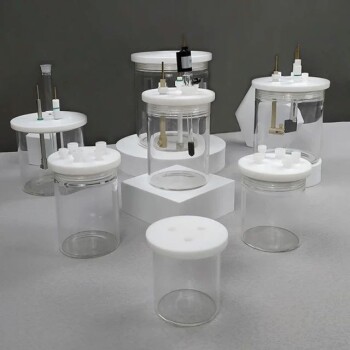
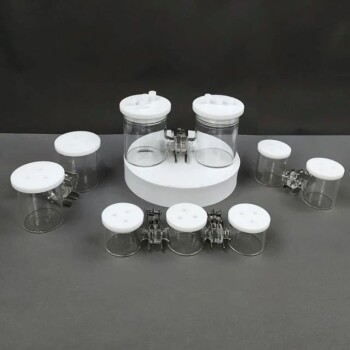
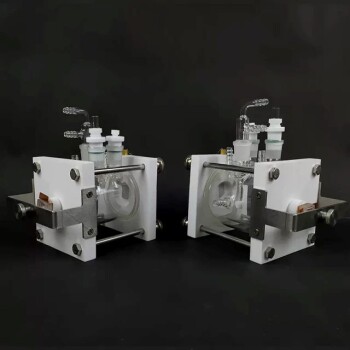
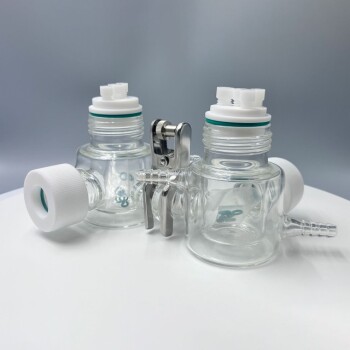
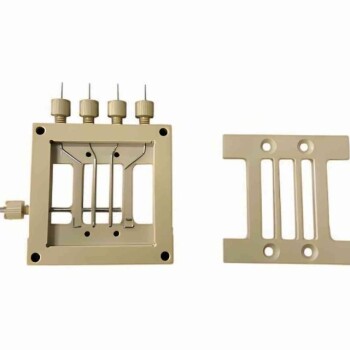
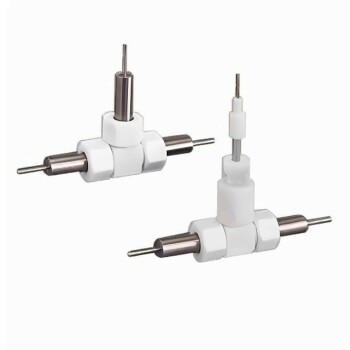
Electrolytic cells act as the fundamental testing platform for photoelectrochemical (PEC) water splitting. These systems create a controlled environment that integrates the photoelectrode with counter and reference electrodes, allowing for the precise application of external voltage. By working in tandem with a potentiostat, the cell facilitates the measurement of photocurrent density and efficiency, ultimately revealing how well a material converts light into chemical energy.
While the photocatalyst captures light, the electrolytic cell provides the necessary infrastructure to force charge separation and quantify performance, bridging the gap between material potential and measurable data.
Establishing a Controlled Electrochemical Environment
The Foundation of Measurement
The primary function of the electrolytic cell is to house the electrodes within a specific electrolyte solution.
This ensures that all chemical reactions occur under standardized, reproducible conditions.
It provides a stable stage where researchers can mount photoanodes or photocathodes to test their reactivity.
The Three-Electrode Configuration
To ensure accuracy, these cells typically utilize a standardized three-electrode system.
The working electrode (the photocatalytic material, such as TiO2 or BiFeO3) captures light energy to generate electrical charges.
A counter electrode (often platinum wire or plate) completes the electrical circuit, while a reference electrode (such as Ag/AgCl) establishes a stable potential baseline for accurate voltage measurement.
Managing Charge Carriers through External Bias
Assisting Carrier Separation
The electrolytic cell works in conjunction with a potentiostat to apply an external bias voltage.
This external force is critical because it assists in separating photogenerated carriers (electrons and holes).
Driving the Reaction
By applying bias, the system prevents charges from recombining before they can be useful.
The voltage drives the carriers toward the solid-liquid interface, enabling the redox reactions necessary for water splitting.
Quantifying Photocatalytic Performance
Measuring Photocurrent Density
The system allows researchers to generate photocurrent density-potential curves.
These measurements directly indicate the rate of hydrogen evolution or oxidation under different voltage conditions.
Analyzing Efficiency and Kinetics
Beyond raw current, the setup measures Incident Photon-to-Current Efficiency (IPCE).
It also facilitates Electrochemical Impedance Spectroscopy (EIS), which reveals critical details about charge transfer resistance and carrier migration rates.
These metrics help researchers understand how modifications, such as doping or heterostructures, affect the underlying physics of the material.
Understanding the Trade-offs
The Cost of External Bias
While applying external bias is necessary for characterization, it represents an energy input.
A material that shows high efficiency only under strong external bias may not be practical for self-driven, real-world solar hydrogen production.
Sensitivity to System Geometry
The data derived from these cells is highly sensitive to the physical setup.
Issues such as improper electrode distance or electrolyte resistance can introduce errors, obscuring the true performance of the photocatalyst.
Making the Right Choice for Your Goal
To get the most out of your PEC testing, align your experimental focus with the specific capabilities of the electrolytic cell.
- If your primary focus is fundamental kinetics: Use the cell to measure IPCE and EIS to isolate charge transport characteristics and interfacial reaction mechanisms.
- If your primary focus is device efficiency: Analyze photocurrent density-potential curves to determine the minimum bias voltage required to achieve significant water splitting.
By isolating the variables of charge generation and transfer, the electrolytic cell transforms theoretical material properties into actionable performance data.
Summary Table:
| Feature | Function in PEC Water Splitting |
|---|---|
| Three-Electrode Setup | Provides stable potential via Working, Counter, and Reference electrodes. |
| External Bias Application | Assists in carrier separation and prevents electron-hole recombination. |
| Performance Metrics | Measures photocurrent density, IPCE, and charge transfer kinetics (EIS). |
| Controlled Environment | Houses electrolyte and electrodes for reproducible, standardized testing. |
| Reaction Driving | Forces carriers to the solid-liquid interface for redox reactions. |
Elevate Your Photoelectrochemical Research with KINTEK
Unlock precise data and superior efficiency in your hydrogen evolution studies. KINTEK specializes in high-performance laboratory equipment, offering specialized electrolytic cells and electrodes designed for rigorous photoelectrochemical (PEC) testing.
Our comprehensive range includes:
- Precision Electrolytic Cells & Electrodes for accurate PEC and water splitting measurements.
- Advanced Thermal Solutions: Muffle, tube, vacuum, and CVD furnaces for material synthesis.
- Sample Preparation: Crushing, milling, and high-pressure hydraulic presses.
- Specialized Labware: PTFE products, ceramics, and high-purity crucibles.
Whether you are analyzing fundamental kinetics or optimizing device efficiency, KINTEK provides the reliable tools needed to bridge the gap between material potential and actionable data. Contact us today to find the perfect solution for your lab!
References
- Rama D. Tentu, Suddhasatwa Basu. Photocatalytic water splitting for hydrogen production. DOI: 10.1016/j.coelec.2017.10.019
This article is also based on technical information from Kintek Solution Knowledge Base .
Related Products
- PTFE Electrolytic Cell Electrochemical Cell Corrosion-Resistant Sealed and Non-Sealed
- Super Sealed Electrolytic Electrochemical Cell
- Electrolytic Electrochemical Cell with Five-Port
- H Type Electrolytic Cell Triple Electrochemical Cell
- Electrolytic Electrochemical Cell Gas Diffusion Liquid Flow Reaction Cell
People Also Ask
- What is the necessity of selecting a PTFE electrolytic cell? Ensure Precise Graphene Corrosion Testing Accuracy
- What is the proper method for cleaning the surface of an all-PTFE electrolytic cell? Ensure Accurate Results with a Pristine Surface
- How should an all-PTFE electrolytic cell be stored after use? Expert Maintenance Tips for Long-Lasting Performance
- What is the proper cleaning method for an all-PTFE electrolytic cell? Essential Tips for Surface Integrity
- What are the standard opening specifications for all-PTFE electrolytic cells? A Guide to Sealed vs. Non-Sealed Ports