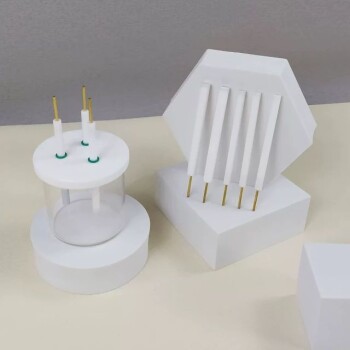
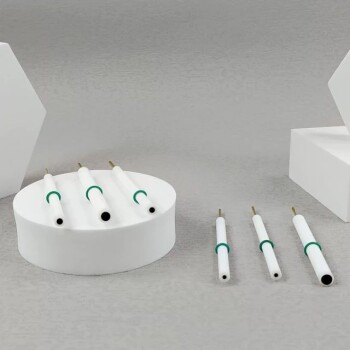
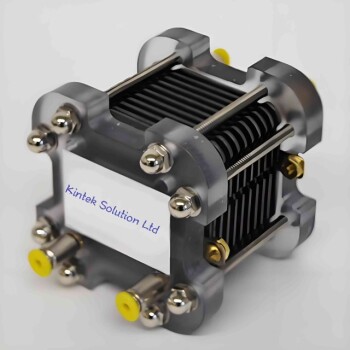
The two-electrode electrochemical reactor serves as the fundamental engine for the synthesis of Titanium Dioxide (TiO2) anodic oxidation films. It acts as the central vessel that houses the electrolyte and facilitates a continuous direct current, driving the oxidation of the Titanium substrate (the anode) to grow structured oxide layers with specific morphologies.
The reactor’s primary function is to maintain a precise equilibrium between oxidation and chemical dissolution. By ensuring a stable electrolytic environment and uniform current distribution, it enables the formation of highly ordered nanostructures that significantly enhance the material's quantum efficiency.
The Mechanics of the Reactor
The Electrolytic Environment
The reactor provides a contained, controlled environment for the electrolyte.
It is responsible for maintaining stable electrolyte circulation, which is critical for consistent chemical reactions.
The Electrode Configuration
The system relies on a specific two-electrode setup. The Titanium substrate acts as the anode, while high-purity graphite or platinum serves as the counter electrode.
This configuration ensures a uniform distribution of current density across the titanium sheet, preventing uneven film growth.
Controlling Film Morphology
The Oxidation Process
Under the influence of continuous direct current (DC), the Titanium anode undergoes oxidation.
This electrochemical reaction converts the surface metal into a Titanium Dioxide film.
Balancing Growth and Dissolution
The reactor does not simply pile oxide onto the surface; it manages a delicate balance.
By maintaining constant cell voltage, the system controls the competition between the oxidation reaction (film building) and chemical dissolution (film etching).
Resulting Nanostructures
This controlled balance allows for the growth of specific, highly ordered surface features.
Depending on the conditions, the reactor can produce morphologies ranging from nano-pitting structures to regular nanotube arrays.
Critical Performance Factors
Structural Orientation
The precision of the two-electrode reactor facilitates the growth of vertically oriented structures.
These regular tube diameters and vertical alignment are not merely aesthetic; they are functional requirements for high-performance films.
Impact on Electron Transport
The ordered nature of the film directly influences its electrochemical properties.
Vertically oriented nanotubes effectively reduce the recombination rate of photogenerated electrons. This reduction leads to a significant enhancement in the quantum efficiency of the Titanium Dioxide.
Optimizing the Growth Process
To achieve specific film properties, you must manipulate the reactor's variables to suit your end goal.
- If your primary focus is Structural Uniformity: Prioritize the use of high-purity counter electrodes (graphite or platinum) to ensure the most even current density distribution possible.
- If your primary focus is Photochemical Efficiency: Strictly regulate the cell voltage to balance dissolution, ensuring the formation of vertical nanotube arrays that minimize electron recombination.
Mastering the balance within the electrochemical reactor is the key to transforming raw titanium into a highly efficient functional material.
Summary Table:
| Feature | Function in TiO2 Growth | Impact on Result |
|---|---|---|
| Anode Setup | Titanium substrate oxidation | Forms the base TiO2 film layer |
| Counter Electrode | Graphite or Platinum placement | Ensures uniform current density |
| DC Power Control | Maintains constant cell voltage | Balances oxidation vs. dissolution |
| Electrolyte Stability | Circulation and temperature control | Dictates nanotube morphology |
| Structural Control | Vertical orientation of nanotubes | Reduces electron recombination rate |
Elevate Your Electrochemical Research with KINTEK
Precision is the backbone of advanced material synthesis. KINTEK specializes in high-performance laboratory equipment designed to meet the rigorous demands of anodic oxidation and battery research. Whether you are developing highly ordered TiO2 nanotubes or exploring next-generation energy storage, our comprehensive range of electrolytic cells, electrodes, and high-purity consumables ensures stable, repeatable results.
Our value to your laboratory:
- Precision Engineering: Optimized electrolytic cells for uniform current distribution.
- Specialized Material Solutions: From platinum/graphite electrodes to corrosion-resistant reactors.
- Comprehensive Portfolio: Access high-temperature furnaces, hydraulic presses, and cooling solutions all in one place.
Ready to transform your raw titanium into high-efficiency functional materials? Contact KINTEK today to find the perfect electrochemical setup for your specific research goals.
References
- Ferenc Koppány, Zsolt Németh. Enhancement of Hydrophilicity of Nano-Pitted TiO2 Surface Using Phosphoric Acid Etching. DOI: 10.3390/nano13030511
This article is also based on technical information from Kintek Solution Knowledge Base .
Related Products
- Reference Electrode Calomel Silver Chloride Mercury Sulfate for Laboratory Use
- Rotating Platinum Disk Electrode for Electrochemical Applications
- Double-Layer Water Bath Electrolytic Electrochemical Cell
- Electrolytic Electrochemical Cell Gas Diffusion Liquid Flow Reaction Cell
- Glassy Carbon Electrochemical Electrode
People Also Ask
- What is the function of a reference electrode? Master Precision in Three-Electrode Reactor Reconstruction
- What is the recommended maintenance for the filling solution of a reference electrode? A Guide to Stable & Accurate Readings
- Which electrode is used as a ground reference? Master the Key to Accurate Electrochemical Measurements
- What is the reference electrode in potentiometry? The Key to Stable & Accurate Measurements
- Which electrode is used as a reference? A Guide to Accurate Electrochemical Measurements