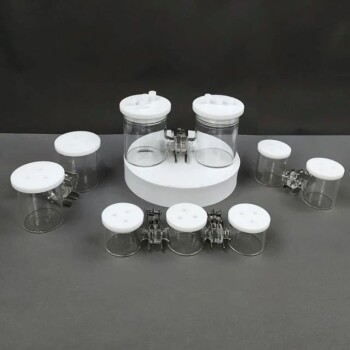
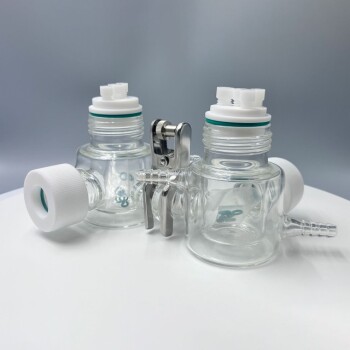
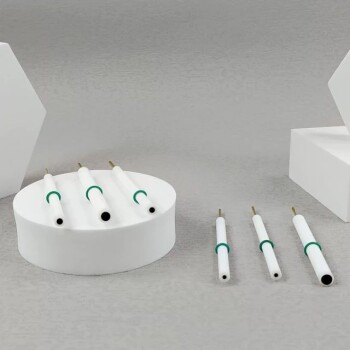
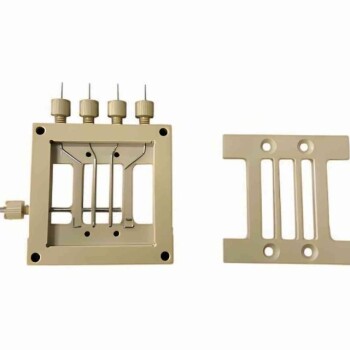
The primary advantages of a three-electrode glass electrolytic cell are the precise isolation of the working electrode’s potential and the elimination of environmental contaminants. This configuration separates the current-carrying circuit from the potential-measuring circuit, while the glass construction ensures complete chemical inertness even in aggressive acidic environments.
Core Takeaway The three-electrode glass cell is the standard for high-fidelity electrochemistry because it decouples potential control from current flow and utilizes inert materials to prevent metallic ion leaching, ensuring that observed catalytic activity stems solely from your platinum sample and not from experimental artifacts.
Achieving Precision Through Configuration
Decoupling Potential and Current
In a standard two-electrode system, the potential and current are coupled, leading to voltage drops that distort data. A three-electrode setup introduces a reference electrode solely to monitor potential, while a separate counter electrode handles the current.
This triangulation allows you to control the potential of your working electrode (the platinum electrocatalyst) with extreme precision, independent of the current magnitude flowing through the cell.
The Role of the Counter Electrode
To maintain this precision, a Platinum (Pt) wire is typically used as the counter electrode. Its high electrical conductivity ensures the efficient completion of the current circuit.
Furthermore, the Pt counter electrode remains chemically inert. It does not oxidize or release impurity ions into the electrolyte, ensuring the current measured is accurately attributed to the polarization of the working electrode.
The Critical Importance of Material Inertness
Resisting Aggressive Electrolytes
Electrochemical characterization often requires strong acidic electrolytes, such as sulfuric acid. The glass material of the cell offers superior chemical resistance compared to metals or lower-grade plastics.
Eliminating Contamination
The most significant risk in characterization is the introduction of foreign ions. If the cell walls corrode, they release metallic ion impurities.
These impurities can deposit onto your platinum electrocatalyst, altering its active surface area and skewing results. The glass construction guarantees a contaminant-free environment, maintaining the integrity of your electrochemical data.
Understanding the Trade-offs
Fragility and Maintenance
While glass offers superior chemical properties, it is physically fragile. These cells require careful handling and cleaning protocols to avoid breakage or scratching, which can harbor contaminants.
System Complexity
Introducing a third electrode adds complexity to the physical setup and the potentiostat wiring. Misplacement of the reference electrode relative to the working electrode can still introduce uncompensated resistance (iR drop), despite the theoretical advantages.
Making the Right Choice for Your Goal
When designing your experiment, consider how these factors align with your specific objectives:
- If your primary focus is fundamental kinetic study: Prioritize the positioning of the reference electrode to minimize uncompensated resistance for the most accurate potential control.
- If your primary focus is trace analysis or purity: rigorous cleaning of the glass cell and the use of a high-purity Pt counter electrode are non-negotiable to prevent background interference.
By leveraging the isolation of the three-electrode system and the inertness of glass, you ensure your data reflects the true intrinsic properties of your catalyst.
Summary Table:
| Feature | Advantage | Impact on Results |
|---|---|---|
| Three-Electrode Setup | Decouples potential from current | Eliminates voltage drops and ensures precise potential control |
| Glass Construction | Chemical inertness in acidic media | Prevents metallic ion leaching and maintains electrolyte purity |
| Platinum Counter Electrode | High conductivity & stability | Completes the circuit without adding chemical artifacts |
| Reference Electrode | Independent potential monitoring | Provides a stable baseline for high-fidelity kinetic studies |
Elevate Your Electrochemical Research with KINTEK
Precision in platinum electrocatalyst characterization starts with the right environment. KINTEK specializes in high-quality laboratory equipment, providing researchers with the advanced electrolytic cells and electrodes needed to eliminate artifacts and ensure data integrity.
Whether you are performing fundamental kinetic studies or trace analysis, our portfolio—including high-purity glass cells, platinum electrodes, and specialized battery research tools—delivers the reliability your lab demands. Our experts can help you select the ideal configuration to minimize uncompensated resistance and maximize your research accuracy.
Ready to achieve high-fidelity results? Contact KINTEK today to explore our comprehensive range of electrochemical solutions and laboratory consumables.
References
- Ruslan M. Mensharapov, S. V. Grigoriev. Screening of Carbon-Supported Platinum Electrocatalysts Using Frumkin Adsorption Isotherms. DOI: 10.3390/inorganics11030103
This article is also based on technical information from Kintek Solution Knowledge Base .
Related Products
- H Type Electrolytic Cell Triple Electrochemical Cell
- Electrolytic Electrochemical Cell Gas Diffusion Liquid Flow Reaction Cell
- PTFE Electrolytic Cell Electrochemical Cell Corrosion-Resistant Sealed and Non-Sealed
- Electrolytic Electrochemical Cell with Five-Port
- Side Window Optical Electrolytic Electrochemical Cell
People Also Ask
- What is a H type cell? A Guide to Divided Electrochemical Cells for Accurate Experiments
- How should the electrolyte be prepared and added to the H-type electrolytic cell? Best Practices for Purity and Safety
- What is the technical necessity of using an H-type electrolytic cell for NO3RR tests? Protect Your Ammonia Yields
- How does the design of an H-type electrolytic cell benefit the neutral water electrolysis process for metal recovery?
- What is the primary function of an H-type electrolytic cell in NitRR? Ensure Accurate Product Yields