At its core, an infrared (IR) spectrometer consists of four essential components: a source of infrared radiation, a sample compartment, a method for separating light by wavelength (an interferometer or monochromator), and a detector. These parts work in sequence to pass a beam of infrared light through a sample and measure which specific frequencies of light are absorbed by the material's chemical bonds.
The fundamental purpose of an IR spectrometer is not just to see what a sample looks like, but to understand its molecular identity. Each component plays a critical role in translating the invisible vibrations of chemical bonds into a unique spectral fingerprint.
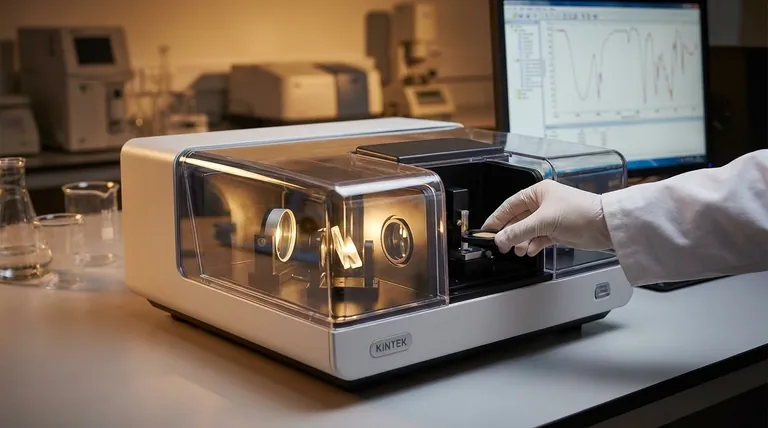
The Path of Light: How an FTIR Spectrometer Works
Modern IR spectroscopy almost exclusively uses the Fourier-Transform (FTIR) method due to its superior speed and sensitivity. The following components describe the journey of light through a typical FTIR instrument.
The Source: Generating the Light
The process begins with a source that emits a broad, continuous spectrum of mid-infrared energy. This is typically an inert solid heated to incandescence (around 1000-1800 °C).
Common sources include a silicon carbide rod (Globar) or a Nernst glower (a ceramic cylinder). The key is to produce stable, high-intensity radiation across the entire range of interest.
The Interferometer: Modulating the Frequencies
This is the heart of an FTIR spectrometer. Instead of filtering out unwanted frequencies, an interferometer—most commonly a Michelson interferometer—modulates the entire beam at once.
It splits the IR beam into two paths. One beam travels a fixed distance, while the other reflects off a mirror that moves back and forth. When the two beams are recombined, they interfere with each other, creating a unique signal called an interferogram.
This interferogram contains intensity information for every frequency in the spectrum, all encoded into a single signal measured over time.
The Sample: The Point of Interaction
The modulated beam from the interferometer then passes through the sample compartment. Here, the IR radiation interacts with the sample's molecules.
When the frequency of the radiation matches the natural vibrational frequency of a chemical bond (e.g., a C=O double bond stretch), the molecule absorbs that energy. All other frequencies pass through unaffected.
The Detector: Measuring What's Left
After passing through the sample, the attenuated beam strikes the detector. The detector's job is to measure the intensity of the interferogram signal.
Common detectors include deuterated triglycine sulfate (DTGS), which is a reliable room-temperature detector, or the more sensitive mercury cadmium telluride (MCT) detector, which requires liquid nitrogen cooling.
The Computer: Translating Data into a Spectrum
The detector sends the measured interferogram—a complex signal of intensity versus mirror position—to a computer. This raw data is not directly interpretable.
The computer performs a mathematical operation called a Fourier Transform. This algorithm instantly deconvolutes the time-domain interferogram into a familiar frequency-domain spectrum, plotting transmittance or absorbance versus wavenumber (cm⁻¹). This final plot is the IR spectrum that reveals the sample's molecular fingerprint.
Key Advantages of the FTIR Approach
The design of FTIR instruments provides significant benefits over the older, slower dispersive method, which used a grating or prism (monochromator) to scan through frequencies one by one.
The Multiplex (Fellgett's) Advantage
An FTIR instrument measures all frequencies simultaneously, rather than one at a time. This means a complete spectrum can be acquired in about one second. This speed allows for signal averaging—taking many scans and averaging them to dramatically reduce random noise and improve data quality.
The Throughput (Jacquinot's) Advantage
Dispersive instruments require narrow slits to select a single wavelength, which blocks most of the light from reaching the detector. An FTIR has fewer restrictive apertures, allowing significantly more of the source's energy to reach the detector. This results in a much stronger signal and higher sensitivity.
The Connes' Advantage
FTIR instruments use a single-frequency HeNe laser as an internal reference to precisely track the position of the moving mirror. This provides extremely high wavenumber accuracy and precision, making spectra highly reliable and reproducible.
How This Informs Your Analysis
Understanding these components helps you interpret your results and choose the right analytical approach.
- If your primary focus is identifying an unknown compound: The high wavenumber accuracy (Connes' Advantage) of an FTIR is critical for confidently matching your spectrum to a reference library.
- If your primary focus is quantifying a weak absorber or trace component: The superior signal-to-noise ratio from signal averaging (Fellgett's Advantage) allows for the accurate measurement of very small peaks.
- If your primary focus is studying reaction kinetics: The rapid scanning capability of FTIR allows you to collect multiple spectra over time, effectively monitoring the disappearance of reactants and the appearance of products.
By understanding how each component contributes to the final spectrum, you gain deeper insight into the data and the molecular world it represents.
Summary Table:
| Component | Key Function | Common Examples |
|---|---|---|
| Source | Generates broad IR radiation | Globar (SiC), Nernst Glower |
| Interferometer | Modulates light; creates interferogram | Michelson Interferometer |
| Sample | Interacts with IR light; absorbs specific frequencies | Solid, Liquid, or Gas |
| Detector | Measures intensity of remaining light | DTGS (room temp), MCT (cooled) |
Ready to achieve precise molecular analysis in your lab?
Understanding your spectrometer's components is the first step to unlocking its full potential. KINTEK specializes in providing high-quality lab equipment and consumables, including reliable FTIR spectrometers and accessories, to meet the exacting needs of modern laboratories.
Let our experts help you select the perfect instrument to enhance your research, quality control, or material identification processes.
Contact KINTEK today to discuss your laboratory requirements and discover the right solution for your analytical challenges!
Visual Guide

Related Products
- Infrared High Resistance Single Crystal Silicon Lens
- Lab Infrared Press Mold
- Infrared Thermal Imaging Temperature Measurement Double-Sided Coated Germanium Ge Lens
- No Demolding Lab Infrared Press Mold for Laboratory Applications
- Customizable XRD Sample Holders for Diverse Research Applications
People Also Ask
- What are the advantages of IR spectrophotometry? Rapid, Non-Destructive Chemical Analysis for Your Lab
- What is the use of SiC semiconductor? Unlock Higher Efficiency for EVs and Power Systems
- Can you see mold with an infrared camera? How Thermal Imaging Reveals Hidden Moisture Problems
- What is the most commonly used in semiconductors? Discover Why Silicon Dominates Modern Electronics
- What are the advantages of SiC technology? Achieve Higher Efficiency and Power Density