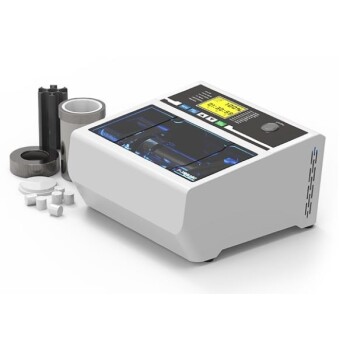
Integrating a high-precision electronic balance with a high-temperature furnace transforms standard thermal testing into a dynamic tool for continuous, real-time monitoring of alloy behavior. This combination allows for the precise tracking of mass changes—specifically during corrosion processes—providing data that static measurements simply cannot reveal.
By capturing the exact moment an alloy transitions from a stable state to rapid failure, this integration provides the kinetic evidence required to accurately predict material lifespan and durability under stress.
Unlocking Real-Time Kinetic Insights
Continuous Process Monitoring
The fundamental benefit of this integration is the ability to observe the corrosion process as it occurs.
Rather than measuring a sample before and after heating, this method tracks mass fluctuations in real-time.
For materials like Fe-16Cr alloys, this continuous stream of data reveals how the material interacts with its environment moment by moment.
Identifying Critical Transition Points
High-precision balances are sensitive enough to detect subtle shifts in oxidation rates.
They allow researchers to pinpoint the exact transition from an initial slow oxidation phase to a rapid oxidation failure phase.
Identifying this specific tipping point is essential for understanding the limits of a material's protective properties.
Evaluating Material Durability
Determining Antioxidant Lifespan
The data gathered provides critical kinetic evidence regarding the material's resistance to oxidation.
By analyzing the time it takes to reach the rapid failure phase, engineers can calculate the antioxidant lifespan of the alloy.
Testing Under Varied Atmospheres
This setup allows for the evaluation of durability under different atmospheric conditions.
The system measures how the alloy performs when exposed to specific gases or environmental stressors at high temperatures.
This versatility ensures that reliability predictions are based on relevant, real-world environmental simulations.
Understanding the Trade-offs
Specificity of Data
While highly effective for tracking mass, this method relies solely on gravimetric data.
It indicates that a reaction is occurring and how fast, but it does not inherently identify the chemical composition of the reaction products without additional analysis techniques.
sensitivity vs. Stability
The "high precision" nature of the balance makes the system sensitive to external factors.
To ensure the kinetic evidence is accurate, the setup requires rigorous isolation from vibrations and thermal buoyancy effects that can alter minute mass readings.
Making the Right Choice for Your Goal
This integration is a powerful tool for establishing the operational limits of alloys.
- If your primary focus is Failure Prediction: Use this method to identify the exact kinetic transition point where slow oxidation accelerates into rapid failure.
- If your primary focus is Material Selection: Use the comparative antioxidant lifespan data to rank different alloys based on their durability in specific atmospheres.
By focusing on the rate of change rather than just the final result, you gain the predictive power needed to ensure long-term material reliability.
Summary Table:
| Feature | Benefit | Application for Alloys |
|---|---|---|
| Real-Time Monitoring | Tracks mass changes as they occur | Observes corrosion processes in Fe-16Cr alloys |
| High-Precision Sensors | Detects subtle oxidation shifts | Pinpoints the transition from stable to rapid failure |
| Atmospheric Versatility | Simulates varied gas environments | Evaluates material durability under real-world stressors |
| Kinetic Evidence | Provides rate-of-change data | Calculates antioxidant lifespan for failure prediction |
Maximize Your Material Insights with KINTEK Precision Solutions
Ensure long-term reliability for your alloy research with KINTEK’s advanced laboratory systems. By combining our industry-leading high-temperature furnaces (tube, muffle, or vacuum) with high-precision balances, you gain the predictive power needed to identify critical failure points and calculate antioxidant lifespans accurately.
From high-pressure reactors to specialized crushing and milling systems, KINTEK provides the comprehensive tools required for demanding TGA and material science applications. Empower your lab with the precision it deserves—Contact KINTEK experts today to build your custom thermal analysis setup!
References
- Zhiyuan Chen, Kuo‐Chih Chou. Thermodynamic Analysis of the Corrosion of Fe-16Cr Alloy Interconnect of Solid Oxide Fuel Cell under Various Atmospheres. DOI: 10.1515/htmp-2013-0104
This article is also based on technical information from Kintek Solution Knowledge Base .
Related Products
- Engineering Advanced Fine Ceramics Alumina Crucibles (Al2O3) for Thermal Analysis TGA DTA
- Laboratory Micro Horizontal Jar Mill for Precision Sample Preparation in Research and Analysis
- Horizontal High Temperature Graphite Vacuum Graphitization Furnace
- Vertical High Temperature Graphite Vacuum Graphitization Furnace
People Also Ask
- Why Use Alumina Crucibles for TGA of Bicyclic Carbonates? Ensure Data Purity & Chemical Inertness
- Why are alumina crucibles and mother powder essential for LATP sintering? Optimize Your Solid Electrolyte Performance
- Why are high-purity alumina crucibles used for liquid lead corrosion experiments? Ensure Data Accuracy at 550°C
- What is the primary purpose of using alumina crucibles for LLTO ceramics? Optimize Your High-Temperature Sintering
- Why Use Alumina Crucibles & Powder Burial for NaSICON? Ensure Phase Purity and Prevent Elemental Volatilization