The accuracy of a melting point determination is primarily influenced by two categories of factors: the intrinsic purity of the sample itself and the experimental technique used for the measurement. Of all technical factors, the rate at which the sample is heated is the most common source of error, often leading to an artificially high and broad melting range.
An accurate melting point is more than just a number; it's a dual indicator of a substance's identity and purity. The key to a reliable measurement is to heat a small, finely powdered sample very slowly and uniformly, allowing for the precise observation of the temperature range over which it fully transitions from solid to liquid.
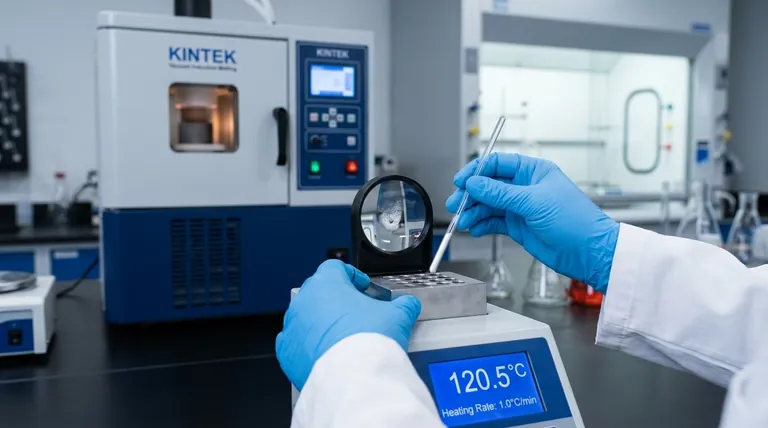
The Foundational Role of Sample Purity
The most significant factor affecting a substance's melting point is its chemical composition. The ideal melting point is a physical constant for a pure, crystalline substance.
The Melting Point of a Pure Substance
A pure, crystalline solid has a highly ordered, tightly packed crystal lattice. A specific amount of thermal energy is required to break down this stable structure.
This results in a sharp, narrow melting range, often less than 1°C, which is a hallmark of a pure compound.
How Impurities Cause Melting Point Depression
Impurities disrupt the uniform structure of the crystal lattice. This introduces defects and weakens the intermolecular forces holding the compound together.
Less energy is required to overcome these weaker forces, causing the substance to begin melting at a lower temperature than its pure form. This phenomenon is known as melting point depression.
Why Impurities Broaden the Melting Range
As the main compound begins to melt, the impurities become more concentrated in the remaining solid. This increased concentration further depresses the melting point of the remaining solid.
This process continues until all the solid is gone, resulting in a broad melting range that can span several degrees. A wide range is a classic indicator of an impure sample.
The Critical Importance of Experimental Technique
Even with a pure sample, poor technique can easily lead to inaccurate results. The goal is to ensure the temperature recorded by the thermometer is the true temperature of the sample at all times.
The Rate of Heating
This is the single most critical procedural factor. If you heat the sample too quickly, the thermometer's reading will lag behind the actual temperature of the sample.
The sample will appear to melt at a temperature higher than its true melting point, and the range will appear artificially broad because the temperature changes too fast to record the start and end points accurately. A rate of 1-2°C per minute near the expected melting point is standard for an accurate reading.
Proper Sample Preparation
The physical state of the sample in the capillary tube is crucial for uniform heat transfer.
The sample must be a dry, fine powder. Large crystals will not pack well and will heat unevenly. The powder should be packed tightly to a height of just 2-3 mm to ensure the entire sample reaches the same temperature simultaneously.
Thermometer Calibration and Placement
An uncalibrated thermometer can be a source of significant systematic error. It's essential to use a calibrated instrument or to calibrate it against known standards.
The thermometer bulb must be placed correctly next to the capillary tube, ensuring both are at the same level within the heating block. This guarantees that the temperature being measured is the temperature the sample is experiencing.
Common Pitfalls and Considerations
Understanding potential sources of error is key to interpreting your results correctly.
The Speed vs. Accuracy Dilemma
In practice, a rapid preliminary scan is often performed to find an approximate melting point. This saves time.
Once the approximate range is known, a second, separate sample is used for a slow, careful determination. You must never re-use a melted sample, as it may have decomposed.
Misinterpreting Decomposition
Some compounds do not melt but decompose upon heating. This is often accompanied by a color change, such as darkening or charring, or the evolution of gas.
It is crucial to record this observation, as a decomposition temperature is also a characteristic physical property, distinct from a melting point.
The Subjectivity of Observation
Identifying the exact moment the first drop of liquid appears (the start of the range) and the last crystal disappears (the end of the range) requires careful observation.
This introduces a small degree of human subjectivity. The best practice is to be consistent in how you define these two points across all measurements.
Making the Right Choice for Your Goal
Your experimental goal dictates the level of precision required for your melting point determination.
- If your primary focus is identifying an unknown compound: You need a sharp, narrow melting range on a purified sample to confidently match it to a literature value. A mixed melting point test is the definitive confirmation.
- If your primary focus is assessing the purity of a known substance: A depressed and broadened melting range compared to the accepted literature value is a strong indicator of the presence of impurities.
- If your primary focus is obtaining a publishable, highly accurate value: You must use a calibrated thermometer, a very slow heating rate (1°C/min), and perform multiple trials to ensure reproducibility.
Ultimately, a carefully measured melting point remains one of the most reliable and accessible tools for characterizing a solid organic compound.
Summary Table:
| Factor Category | Key Consideration | Impact on Melting Point |
|---|---|---|
| Sample Purity | Purity of crystalline solid | Pure samples melt sharply (<1°C range); impurities depress and broaden the range. |
| Experimental Technique | Heating rate (critical) | Fast heating (>1-2°C/min) causes artificially high/broad range; slow heating ensures accuracy. |
| Sample Preparation | Dry, fine powder, packed tightly | Ensures uniform heat transfer; poor preparation leads to uneven melting. |
| Instrumentation | Thermometer calibration and placement | Uncalibrated thermometers cause systematic error; correct placement ensures true sample temperature. |
Achieve precise and reliable melting point determinations in your laboratory.
At KINTEK, we specialize in high-quality lab equipment and consumables designed to support accurate thermal analysis. Whether you're identifying unknown compounds, assessing purity, or preparing samples for publication, the right tools are essential for success.
Our range of calibrated melting point apparatus and supporting supplies ensures uniform heating, precise temperature control, and reproducible results—helping you avoid common pitfalls like heating rate errors and poor sample preparation.
Let KINTEK be your partner in precision. Contact us today to discuss your specific laboratory needs and discover how our solutions can enhance the accuracy and efficiency of your melting point analyses.
Visual Guide

Related Products
- Lab-Scale Vacuum Induction Melting Furnace
- Vacuum Arc Induction Melting Furnace
- Hydrogen Determination Probe for Quickly Measuring Hydrogen Content with High Success Rate
- Non Consumable Vacuum Arc Induction Melting Furnace
- Lab Electrochemical Workstation Potentiostat for Laboratory Use
People Also Ask
- Why use VIM for rare earth steel? Essential Precision for Melting Reactive Lanthanum and Cerium
- What is the primary function of a vacuum induction melting furnace in Ni-Mo-Cr-Fe master alloy prep? Ensure High Purity
- What types of metals are typically processed in a vacuum induction melting furnace? High-Purity Alloys for Critical Applications
- What are the key components inside the vacuum chamber of a vacuum induction melting furnace? A Guide to the Core Melting Assembly
- What is the temperature range of the induction melting furnace? Find the Right Heat for Your Metals