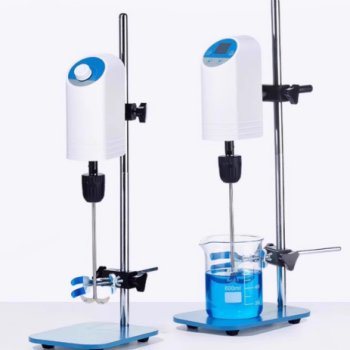
A high-pressure magnetic stirring reactor is the fundamental tool for replicating the harsh hydrothermal conditions of a nuclear primary circuit. It provides a stabilized environment of high temperature (up to 330°C) and high pressure (up to 15.5 MPa) while utilizing magnetic agitation to ensure chemical and thermal uniformity. This combination allows researchers to study material corrosion, nanoparticle dispersion, and oxide film growth under realistic service conditions.
The primary function of this reactor is to provide a stable, controlled platform that simultaneously maintains extreme physical conditions and dynamic chemical uniformity to accurately predict long-term material behavior in nuclear power environments.
Simulating the PWR Primary Circuit Environment
Achieving Precise Temperature and Pressure Control
The reactor serves as the core equipment for simulating the extreme service conditions of a Pressurized Water Reactor (PWR). It can maintain stable physical parameters, typically reaching temperatures near 315°C to 330°C and pressures up to 15.5 MPa (155 bar).
These conditions are essential for evaluating the oxidation behavior and long-term durability of nuclear-grade materials like Alloy 690TT or zirconium alloys. Without this stability, laboratory results cannot accurately reflect the actual service life of reactor components.
Replicating Coolant Chemistry and Additives
The reactor allows for the precise control of corrosion media, including the introduction of chemical solutions containing boron and lithium. This replicates the lithiated aqueous environment found in a functional primary circuit.
By maintaining these specific chemistries over exposure periods ranging from 500 hours to 60 days, researchers can observe the growth and dissolution of oxide films. This provides a high-fidelity model for how internal surfaces react to long-term chemical exposure.
The Critical Role of Magnetic Stirring
Ensuring Uniform Nanoparticle and Solute Dispersion
The integrated magnetic stirring function—often operating at speeds such as 200 rpm—is vital for keeping sacrificial agents or indicators in suspension. It ensures that nanoparticles, such as gold (Au) or palladium (Pd), remain uniformly dispersed in the deionized water.
This uniform dispersion guarantees sufficient and consistent contact between the coolant, the sacrificial agents, and the sample surface. Without active stirring, particles would settle, leading to localized reactions that skew experimental data.
Maintaining Thermal and Chemical Homogeneity
Forced convection via the magnetic stirrer ensures that temperature distribution throughout the reactor remains homogenous. This prevents "hot spots" or "cold zones" that could lead to inconsistent corrosion rates across a single specimen.
Beyond temperature, stirring promotes the mass transfer of corrosive impurities and reactants to the material surfaces. This ensures that the chemical environment at the interface of the test specimen is representative of the bulk solution.
Simulating Dynamic Fluid Flow
The stirring mechanism helps approximate the dynamic fluid flow and physical scouring experienced within industrial pipes and vessels. By driving the solution at high speeds, the reactor mimics the forced convection found in a moving primary circuit.
This "scouring" effect is critical for understanding how fluid velocity impacts the stability of protective oxide layers. It moves the laboratory simulation closer to the actual physical stresses found in a functioning nuclear power plant.
Understanding the Trade-offs and Limitations
Mechanical Wear and Seal Integrity
Operating a magnetic stirrer under high-pressure conditions introduces mechanical complexity, particularly regarding seal integrity. Constant rotation at high temperatures can accelerate the wear of bearings and seals, potentially leading to leaks or contamination of the coolant chemistry.
Static vs. Flowing System Limitations
While a stirring reactor simulates dynamic flow, it remains a closed-batch system rather than a continuous flow loop. This means that while it provides excellent local mixing, it may not perfectly capture the depletion of reactants or the accumulation of corrosion products seen in a true flowing primary circuit.
Optimizing Your Reactor Configuration for Research Goals
How to Apply This to Your Project
To achieve the most accurate simulation of a PWR environment, align your reactor's operation with your specific experimental objectives.
- If your primary focus is material corrosion kinetics: Prioritize a reactor that offers high-precision pressure and temperature stability over long durations (60+ days) to capture the slow growth of oxide films.
- If your primary focus is nanoparticle and scavenger efficiency: Focus on the magnetic stirring speed and impeller design to ensure the uniform suspension of heavy particles like gold or palladium.
- If your primary focus is chemical uniformity: Ensure the reactor design minimizes dead zones where lithium or boron concentrations might fluctuate, using high-speed agitation to maintain a homogenous solution.
Selecting the right balance of thermal stability and mechanical agitation is critical for translating laboratory findings into reliable nuclear safety data.
Summary Table:
| Key Function | Technical Specification | Research Application |
|---|---|---|
| Extreme Environment Simulation | Temp: 330°C / Pressure: 15.5 MPa | Replicates PWR primary circuit hydrothermal conditions. |
| Chemical Homogeneity | Boron & Lithium chemistry control | Maintains stable corrosion media for realistic material exposure. |
| Dynamic Fluid Simulation | Magnetic stirring (e.g., 200 rpm) | Simulates fluid scouring and ensures uniform solute dispersion. |
| Long-term Stability | 500 hours to 60 days duration | Predicts long-term oxidation behavior and material durability. |
Advance Your Nuclear Research with KINTEK Precision
Ensure the highest accuracy in your hydrothermal simulations with KINTEK’s specialized laboratory equipment. We provide researchers with robust high-temperature high-pressure reactors and autoclaves designed specifically for the demanding conditions of nuclear material testing.
Beyond reactors, KINTEK offers a comprehensive portfolio including:
- Advanced Thermal Systems: Muffle, tube, vacuum, and CVD furnaces.
- Sample Preparation: Crushing and milling systems, sieving equipment, and hydraulic presses.
- Electrochemical Tools: High-performance electrolytic cells and electrodes.
- Laboratory Essentials: PTFE products, ceramics, crucibles, and cooling solutions.
Contact our technical experts today to find the perfect configuration for your PWR simulation or material science project. Let KINTEK deliver the reliability and precision your research deserves.
References
- Yeon Ju Lee, Young‐Sang Youn. Decreasing Hydrogen Content within Zirconium Using Au and Pd Nanoparticles as Sacrificial Agents under Pressurized Water at High Temperature. DOI: 10.3390/ma16186164
This article is also based on technical information from Kintek Solution Knowledge Base .
Related Products
- Customizable High Pressure Reactors for Advanced Scientific and Industrial Applications
- Customizable Laboratory High Temperature High Pressure Reactors for Diverse Scientific Applications
- Laboratory Small Constant Temperature Heated Magnetic Stirrer Heater and Stirrer
- Mini SS High Pressure Autoclave Reactor for Laboratory Use
- High Performance Laboratory Stirrers for Diverse Applications
People Also Ask
- What is the function of high-pressure reactors in the synthesis of MFI-type zeolites? Master Dry Gel Conversion.
- Graphene Fiber Synthesis: Key High-Pressure Reactor Processing Conditions Explained
- What reactor is used for high pressure reactions? Select the Right Autoclave for Your Lab
- What is the primary function of a high-pressure reactor in NiMoO4 preparation? Optimize Hydrothermal Catalyst Synthesis
- What are the hazards of high pressure reactors? A Guide to Managing Explosive Risks