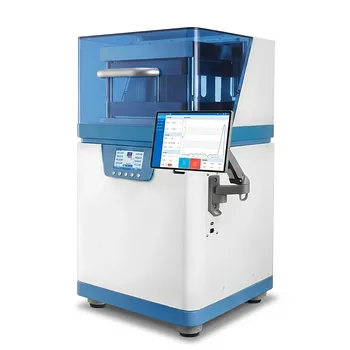
The primary function of a high-pressure reactor in preparing $\text{NiMoO}_4$ nanorod precursors is to provide a sealed, high-temperature environment that enables the hydrothermal synthesis of structured nanomaterials. By allowing the reaction to occur at temperatures well above the boiling point of the solvent, the reactor facilitates uniform nucleation and oriented growth, which are essential for forming stable, free-standing nanorod arrays on substrates like nickel foam.
Core Takeaway: The high-pressure reactor acts as a thermodynamic catalyst, creating the specific "superheated" conditions necessary for raw precursors to dissolve and recrystallize into precise, high-surface-area nanorod morphologies that serve as the foundation for NiMoN catalysts.
The Role of the Hydrothermal Environment
Operating Beyond the Boiling Point
In a standard open vessel, the reaction temperature is limited by the solvent's boiling point. The high-pressure reactor circumvents this by maintaining a sealed environment, allowing the liquid to reach temperatures—often around 150°C to 160°C—where chemical kinetics are significantly enhanced.
Generating Autogenous Pressure
As the temperature rises within the sealed vessel, it creates autogenous pressure. This pressure is critical for forcing the precursor solution into the pores of substrates like nickel foam or carbon cloth, ensuring that the nanorods grow in-situ and remain structurally attached to the base material.
Driving Morphological Precision
Facilitating Oriented Crystal Growth
The high-pressure environment allows metal ions to arrange themselves along specific crystal planes. This directional arrangement is what transforms a simple chemical mixture into a highly ordered nanorod array, which provides a much larger specific surface area than bulk materials.
Promoting Dissolution and Recrystallization
Under these extreme conditions, the raw material powders undergo a process of thorough dissolution and recrystallization. This cycle ensures that the resulting $\text{NiMoO}_4$ precursors have high crystallinity and the specific rod-like shape required for subsequent treatments, such as sulfidation or nitridation.
Understanding the Trade-offs
Technical Limitations and Safety
While high-pressure reactors are essential for morphology control, they require precise monitoring of temperature and pressure to prevent vessel failure. The sealed nature of the process also means that real-time adjustments to the chemical composition are impossible once the reaction has started.
Scalability and Energy Costs
Hydrothermal synthesis is often a batch process that can take several hours (typically 6 hours or more) to complete. This leads to higher energy consumption and lower throughput compared to continuous flow methods, making it a more expensive option for large-scale industrial production.
How to Apply This to Your Project
When utilizing a high-pressure reactor for catalyst preparation, your approach should vary based on your specific research or production requirements:
- If your primary focus is Maximum Surface Area: Prioritize longer reaction times at a constant 150°C to ensure the full development of vertical nanorod arrays that maximize the exposure of active sites.
- If your primary focus is Structural Stability: Ensure the substrate (such as nickel foam) is properly pre-treated to allow the autogenous pressure to facilitate deep penetration and strong adhesion of the nanorods to the surface.
- If your primary focus is High Crystallinity: Focus on the cooling rate after the hydrothermal process; a slow, controlled return to room temperature can often improve the single-crystal structure of the resulting nanowires or rods.
The high-pressure reactor is the indispensable tool that transforms chemical precursors into the sophisticated, high-performance architectures required for modern catalysis.
Summary Table:
| Feature | Benefit in Synthesis | Impact on NiMoO4 Nanorods |
|---|---|---|
| Sealed Environment | Enables temperatures above boiling point | Accelerates chemical kinetics & dissolution |
| Autogenous Pressure | Forces solution into substrate pores | Ensures stable, in-situ growth on nickel foam |
| Oriented Growth | Precise control over crystal planes | Creates high-surface-area nanorod arrays |
| Recrystallization | High-temperature dissolution cycle | Results in high crystallinity and rod morphology |
Elevate Your Catalyst Research with KINTEK Precision
Achieving the perfect nanorod morphology requires uncompromising control over temperature and pressure. KINTEK specializes in advanced laboratory solutions, offering a premium range of high-temperature high-pressure reactors and autoclaves specifically designed for hydrothermal synthesis and material recrystallization.
Whether you are developing NiMoN catalysts, exploring battery research tools, or utilizing our high-purity ceramics and crucibles, our equipment ensures the structural stability and uniform growth your project demands. Don't settle for inconsistent results—contact our experts today to find the ideal reactor configuration for your laboratory.
References
- Minghui Ning, Zhifeng Ren. Hierarchical Interconnected NiMoN with Large Specific Surface Area and High Mechanical Strength for Efficient and Stable Alkaline Water/Seawater Hydrogen Evolution. DOI: 10.1007/s40820-023-01129-y
This article is also based on technical information from Kintek Solution Knowledge Base .
Related Products
- Customizable Laboratory High Temperature High Pressure Reactors for Diverse Scientific Applications
- Customizable High Pressure Reactors for Advanced Scientific and Industrial Applications
- Stainless High Pressure Autoclave Reactor Laboratory Pressure Reactor
- Mini SS High Pressure Autoclave Reactor for Laboratory Use
- Visual High-Pressure Reactor for In-Situ Observation
People Also Ask
- How do high-pressure and high-temperature reactors ensure the effective treatment of lignocellulosic wastewater in WAO?
- What equipment is required for high-pressure high-temperature reactions? Master Extreme Chemistry Safely
- How do you control high pressure in a reactor? A Guide to Safe & Stable Operation
- How does initial oxygen pressure affect the wet oxidation of pharmaceutical sludge? Master Your Oxidation Depth
- Why is argon better than nitrogen for inert atmosphere? Ensure Absolute Reactivity & Stability