Knowledge What are the roles of sintering additives? Master the Process for Superior Material Performance
Author avatar

Tech Team · Kintek Solution

Updated 4 days ago

What are the roles of sintering additives? Master the Process for Superior Material Performance


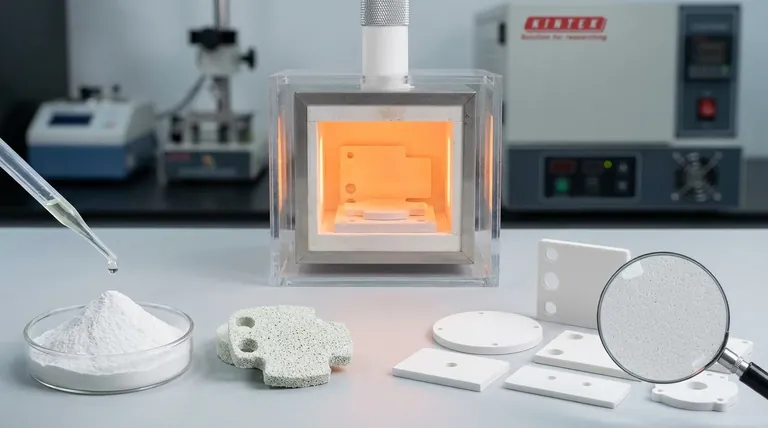
In short, sintering additives are strategically chosen materials that fundamentally alter the sintering process to achieve specific outcomes. Their primary roles are to reduce the required temperature and time for sintering and to precisely control the final microstructure and density of the component, thereby determining its ultimate performance characteristics.

Sintering additives are not passive fillers; they are active agents used by materials engineers to control the physics of the sintering process, enabling the creation of advanced materials with properties that would otherwise be unattainable.
What are the roles of sintering additives? Master the Process for Superior Material Performance

How Additives Control the Sintering Process

Sintering joins powder particles together through heat, but the process can be slow, require extreme temperatures, or result in a weak, porous structure. Additives are the tools used to overcome these limitations.

Activating the Sintering Mechanism

Many high-performance materials, like advanced ceramics or refractory metals, have exceptionally high melting points. Sintering them directly would require immense energy and time.

Additives can create a liquid phase that melts at a lower temperature than the primary material. This liquid acts as a rapid transport path, dissolving particles and re-precipitating them to quickly fill the gaps and densify the part. This is known as liquid phase sintering.

Other additives work in the solid state by creating defects in the material's crystal lattice. These defects dramatically increase the rate of atomic diffusion—the movement of atoms—which is the fundamental mechanism behind solid-state sintering.

Controlling Microstructure and Grain Growth

The final properties of a sintered part, such as hardness, toughness, and strength, are dictated by its microstructure, particularly the size of its crystalline grains.

During sintering, grains naturally tend to grow larger, which can often make the material more brittle. Grain growth inhibitors are additives that segregate to the boundaries between grains, physically "pinning" them and preventing them from growing too large. This results in a fine-grained, stronger final product.

Enhancing Final Density

Porosity is the enemy of mechanical performance. Pores are microscopic voids left between the initial powder particles that act as stress concentrators and fracture initiation sites.

Additives aid in densification by accelerating the mechanisms that close these pores. By promoting atomic transport or creating a liquid phase, they help pull particles together more effectively, leading to a denser, stronger, and more reliable component.

Understanding the Trade-offs and Risks

While powerful, the use of sintering additives requires careful control. The wrong additive or an incorrect amount can be detrimental to the final product.

Potential for Undesirable Phases

The additive itself can react with the primary material to form brittle or weak secondary phases, often at the critical grain boundaries. These phases can severely compromise the mechanical or chemical properties of the component.

Contamination and Purity Concerns

For applications requiring high purity, such as in electronics or medical implants, the additive is by definition a contaminant. Its presence can negatively affect properties like electrical conductivity, thermal conductivity, or biocompatibility.

The "Too Much of a Good Thing" Problem

There is always an optimal concentration for an additive. Adding too little may have no effect, while adding too much can lead to negative consequences. For example, an excess of a liquid phase former can lead to slumping or distortion of the part, while too much of a grain growth inhibitor can sometimes form clusters that act as defects.

Selecting the Right Additive Strategy

The choice of additive is entirely dependent on the desired outcome for the final component. Your selection should be guided by your primary engineering goal.

  • If your primary focus is reducing cost and processing time: Prioritize additives that enable liquid phase sintering or act as diffusion activators to lower the required temperature and shorten the cycle.
  • If your primary focus is maximizing mechanical strength and hardness: Select grain growth inhibitors that will ensure a fine-grained, robust microstructure.
  • If your primary focus is achieving maximum density and eliminating porosity: Choose additives known to promote efficient mass transport and pore closure for your specific material system.

Ultimately, mastering the use of sintering additives is a key step in transforming raw powders into high-performance engineered components.

Summary Table:

Role of Sintering Additives Key Benefit
Activate Sintering Lowers required temperature & time via liquid phase or diffusion.
Control Microstructure Inhibits grain growth for a finer, stronger final structure.
Enhance Final Density Promotes pore closure for improved mechanical properties.

Ready to optimize your sintering process? KINTEK provides the advanced lab equipment and consumables you need to precisely control material properties. Whether you're developing ceramics, metals, or advanced composites, our solutions help you achieve superior density, strength, and performance. Contact our experts today to discuss your specific application!

Visual Guide

What are the roles of sintering additives? Master the Process for Superior Material Performance Visual Guide

Related Products

People Also Ask

Related Products

Custom-Made Alumina Zirconia Special-Shaped Ceramic Plates for Engineering Advanced Fine Ceramics Processing

Custom-Made Alumina Zirconia Special-Shaped Ceramic Plates for Engineering Advanced Fine Ceramics Processing

Alumina ceramics have good electrical conductivity, mechanical strength and high temperature resistance, while zirconia ceramics are known for their high strength and high toughness and are widely used.

Small Vacuum Heat Treat and Tungsten Wire Sintering Furnace

Small Vacuum Heat Treat and Tungsten Wire Sintering Furnace

The small vacuum tungsten wire sintering furnace is a compact experimental vacuum furnace specially designed for universities and scientific research institutes. The furnace features a CNC welded shell and vacuum piping to ensure leak-free operation. Quick-connect electrical connections facilitate relocation and debugging, and the standard electrical control cabinet is safe and convenient to operate.

Precision Machined Zirconia Ceramic Ball for Engineering Advanced Fine Ceramics

Precision Machined Zirconia Ceramic Ball for Engineering Advanced Fine Ceramics

zirconia ceramic ball have the characteristics of high strength, high hardness, PPM wear level, high fracture toughness, good wear resistance, and high specific gravity.

Metallographic Specimen Mounting Machine for Laboratory Materials and Analysis

Metallographic Specimen Mounting Machine for Laboratory Materials and Analysis

Precision metallographic mounting machines for labs—automated, versatile, and efficient. Ideal for sample prep in research and quality control. Contact KINTEK today!

Single Punch Electric Tablet Press Machine Laboratory Powder Tablet Punching TDP Tablet Press

Single Punch Electric Tablet Press Machine Laboratory Powder Tablet Punching TDP Tablet Press

The single-punch electric tablet press is a laboratory-scale tablet press suitable for corporate laboratories in pharmaceutical, chemical, food, metallurgical and other industries.

No Demolding Lab Infrared Press Mold for Laboratory Applications

No Demolding Lab Infrared Press Mold for Laboratory Applications

Effortlessly test your samples with no demolding required using our lab infrared press mold. Enjoy high transmittance and customizable sizes for your convenience.

Manual High Temperature Heated Hydraulic Press Machine with Heated Plates for Lab

Manual High Temperature Heated Hydraulic Press Machine with Heated Plates for Lab

The High Temperature Hot Press is a machine specifically designed for pressing, sintering and processing materials in a high temperature environment. It is capable of operating in the range of hundreds of degrees Celsius to thousands of degrees Celsius for a variety of high temperature process requirements.

High-Purity Titanium Foil and Sheet for Industrial Applications

High-Purity Titanium Foil and Sheet for Industrial Applications

Titanium is chemically stable, with a density of 4.51g/cm3, which is higher than aluminum and lower than steel, copper, and nickel, but its specific strength ranks first among metals.

Zirconia Ceramic Gasket Insulating Engineering Advanced Fine Ceramics

Zirconia Ceramic Gasket Insulating Engineering Advanced Fine Ceramics

Zirconia insulating ceramic gasket has high melting point, high resistivity, low thermal expansion coefficient and other properties, making it an important high temperature resistant material, ceramic insulating material and ceramic sunscreen material.

Warm Isostatic Press for Solid State Battery Research

Warm Isostatic Press for Solid State Battery Research

Discover the advanced Warm Isostatic Press (WIP) for semiconductor lamination. Ideal for MLCC, hybrid chips, and medical electronics. Enhance strength and stability with precision.

Automatic High Temperature Heated Hydraulic Press Machine with Heated Plates for Lab

Automatic High Temperature Heated Hydraulic Press Machine with Heated Plates for Lab

The High Temperature Hot Press is a machine specifically designed for pressing, sintering and processing materials in a high temperature environment. It is capable of operating in the range of hundreds of degrees Celsius to thousands of degrees Celsius for a variety of high temperature process requirements.

Electric Split Lab Cold Isostatic Press CIP Machine for Cold Isostatic Pressing

Electric Split Lab Cold Isostatic Press CIP Machine for Cold Isostatic Pressing

Split cold isostatic presses are capable of providing higher pressures, making them suitable for testing applications that require high pressure levels.

Heated Hydraulic Press Machine with Heated Plates for Vacuum Box Laboratory Hot Press

Heated Hydraulic Press Machine with Heated Plates for Vacuum Box Laboratory Hot Press

Enhance your lab's precision with our lab press for vacuum box. Press pills and powders with ease and precision in a vacuum environment, reducing oxidation and improving consistency. Compact and easy to use with a digital pressure gauge.

Graphite Vacuum Continuous Graphitization Furnace

Graphite Vacuum Continuous Graphitization Furnace

High-temperature graphitization furnace is a professional equipment for graphitization treatment of carbon materials. It is a key equipment for the production of high-quality graphite products. It has high temperature, high efficiency and uniform heating. It is suitable for various high-temperature treatments and graphitization treatments. It is widely used in metallurgy, electronics, aerospace, etc. industry.

Laboratory Hydraulic Press Lab Pellet Press for Button Battery

Laboratory Hydraulic Press Lab Pellet Press for Button Battery

Efficiently prepare samples with our 2T Button Battery Press. Ideal for material research labs and small-scale production. Small footprint, lightweight, and vacuum-compatible.

Electric Lab Cold Isostatic Press CIP Machine for Cold Isostatic Pressing

Electric Lab Cold Isostatic Press CIP Machine for Cold Isostatic Pressing

Produce dense, uniform parts with improved mechanical properties with our Electric Lab Cold Isostatic Press. Widely used in material research, pharmacy, and electronic industries. Efficient, compact, and vacuum-compatible.

Warm Isostatic Press WIP Workstation 300Mpa for High Pressure Applications

Warm Isostatic Press WIP Workstation 300Mpa for High Pressure Applications

Discover Warm Isostatic Pressing (WIP) - A cutting-edge technology that enables uniform pressure to shape and press powdered products at a precise temperature. Ideal for complex parts and components in manufacturing.

Double Plate Heating Press Mold for Lab

Double Plate Heating Press Mold for Lab

Discover precision in heating with our Double Plate Heating Mold, featuring high-quality steel and uniform temperature control for efficient lab processes. Ideal for various thermal applications.

Lab Infrared Press Mold

Lab Infrared Press Mold

Easily release samples from our lab infrared press mold for accurate testing. Ideal for battery, cement, ceramics, and other sample preparation research. Customizable sizes available.

Laboratory Disc Rotary Mixer for Efficient Sample Mixing and Homogenization

Laboratory Disc Rotary Mixer for Efficient Sample Mixing and Homogenization

Efficient Laboratory Disc Rotary Mixer for Precise Sample Mixing, Versatile for Various Applications, DC Motor and Microcomputer Control, Adjustable Speed and Angle.


Leave Your Message