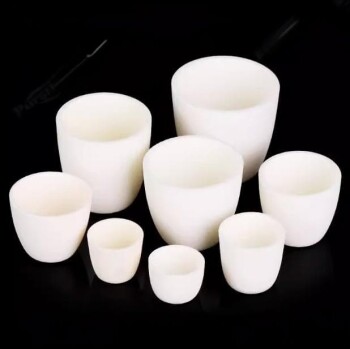
High-purity alumina crucibles are the preferred choice for battery black mass analysis due to their exceptional thermal stability and chemical inertness at temperatures up to 1000°C. However, technical success depends on maintaining temperatures strictly below 1100°C, as cathode particles within the black mass can react with the alumina material at higher thresholds, compromising both the sample and the crucible.
High-purity alumina provides a chemically neutral environment that ensures experimental data reflects only the sample's behavior, but users must manage the critical thermal limit of 1100°C to prevent unwanted chemical reactions between the cathode material and the container.
Maintaining Chemical Purity and Sample Integrity
Resistance to Reducing Agents and Oxides
High-purity alumina is selected because it does not react with reducing agents like H2 or various metal oxides during the reduction of spent lithium battery powders. This inertness prevents the introduction of external impurities, ensuring that the recovered product remains high-purity.
Prevention of Cross-Contamination
During high-temperature cycling, these crucibles act as a barrier between the black mass specimen and the furnace interior. By preventing direct contact, they protect the furnace sensors and heating elements from potential chemical erosion caused by acidic or alkaline mineral components.
Ensuring Precise Gravimetric Data
Collection of Spalled Materials
In oxidation and thermal performance experiments, alumina crucibles are essential for collecting corrosion product fragments and spalled oxide scales. This containment ensures that any measured mass loss is derived solely from the sample's reaction, rather than the loss of material to the furnace floor.
Stability Under Load
High-purity alumina possesses high structural strength, allowing the crucible to maintain its shape even when supporting heavy pack-cementation mixtures. This structural reliability ensures that the atmosphere within the container remains uniformly distributed during prolonged heat treatments.
Understanding the Trade-offs and Limits
The 1100°C Reactive Threshold
The most significant technical constraint is the temperature ceiling; while alumina is highly refractory, cathode particles begin to react with the crucible material at temperatures exceeding 1100°C. Exceeding this limit leads to sample contamination and potential permanent damage to the crucible through chemical bonding.
Thermal Shock and Fluctuations
While alumina resists drastic temperature fluctuations better than many ceramics, it is still a brittle material. Rapid heating or cooling cycles must be managed carefully to avoid structural fatigue, even if the material remains chemically inert during the process.
How to Apply This to Your Project
Recommendations for High-Temperature Analysis
Before beginning your analysis, identify your primary experimental goal to determine the best handling procedure for alumina consumables.
- If your primary focus is pure material recovery: Keep temperatures within a safe range of 850°C to 1000°C to ensure zero interaction between the alumina and the metal oxides.
- If your primary focus is gravimetric accuracy (mass change): Ensure the crucible is pre-fired and cleaned to prevent any residual moisture or contaminants from skewing the initial weight.
- If your primary focus is equipment longevity: Never exceed the 1100°C limit when cathode particles are present to prevent "glassing" or bonding of the sample to the crucible walls.
By strictly respecting the chemical limits of alumina in the presence of cathode materials, you ensure the highest level of data reliability and sample purity.
Summary Table:
| Key Factor | Technical Specification | Benefit for Black Mass Analysis |
|---|---|---|
| Temperature Limit | Strictly < 1100°C | Prevents chemical reactions between cathode particles and crucible material. |
| Chemical Stability | Resistant to $H_2$ and metal oxides | Ensures high-purity recovery and prevents sample contamination. |
| Structural Strength | High load-bearing capacity | Maintains shape and uniform atmosphere during prolonged heat treatments. |
| Thermal Stability | Stable up to 1000°C | Provides a chemically neutral environment for reliable gravimetric data. |
| Equipment Safety | Protective barrier | Guards furnace sensors and heating elements against chemical erosion. |
Elevate your battery research with KINTEK’s precision-engineered laboratory solutions. We specialize in high-performance consumables and equipment, including high-purity alumina crucibles, ceramic components, and specialized battery research tools designed for rigorous high-temperature analysis. Whether you need advanced high-temperature furnaces or precise crushing and milling systems, our team is ready to support your quest for material purity and data reliability. Contact our experts today to find the perfect tools for your black mass analysis and material recovery projects!
References
- Luis Arturo Gomez-Moreno, Rodrigo Serna-Guerrero. A simple methodology for the quantification of graphite in end-of-life lithium-ion batteries using thermogravimetric analysis. DOI: 10.1016/j.isci.2023.107782
This article is also based on technical information from Kintek Solution Knowledge Base .
Related Products
- Engineering Advanced Fine Ceramics Alumina Crucibles (Al2O3) for Thermal Analysis TGA DTA
- Engineering Advanced Fine Ceramics Alumina Al2O3 Crucible With Lid Cylindrical Laboratory Crucible
- Engineering Advanced Fine Alumina Al2O3 Ceramic Crucible for Laboratory Muffle Furnace
- Arc-Shaped Alumina Ceramic Crucible High Temperature Resistant for Engineering Advanced Fine Ceramics
- High Purity Pure Graphite Crucible for Electron Beam Evaporation
People Also Ask
- Why Use Alumina Crucibles for TGA of Bicyclic Carbonates? Ensure Data Purity & Chemical Inertness
- Why are alumina crucibles and mother powder essential for LATP sintering? Optimize Your Solid Electrolyte Performance
- Why are high-purity alumina crucibles used for liquid lead corrosion experiments? Ensure Data Accuracy at 550°C
- What is the primary purpose of using alumina crucibles for LLTO ceramics? Optimize Your High-Temperature Sintering
- Why Use Alumina Crucibles & Powder Burial for NaSICON? Ensure Phase Purity and Prevent Elemental Volatilization