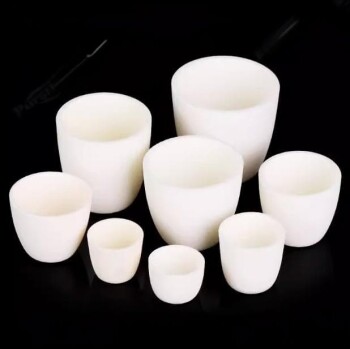
The primary function of alumina crucibles during the high-temperature sintering of Lithium Lanthanum Titanate (LLTO) is to facilitate a controlled, lithium-rich environment that prevents material degradation. Used specifically in conjunction with a powder-bedding technique, the crucible acts as a containment vessel to suppress the rapid volatilization of lithium at temperatures around 1200°C.
Core Insight High-temperature sintering poses a critical risk of lithium evaporation, which destroys the chemical balance of the ceramic. The alumina crucible creates a closed system that traps lithium vapors, preserving the material's stoichiometry, phase purity, and ionic conductivity.
The Critical Role of Atmosphere Control
The Volatility Challenge
At sintering temperatures of 1200°C, lithium components within the ceramic are highly volatile. Without physical containment, lithium evaporates rapidly from the material surface.
Creating a Closed System
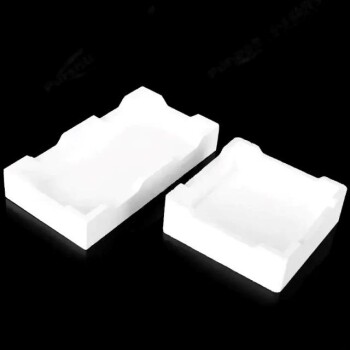
The alumina crucible serves as a physical barrier that defines the immediate atmosphere around the sample. By enclosing the sample, it prevents the lithium vapors from dissipating into the larger furnace chamber.
The Powder-Bedding Synergy
According to standard protocols, the crucible is used with a powder-bedding technique. This involves surrounding the sample with "mother powder" (sacrificial powder of similar composition) inside the crucible.
Impact on Material Performance
Preventing Component Segregation
When lithium evaporates, the remaining material suffers from compositional segregation. The stoichiometry shifts, leading to an imbalance in the chemical formula of the LLTO.
Suppressing Secondary Phases
If the stoichiometry changes due to lithium loss, unwanted secondary phases begin to form. These impurities disrupt the crystal structure of the ceramic.
Ensuring Ionic Conductivity
The ultimate goal of LLTO ceramics is high ionic conductivity. By preventing lithium loss and secondary phase formation, the alumina crucible ensures the electrolyte retains its conductive properties.
Understanding the Trade-offs
Potential for Reactivity
While alumina provides excellent high-temperature resistance, it is not chemically inert in all scenarios. Direct contact between lithium-rich pellets and the alumina wall can sometimes lead to sticking or reaction. The powder-bedding technique helps mitigate this by acting as a buffer between the sample and the crucible walls.
Thermal Stress Management
Alumina crucibles are robust, but they can be susceptible to thermal shock if heating or cooling rates are too aggressive. Users must ensure the thermal profile of the furnace does not exceed the mechanical limits of the crucible to prevent cracking during the 1200°C cycle.
Making the Right Choice for Your Goal
To ensure the success of your LLTO sintering process, consider the following:
- If your primary focus is Phase Purity: Ensure the alumina crucible is used in conjunction with a sufficient quantity of mother powder to maintain a saturated lithium atmosphere.
- If your primary focus is Structural Integrity: Verify that the sample is fully buried or separated from the crucible walls to prevent reaction-induced sticking or warping.
- If your primary focus is Repeatability: Use a crucible with a fitted lid to minimize vapor leakage and maintain a consistent internal pressure of lithium vapor.
Effective sintering is not just about temperature; it is about creating a micro-environment that preserves the delicate chemistry of your material.
Summary Table:
| Feature | Function in LLTO Sintering | Impact on Material Quality |
|---|---|---|
| Atmosphere Control | Encloses lithium vapors within a closed system | Preserves stoichiometry and chemical balance |
| Powder-Bedding | Acts as a sacrificial buffer (mother powder) | Prevents lithium evaporation from the sample |
| Physical Barrier | Prevents direct contact with furnace environment | Suppresses the formation of unwanted secondary phases |
| Material Stability | Provides high-temperature resistance at 1200°C | Ensures structural integrity and high ionic conductivity |
Elevate Your Advanced Ceramic Research with KINTEK
Precision in high-temperature sintering requires more than just heat—it requires the right environment. KINTEK specializes in premium laboratory equipment and high-purity consumables designed for the most demanding applications.
Whether you are developing solid-state electrolytes like LLTO or conducting battery research, we provide the tools you need for success:
- High-Purity Alumina & Ceramic Crucibles: Engineered for thermal stability and chemical resistance.
- Advanced Muffle & Tube Furnaces: Precise temperature control for volatile sintering processes.
- Crushing, Milling & Hydraulic Presses: For consistent pellet preparation and mother-powder production.
- Comprehensive Battery Solutions: From electrolytic cells to specialized cooling solutions like ULT freezers.
Don't let lithium volatilization compromise your results. Contact KINTEK today to discover how our high-performance laboratory solutions can ensure the stoichiometry and ionic conductivity of your materials.
Related Products
- Arc-Shaped Alumina Ceramic Crucible High Temperature Resistant for Engineering Advanced Fine Ceramics
- Alumina Al2O3 Ceramic Crucible Semicircle Boat with Lid for Engineering Advanced Fine Ceramics
- Engineering Advanced Fine Ceramics Alumina Al2O3 Crucible With Lid Cylindrical Laboratory Crucible
- Engineering Advanced Fine Ceramics Alumina Crucibles (Al2O3) for Thermal Analysis TGA DTA
- Engineering Advanced Fine Alumina Al2O3 Ceramic Crucible for Laboratory Muffle Furnace
People Also Ask
- Why Use Alumina Crucibles & Powder Burial for NaSICON? Ensure Phase Purity and Prevent Elemental Volatilization
- Why are alumina crucibles and mother powder essential for LATP sintering? Optimize Your Solid Electrolyte Performance
- Why are high-purity alumina crucibles used for liquid lead corrosion experiments? Ensure Data Accuracy at 550°C
- Primary considerations for choosing alumina crucibles and quartz tubes in indium intercalation: Ensure Material Purity
- Why is an alumina crucible selected for the CaCl2-NaCl molten salt system? Ensure High Purity and Thermal Stability