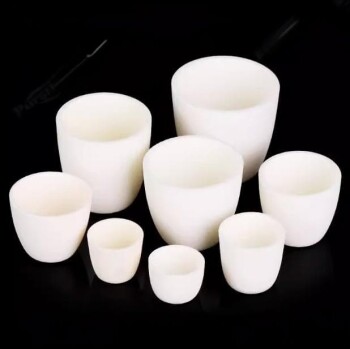
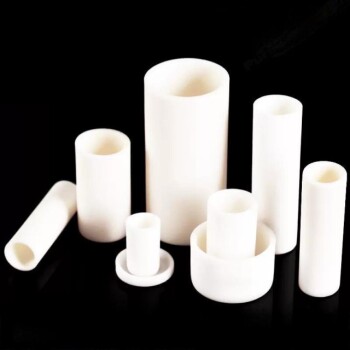
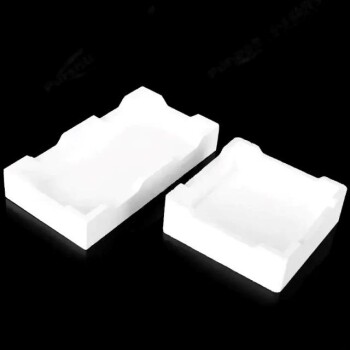
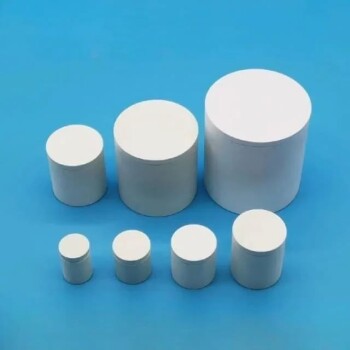
High-purity alumina crucibles serve as essential chemical isolation barriers. In static exposure tests, they function as inert liners that physically separate the liquid test medium (such as liquid lead) from the stainless steel walls of the autoclave. This isolation prevents the corrosive medium from reacting with the pressure vessel itself, ensuring the chemical composition of the environment remains pure.
The core purpose of the alumina liner is to eliminate experimental noise. By preventing interaction between the liquid lead and the autoclave walls, it ensures that any observed corrosion is strictly a result of the interaction between the test specimen (e.g., T91 steel) and the environment, devoid of external contamination.
Ensuring Data Integrity
The primary challenge in static exposure tests involves distinguishing between genuine specimen corrosion and artifacts caused by the testing equipment.
Preventing Cross-Contamination
Stainless steel autoclaves are necessary for withstanding high pressure, but they are chemically reactive in aggressive environments like liquid lead.
Without a liner, the liquid lead would attack the stainless steel walls. This reaction would dissolve elements from the autoclave into the liquid.
High-purity alumina (Al₂O₃) effectively blocks this interaction. It acts as a shield, ensuring the liquid lead interacts only with the target specimen.
Isolating the Corrosion Mechanism
To accurately study how T91 steel behaves in liquid lead, the chemistry of the lead must remain constant.
If the autoclave walls corrode, the dissolved byproducts alter the chemical aggressiveness of the lead.
Using an alumina crucible guarantees that the observed oxidation and corrosion behaviors are intrinsic to the specimen, not a side effect of a changing environment.
Material Advantages of Alumina
Alumina is selected not just for isolation, but for its stability under extreme conditions.
Chemical Inertness
High-purity alumina is chemically neutral relative to many aggressive media and metal alloys.
It does not react with Fe-Cr-Al Oxide Dispersion Strengthened (ODS) alloys, even at high temperatures. This neutrality prevents the liner from becoming a variable in the experiment.
Thermal and Mass Stability
These tests often occur at extreme temperatures, such as 1200°C. Alumina retains its structural integrity without degrading in this heat.
Furthermore, it maintains a stable mass throughout the experiment.
This is critical for gravimetric analysis, where scientists measure minute mass changes in the alloy specimens to quantify oxidation. If the container itself lost mass, the data would be compromised.
Understanding the Constraints
While alumina is excellent for chemical isolation, it introduces physical limitations that must be managed.
Mechanical Fragility
Unlike the stainless steel autoclave, alumina is a ceramic and is inherently brittle.
It effectively resists chemical attack but has low resistance to mechanical impact or rapid thermal shock.
Purity Requirements
The effectiveness of the liner is dependent on the purity of the Al₂O₃.
Lower-grade alumina may contain binders or impurities. These can leach into the test environment at high temperatures, reintroducing the very contamination issues the liner was meant to solve.
Making the Right Choice for Your Goal
Using an alumina liner is a strategic decision to balance mechanical containment with chemical precision.
- If your primary focus is chemical accuracy: Use high-purity alumina liners to completely decouple the test environment from the vessel metallurgy.
- If your primary focus is gravimetric measurement: Rely on alumina’s mass stability to ensure that weight changes are exclusively attributable to the specimen's oxidation.
Ultimately, the alumina crucible acts as the guardian of your chemical baseline, allowing the stainless steel autoclave to focus solely on pressure containment.
Summary Table:
| Feature | High-Purity Alumina (Al₂O₃) | Stainless Steel Autoclave |
|---|---|---|
| Primary Function | Chemical isolation & specimen container | Pressure containment & structural support |
| Chemical Reactivity | Inert (prevents liquid lead interaction) | Reactive (susceptible to corrosion/dissolution) |
| Thermal Stability | Maintains integrity & mass up to 1200°C+ | Subject to oxidation at high temperatures |
| Mechanical Properties | Brittle (low impact resistance) | Ductile & high strength |
| Impact on Data | Eliminates experimental noise/artifacts | Potential source of cross-contamination |
Precision Results Start with Superior Materials
At KINTEK, we understand that your research depends on the integrity of your experimental environment. Whether you are conducting corrosion studies in liquid lead or high-temperature oxidation tests, our high-purity alumina crucibles and ceramic components provide the chemical baseline you need.
From high-temperature high-pressure reactors and autoclaves to advanced crushing, milling, and sieving equipment, KINTEK specializes in empowering laboratory breakthroughs. We offer a comprehensive range of solutions for material science, including:
- Heating Solutions: Muffle, tube, vacuum, and atmosphere furnaces.
- Sample Prep: Hydraulic presses (pellet, isostatic), ceramic crucibles, and PTFE products.
- Advanced Research: CVD/PECVD systems, battery research tools, and electrolytic cells.
Don't let vessel contamination compromise your data. Contact KINTEK today to find the perfect high-purity liners and lab equipment tailored to your specific research requirements!
References
- Anna Hojná, Vít Jan. Effect of Applied Stress on T91 Steel Performance in Liquid Lead at 400 °C. DOI: 10.3390/ma11122512
This article is also based on technical information from Kintek Solution Knowledge Base .
Related Products
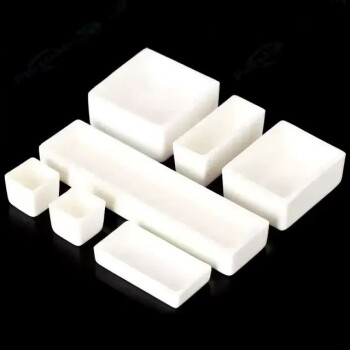
- Arc-Shaped Alumina Ceramic Crucible High Temperature Resistant for Engineering Advanced Fine Ceramics
- High Purity Alumina Granulated Powder for Engineering Advanced Fine Ceramics
- High Purity Pure Graphite Crucible for Evaporation
- Engineering Advanced Fine Alumina Al2O3 Ceramic Crucible for Laboratory Muffle Furnace
- High Purity Pure Graphite Crucible for Electron Beam Evaporation
People Also Ask
- Why Use Alumina Crucibles & Powder Burial for NaSICON? Ensure Phase Purity and Prevent Elemental Volatilization
- What is the primary purpose of using alumina crucibles for LLTO ceramics? Optimize Your High-Temperature Sintering
- Why are alumina crucibles and mother powder essential for LATP sintering? Optimize Your Solid Electrolyte Performance
- Why are high-purity alumina crucibles used for liquid lead corrosion experiments? Ensure Data Accuracy at 550°C
- Primary considerations for choosing alumina crucibles and quartz tubes in indium intercalation: Ensure Material Purity