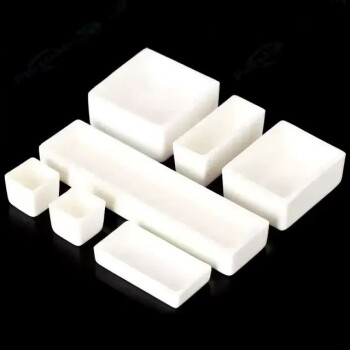
The primary advantage of selecting an alumina crucible for Thermogravimetric Analysis (TGA) lies in its unique combination of high thermal conductivity and chemical inertness. These vessels facilitate rapid, uniform heat transfer to the sample while ensuring the container itself does not interfere with the weight measurements, which is the fundamental metric of TGA experiments.
Core Takeaway Success in TGA relies on isolating the sample's behavior from experimental artifacts. Alumina crucibles provide the necessary thermal and chemical neutrality to ensure that observed mass changes correspond strictly to the analyte's decomposition, particularly in kinetic studies.
Ensuring Data Integrity Through Thermal Properties
Rapid Heat Transfer
For TGA data to be valid, the temperature recorded by the instrument must match the actual temperature of the sample. Alumina offers excellent thermal conductivity, allowing heat to flow quickly from the furnace environment to the biomass or analyte inside the crucible.
Uniform Temperature Distribution
Uneven heating can cause different parts of a sample to decompose at different rates, skewing results. Alumina crucibles ensure that heat is distributed uniformly throughout the interior of the sample during programmed temperature increases.
Accuracy of Kinetic Data
The precision of pyrolysis reaction kinetic data depends on the exact correlation between temperature and mass loss. By minimizing thermal lag and gradients, alumina crucibles allow researchers to capture accurate kinetic data essential for modeling thermal decomposition.
Chemical and Physical Stability
Inertness to Analytes
In TGA, any chemical reaction between the container and the sample introduces mass change errors. Alumina crucibles are chemically stable and do not undergo interfering reactions with standard analytes, ensuring the "baseline" remains flat regarding the container itself.
Mass Stability at High Temperatures
The crucible must maintain a constant weight even as the furnace heats up. Alumina crucibles maintain mass stability at conventional pyrolysis temperatures up to 800 degrees Celsius, preventing container weight loss from masking sample weight loss.
Prevention of Contamination
High-purity alumina ensures that no impurities migrate from the crucible into the sample. This is critical for maintaining the accuracy of research, as it prevents external contamination from altering the sample's composition or leaching rate.
Understanding the Operational Limits
Temperature Constraints
While alumina is highly refractory and can handle melting processes at higher temperatures (up to 1150°C in some contexts), TGA specific to biomass pyrolysis typically operates up to 800°C. It is vital to recognize the specific temperature ceiling for your experimental setup to maintain the crucible's mass stability.
Chemical Resistance Profile
Although alumina resists erosion from corrosive salts and metal oxides, it is best utilized within its known resistance profile. While effective for biomass and glass matrix research, users must verify compatibility if introducing highly exotic or caustic reagents that might exceed the standard inertness described.
Making the Right Choice for Your Goal
When designing your TGA experiment, select alumina based on your specific analytical requirements:
- If your primary focus is Kinetic Modeling: Rely on alumina to eliminate thermal gradients, ensuring the reaction rate data reflects the sample's chemistry rather than heat transfer lag.
- If your primary focus is Compositional Purity: Choose alumina for its chemical stability to prevent crucible-induced reactions or contamination from affecting sensitive weight measurements.
By utilizing alumina crucibles, you effectively remove the container as a variable, securing the reliability of your thermal analysis.
Summary Table:
| Feature | Benefit for TGA Experiments | Impact on Data Accuracy |
|---|---|---|
| Thermal Conductivity | Rapid, uniform heat transfer to the sample | Eliminates thermal lag and gradients |
| Chemical Inertness | No reaction between container and analyte | Prevents baseline errors and mass artifacts |
| High-Temp Stability | Constant crucible weight up to 800°C+ | Ensures mass loss reflects only sample decomposition |
| Purity Levels | Prevents sample leaching or contamination | Maintains sample integrity for sensitive research |
Elevate Your Thermal Analysis with KINTEK Precision
Don't let container interference compromise your research integrity. KINTEK specializes in high-performance laboratory equipment and consumables, providing premium alumina crucibles and ceramics specifically engineered for the rigorous demands of TGA and high-temperature environments.
Whether you are conducting biomass pyrolysis, kinetic modeling, or material characterization, our comprehensive range—from high-temperature furnaces (muffle, vacuum, CVD) to crucibles and high-pressure reactors—ensures your lab achieves unmatched accuracy.
Ready to optimize your experimental results? Contact our technical experts today to find the perfect ceramic solutions for your application!
References
- Meng Li, Zhenzhong Gao. Synergistic effect of mixed fungal pretreatment on thermogravimetric characteristics of rice straw. DOI: 10.15376/biores.16.2.3978-3990
This article is also based on technical information from Kintek Solution Knowledge Base .
Related Products
- Arc-Shaped Alumina Ceramic Crucible High Temperature Resistant for Engineering Advanced Fine Ceramics
- Alumina Al2O3 Ceramic Crucible Semicircle Boat with Lid for Engineering Advanced Fine Ceramics
- Engineering Advanced Fine Ceramics Alumina Al2O3 Crucible With Lid Cylindrical Laboratory Crucible
- Engineering Advanced Fine Ceramics Alumina Crucibles (Al2O3) for Thermal Analysis TGA DTA
- Engineering Advanced Fine Alumina Al2O3 Ceramic Crucible for Laboratory Muffle Furnace
People Also Ask
- Why Use Alumina Crucibles & Powder Burial for NaSICON? Ensure Phase Purity and Prevent Elemental Volatilization
- What is the primary purpose of using alumina crucibles for LLTO ceramics? Optimize Your High-Temperature Sintering
- Why are alumina crucibles and mother powder essential for LATP sintering? Optimize Your Solid Electrolyte Performance
- Why are high-purity alumina crucibles used for liquid lead corrosion experiments? Ensure Data Accuracy at 550°C
- Primary considerations for choosing alumina crucibles and quartz tubes in indium intercalation: Ensure Material Purity