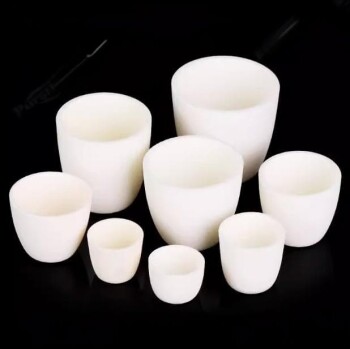
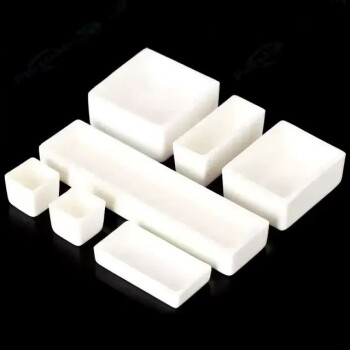
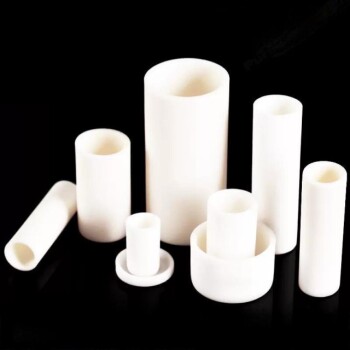
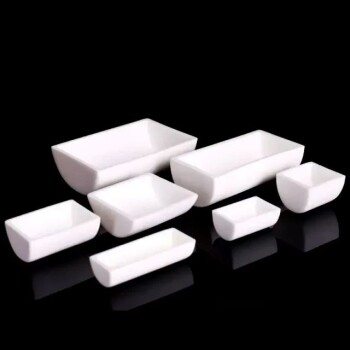
Scientific integrity dictates the choice. High-purity Alumina Crucibles are selected primarily for their exceptional chemical inertness and thermal stability. In molten nitrate environments (such as Solar Salt or HitecXL) up to 500°C, these vessels remain unreactive, strictly preventing container material from leaching into the melt. This isolation ensures that corrosion kinetics data specifically reflects the carbon steel's performance, uncontaminated by external variables.
The core value of high-purity alumina lies in its ability to remain "invisible" to the experiment. By preventing chemical interference and container degradation, these crucibles ensure that mass change measurements quantify the specimen's corrosion resistance, not the test environment's contamination.
The Imperative of Chemical Inertness
Preventing Experimental Contamination
The primary risk in corrosion testing is the alteration of the corrosive medium by the container itself. High-purity alumina (typically >99%) offers superior chemical inertness.
This prevents the container components from leaching into the molten salt. Even trace amounts of leached material can alter the chemistry of the melt, invalidating the results of the study.
Compatibility with Aggressive Media
Carbon steel testing often utilizes aggressive media like Solar Salt or HitecXL. Alumina crucibles withstand these nitrate salts effectively at temperatures up to 500°C.
Furthermore, their stability extends to even harsher environments, such as chloride salts or liquid bismuth, at temperatures up to 800°C. This broad compatibility makes them a standard for diverse high-temperature corrosion studies.
Guaranteeing Data Fidelity
Isolating Corrosion Kinetics
Scientific analysis of carbon steel relies heavily on measuring weight gain or loss to determine corrosion rates.
If the crucible reacts with the salt, it introduces "noise" into these measurements. High-purity alumina ensures that any measured weight change is solely attributable to the carbon steel specimen, not the degradation of the vessel.
Structural Density and Containment
High-purity alumina is characterized by a dense material structure.
This density is critical for preventing molten salt penetration into the crucible walls. By keeping the salt contained and isolated from external impurities, the crucible maintains a closed, controlled system for long-duration testing.
Understanding the Trade-offs
The Requirement for High Purity
It is critical to distinguish between standard alumina and high-purity variants. Lower purity ceramics may contain binders or silicates that can react with molten salts, defeating the purpose of the test.
Thermal and Mechanical Sensitivity
While chemically robust, alumina is a ceramic and acts differently than metal containers.
It generally has lower thermal shock resistance compared to metals. While it handles high steady-state temperatures (thermal stability) excellently, rapid temperature changes can cause cracking.
Making the Right Choice for Your Goal
To ensure the validity of your corrosion testing, select your equipment based on your specific data requirements.
- If your primary focus is precise kinetic data: Prioritize >99% purity alumina to strictly prevent element leaching that would distort weight gain/loss calculations.
- If your primary focus is oxide film analysis: Utilize alumina to ensure no foreign trace elements are introduced into the melt that could alter the film formation mechanism on the carbon steel.
By eliminating the variable of container interaction, high-purity alumina transforms a volatile chemical test into a controlled, quantifiable scientific study.
Summary Table:
| Feature | High-Purity Alumina (>99%) | Benefit for Corrosion Testing |
|---|---|---|
| Chemical Inertness | Exceptional resistance to nitrates/chlorides | Prevents melt contamination and leaching |
| Thermal Stability | Reliable performance up to 1600°C+ | Stable environment for long-term isothermal tests |
| Material Density | Non-porous, dense ceramic structure | Prevents molten salt penetration and wall leakage |
| Purity Level | Minimal binders or silicates | Ensures mass change data reflects specimen only |
| Compatibility | Solar Salt, HitecXL, liquid bismuth | Versatile for diverse high-temperature media |
Elevate Your Material Research with KINTEK Precision
Don’t let container contamination compromise your critical data. KINTEK specializes in premium laboratory equipment and consumables designed for the most demanding scientific environments. Our high-purity alumina crucibles and ceramic products are engineered to provide the chemical inertness and thermal stability required for accurate corrosion kinetics and high-temperature studies.
Beyond consumables, KINTEK offers a comprehensive range of solutions including:
- High-Temperature Furnaces: Muffle, tube, vacuum, and atmosphere furnaces for precise thermal control.
- Advanced Reactors: High-temperature high-pressure reactors and autoclaves for complex chemical processing.
- Sample Preparation: Crushing, milling, and hydraulic presses for consistent specimen creation.
- Specialized Tools: Electrolytic cells, battery research tools, and cooling solutions.
Ensure the integrity of your next experiment. Contact KINTEK today to discuss your specific application and discover how our high-performance laboratory solutions can enhance your lab's efficiency and results.
References
- Yaroslav Grosu, Abdessamad Faik. A simple method for the inhibition of the corrosion of carbon steel by molten nitrate salt for thermal storage in concentrating solar power applications. DOI: 10.1038/s41529-018-0055-0
This article is also based on technical information from Kintek Solution Knowledge Base .
Related Products
- Arc-Shaped Alumina Ceramic Crucible High Temperature Resistant for Engineering Advanced Fine Ceramics
- High Purity Alumina Granulated Powder for Engineering Advanced Fine Ceramics
- High Purity Pure Graphite Crucible for Evaporation
- Engineering Advanced Fine Alumina Al2O3 Ceramic Crucible for Laboratory Muffle Furnace
- High Purity Pure Graphite Crucible for Electron Beam Evaporation
People Also Ask
- Why Use Alumina Crucibles & Powder Burial for NaSICON? Ensure Phase Purity and Prevent Elemental Volatilization
- What is the primary purpose of using alumina crucibles for LLTO ceramics? Optimize Your High-Temperature Sintering
- Why are alumina crucibles and mother powder essential for LATP sintering? Optimize Your Solid Electrolyte Performance
- Why are high-purity alumina crucibles used for liquid lead corrosion experiments? Ensure Data Accuracy at 550°C
- Primary considerations for choosing alumina crucibles and quartz tubes in indium intercalation: Ensure Material Purity