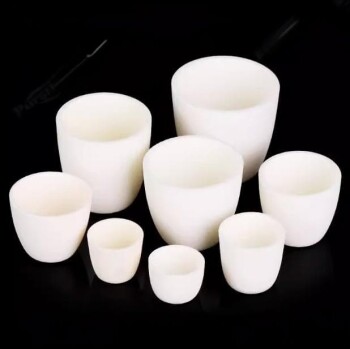
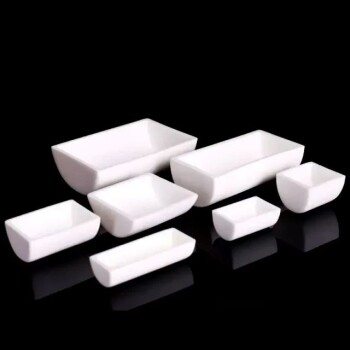
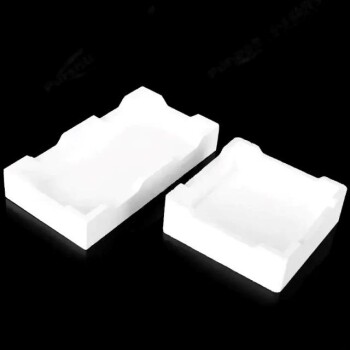
High-purity alumina crucibles serve as chemically inert containment vessels designed to physically support metal samples during high-temperature steam oxidation. Their fundamental purpose is to isolate the specimen from external variables, ensuring that the metal interacts only with the steam atmosphere up to temperatures of 1350 °C without reacting with the container itself.
The critical value of high-purity alumina lies in data integrity. By providing a non-reactive environment and capturing any oxide scale that flakes off, these crucibles ensure that measured weight changes reflect only the oxidation of the metal, eliminating errors from container interaction or material loss.
Guaranteeing Chemical Isolation
Preventing Cross-Contamination
The primary requirement for high-temperature oxidation studies is chemical inertness. High-purity alumina does not chemically react with metal specimens (such as stainless steel or FeCrAl alloys) or introduce impurities into the reaction zone.
Eliminating Container Interference
In lower-quality containers, the vessel itself might interact with the catalyst precursors or the metal coating. Alumina remains stable, ensuring that the chemical composition of the final material and its surface morphology remain unaltered by the container.
Maintaining Physical Stability in Steam
Resistance to Steam Erosion
Steam environments at high temperatures are highly corrosive. Unlike materials such as quartz, which may undergo crystallization or deformation, high-purity alumina maintains its structural strength and resists steam erosion.
High-Temperature Endurance
These crucibles are rated for extreme thermal environments. In steam oxidation contexts, they maintain stability up to 1350 °C, preventing the deformation or melting that would ruin a long-duration experiment.
Ensuring Gravimetric Accuracy
Capturing Spalled Oxide Scale
During oxidation, the oxide layer forming on the metal often cracks or peels off (spallation). The crucible acts as a catch-basin to collect this spalled oxide scale.
Validating Mass Gain Data
Experimental results rely on "gravimetric methods"—measuring the precise weight change of the sample. By collecting the spalled scale, the crucible ensures that all oxidation products are included in the final weighing, preventing data skewing caused by material loss.
Critical Operational Considerations
Adhering to Temperature Thresholds
While high-purity alumina is robust, it is not invincible. The primary reference specifies a safe operating limit of 1350 °C in steam environments. Exceeding this specific threshold may compromise the material's inertness or structural integrity.
Material Selection Matters
Not all ceramics are equal. Standard porcelain or lower-purity alumina may contain binders or impurities that react at high temperatures. You must verify the purity rating to ensure the crucible does not become a variable in your experiment.
Making the Right Choice for Your Goal
To ensure your experimental data is valid, match the crucible's capabilities to your specific analytical needs:
- If your primary focus is Gravimetric Analysis (Mass Gain): Rely on high-purity alumina to capture 100% of spalled oxide scale, ensuring the total mass of the reaction products is weighed accurately.
- If your primary focus is Surface Morphology/Microscopy: Select high-purity alumina to prevent chemical reactions between the container and the metal interface, which could distort surface imaging results.
Using the correct containment ensures your results measure the science of the sample, not the failure of the vessel.
Summary Table:
| Feature | Benefit in Steam Oxidation | Importance |
|---|---|---|
| Chemical Inertness | Prevents cross-contamination & reactions | Guarantees sample purity |
| Thermal Stability | Rated up to 1350°C in steam | Prevents vessel deformation |
| Physical Design | Captures spalled oxide scale | Ensures gravimetric accuracy |
| Material Purity | Eliminates binder/impurity interference | Protects data integrity |
Elevate Your Material Research with KINTEK
Precision in high-temperature oxidation requires containment that never fails. KINTEK specializes in premium laboratory solutions, providing high-purity alumina crucibles and ceramics designed to withstand the most corrosive steam environments.
Whether you are performing gravimetric analysis or complex surface morphology studies, our comprehensive range of high-temperature furnaces—including muffle, tube, and vacuum systems—pairs perfectly with our precision-engineered crucibles to deliver repeatable results for metal and alloy research.
Our value to you:
- Advanced Thermal Systems: From 1350°C furnaces to specialized CVD/PECVD units.
- Premium Consumables: High-purity alumina, PTFE, and ceramic products tailored for chemical isolation.
- Complete Lab Solutions: Crushing, milling, and hydraulic presses for integrated sample preparation.
Don't let vessel failure compromise your data. Contact KINTEK today to secure the high-performance tools your lab deserves.
References
- Alan Matias Avelar, Marcelo Breda Mourão. Oxidation of AISI 304L and 348 Stainless Steels in Water at High Temperatures. DOI: 10.1590/1980-5373-mr-2020-0373
This article is also based on technical information from Kintek Solution Knowledge Base .
Related Products
- Arc-Shaped Alumina Ceramic Crucible High Temperature Resistant for Engineering Advanced Fine Ceramics
- Engineering Advanced Fine Alumina Al2O3 Ceramic Crucible for Laboratory Muffle Furnace
- Engineering Advanced Fine Ceramics Alumina Al2O3 Crucible With Lid Cylindrical Laboratory Crucible
- Engineering Advanced Fine Ceramics Alumina Crucibles (Al2O3) for Thermal Analysis TGA DTA
- Alumina Al2O3 Ceramic Crucible Semicircle Boat with Lid for Engineering Advanced Fine Ceramics
People Also Ask
- Why Use Alumina Crucibles & Powder Burial for NaSICON? Ensure Phase Purity and Prevent Elemental Volatilization
- What is the primary purpose of using alumina crucibles for LLTO ceramics? Optimize Your High-Temperature Sintering
- Why are alumina crucibles and mother powder essential for LATP sintering? Optimize Your Solid Electrolyte Performance
- Why are high-purity alumina crucibles used for liquid lead corrosion experiments? Ensure Data Accuracy at 550°C
- Primary considerations for choosing alumina crucibles and quartz tubes in indium intercalation: Ensure Material Purity