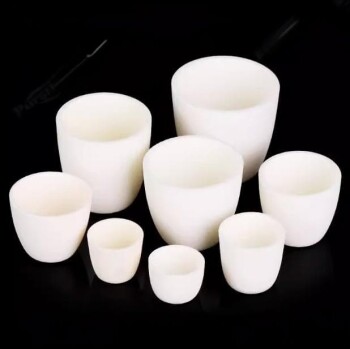
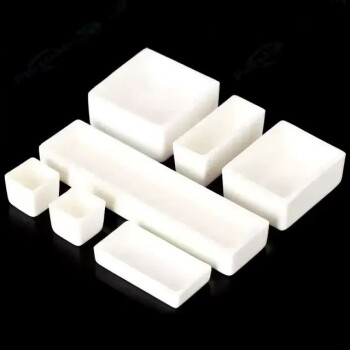
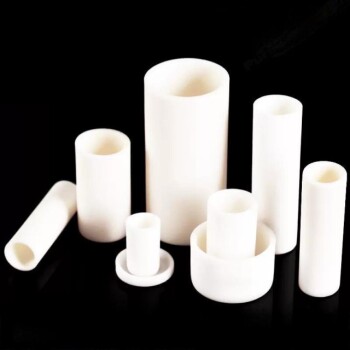
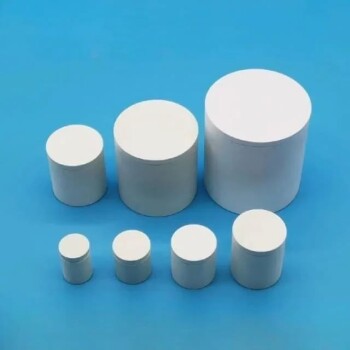
High-purity alumina crucibles provide a critical barrier of chemical inertness. In liquid lead environments reaching 600°C, these crucibles isolate the corrosive molten metal from the reactor's metallic walls. This separation is essential to prevent the dissolution of the reactor vessel and to ensure that no foreign contaminants skew the corrosion data of the test specimens.
The core function of the alumina crucible is to act as a chemically neutral "firewall." It protects the autoclave infrastructure from aggressive liquid metal corrosion while simultaneously preserving the chemical purity of the melt to ensure experimental data reflects only the interaction between the lead and the test specimen.
Preserving Experimental Accuracy
Achieving Chemical Inertness
Liquid lead is highly corrosive to most metallic materials at elevated temperatures. High-purity alumina (typically >99.7% Al2O3) exhibits exceptional chemical stability in these environments.
Unlike metallic containers, alumina does not react with molten lead even at temperatures as high as 800°C. This inertness ensures the crucible acts solely as a vessel, rather than a participant in the chemical reaction.
Preventing Melt Contamination
If liquid lead were allowed to touch the steel walls of an autoclave, it would leach iron, nickel, or chromium into the melt. This cross-contamination alters the chemistry of the liquid lead.
Alumina prevents this leaching process completely. By maintaining the purity of the lead melt, you ensure that the test environment remains consistent throughout long-term exposure tests.
Isolating Variable Interactions
For accurate data, specifically regarding oxide film formation and self-healing properties of alloys like ODS steel, the environment must be controlled. Impurities from a dissolving container can interfere with these delicate surface mechanisms.
Using an alumina crucible ensures that any observed corrosion or oxidation is exclusively a result of the interaction between the specimen and the liquid lead. It eliminates "background noise" caused by foreign metal ions.
Protecting the Reactor Infrastructure
Preventing Reactor Dissolution
High-pressure autoclaves are expensive, precision instruments typically made of high-strength alloys. Direct contact with molten lead at 600°C causes rapid erosion and dissolution of the reactor's inner walls.
The alumina crucible serves as the primary containment liner. It physically prevents the liquid lead from reaching the reactor shell, thereby preserving the structural integrity of the high-pressure vessel.
Withstanding Thermal Extremes
These tests often require temperatures exceeding 600°C, with some reaching up to 800°C. Alumina retains its structural strength and chemical resistance well beyond these operating points.
This thermal stability ensures that the containment does not degrade or deform over long test durations, preventing catastrophic leaks of molten lead into the reactor chamber.
Understanding the Trade-offs
Mechanical Brittleness
While chemically superior, alumina is a ceramic and lacks the ductility of metal. It is brittle and prone to cracking under mechanical stress or improper handling during loading.
Sensitivity to Thermal Shock
High-purity alumina has low thermal shock resistance compared to metals. Rapid heating or cooling of the reactor can cause the crucible to fracture, potentially spilling molten lead into the autoclave.
Sealing Challenges
Unlike metal liners which can be welded or sealed tightly, alumina crucibles are open vessels. This requires careful design of the autoclave internals to ensure the liquid lead remains contained even under high-pressure circulation.
Making the Right Choice for Your Goal
When designing your liquid lead corrosion experiments, consider the following specific requirements:
- If your primary focus is fundamental research: Prioritize alumina purity exceeding 99.7% to ensure absolutely no trace elements interfere with the study of oxide film growth mechanisms.
- If your primary focus is equipment longevity: Ensure the crucible dimensions provide a substantial gap between the melt and the autoclave wall to prevent accidental contact during thermal expansion.
Ultimately, the use of high-purity alumina is the industry standard for decoupling the test specimen's behavior from the containment vessel's limitations.
Summary Table:
| Feature | High-Purity Alumina (99.7% Al2O3) | Impact on Corrosion Testing |
|---|---|---|
| Chemical Inertness | Exceptional resistance to molten lead up to 800°C | Prevents crucible-melt reactions and data skewing |
| Contamination Control | Eliminates leaching of Fe, Ni, or Cr | Ensures lead purity for accurate oxide film analysis |
| Thermal Stability | Maintains integrity at extreme temperatures | Protects autoclave infrastructure from metallic erosion |
| Material Property | Ceramic / Brittle | Requires careful thermal ramping to avoid shock cracks |
Elevate Your Corrosion Research with KINTEK Precision
Protect your investment and ensure the integrity of your experimental data with KINTEK’s industry-leading laboratory solutions. We specialize in providing high-purity alumina crucibles and ceramics specifically designed to withstand the aggressive environments of liquid lead and molten salts.
Whether you are conducting fundamental research in high-temperature high-pressure reactors and autoclaves or performing material stress tests in crushing and milling systems, KINTEK delivers the durability and chemical purity you require. From PTFE products and specialized crucibles to advanced vacuum and atmosphere furnaces, our comprehensive portfolio supports the most demanding metallurgy and battery research applications.
Don't let cross-contamination or vessel erosion compromise your results. Contact KINTEK today to consult with our experts on the perfect containment solutions for your high-temperature laboratory needs.
References
- Qian Du, Shaoqiang Guo. Development of Corrosion-Resistant Si/Al-Doped Fe–Cr Ods Steels for Lead-Cooled Fast Reactors. DOI: 10.2139/ssrn.5396554
This article is also based on technical information from Kintek Solution Knowledge Base .
Related Products
- Arc-Shaped Alumina Ceramic Crucible High Temperature Resistant for Engineering Advanced Fine Ceramics
- High Purity Alumina Granulated Powder for Engineering Advanced Fine Ceramics
- High Purity Pure Graphite Crucible for Evaporation
- Engineering Advanced Fine Alumina Al2O3 Ceramic Crucible for Laboratory Muffle Furnace
- High Purity Pure Graphite Crucible for Electron Beam Evaporation
People Also Ask
- Why Use Alumina Crucibles & Powder Burial for NaSICON? Ensure Phase Purity and Prevent Elemental Volatilization
- What is the primary purpose of using alumina crucibles for LLTO ceramics? Optimize Your High-Temperature Sintering
- Why are alumina crucibles and mother powder essential for LATP sintering? Optimize Your Solid Electrolyte Performance
- Why are high-purity alumina crucibles used for liquid lead corrosion experiments? Ensure Data Accuracy at 550°C
- Primary considerations for choosing alumina crucibles and quartz tubes in indium intercalation: Ensure Material Purity