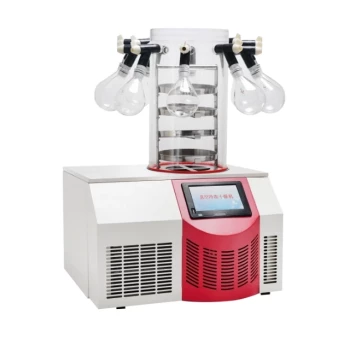
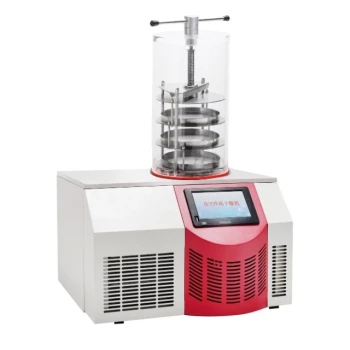
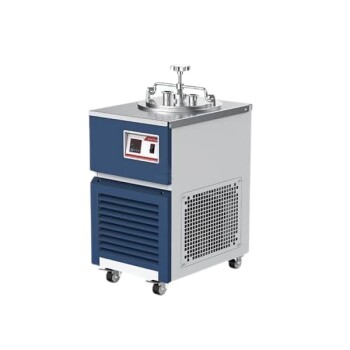
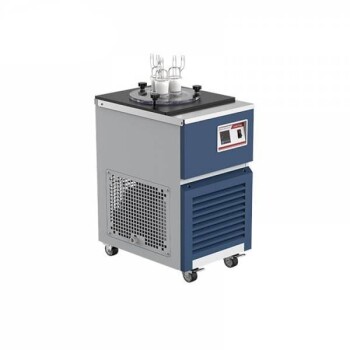
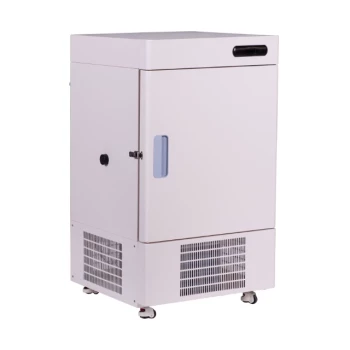
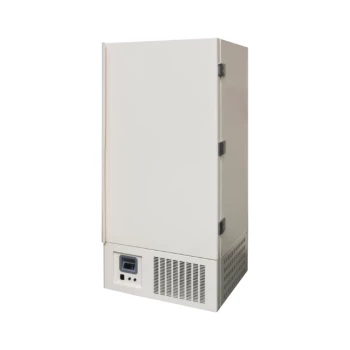
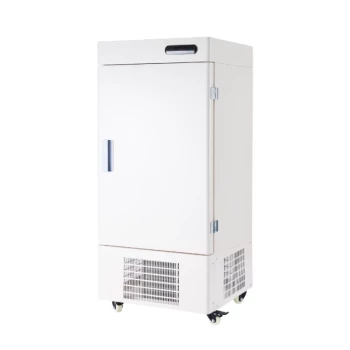
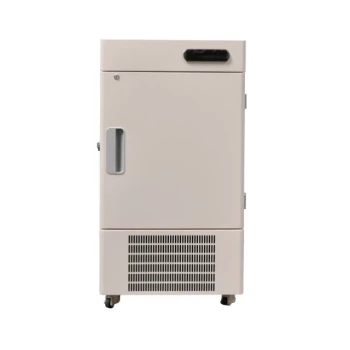
The laboratory vacuum freeze dryer acts as the primary safeguard for structural integrity during the preparation of nanocellulose-based nanopaper membranes. Its critical function is to remove moisture from frozen samples through sublimation—transitioning directly from solid to gas—rather than evaporation. This specific mechanism prevents the collapse of delicate nanopores, which is often caused by liquid surface tension in conventional thermal drying.
By bypassing the liquid phase entirely, the vacuum freeze dryer preserves the material's original three-dimensional architecture. This ensures the final membrane achieves the high specific surface area and throughput necessary for advanced filtration applications.
The Mechanism of Structural Preservation
Sublimation Over Evaporation
The fundamental value of this equipment lies in the principle of sublimation. Instead of applying heat to evaporate liquid water, the freeze dryer first freezes the water-containing material into a solid state.
Under a vacuum, the ice within the nanocellulose composite transitions directly into water vapor. This allows for moisture removal without the material ever passing back through a liquid phase.
Eliminating Surface Tension Forces
In standard drying methods, as water evaporates, the receding liquid interface creates significant capillary forces and surface tension. These forces are strong enough to pull the nanocellulose fibers together, effectively crushing the internal voids.
The freeze dryer negates this risk. Because the water is removed as a gas from a solid state, there is no liquid surface tension to exert mechanical stress on the pore walls.
Impact on Material Properties
Retention of 3D Nanoporous Structure
The primary reference highlights that the freeze dryer completely preserves the original three-dimensional nanoporous structure of the composite. Unlike air-dried samples, which often shrink or densify, freeze-dried membranes retain their volume and loft.
Maximizing Filtration Efficiency
This structural preservation directly translates to performance. The resulting material boasts an extremely high specific surface area, providing more interaction sites for filtration.
Furthermore, because the pores remain open and interconnected rather than collapsed, the membrane achieves high throughput. This allows fluids to pass through efficiently without sacrificing filtration quality.
Understanding the Trade-offs
Porosity vs. Mechanical Strength
It is vital to distinguish between the goals of different equipment. While the freeze dryer is essential for porosity, it does not densify the material.
If your goal is to maximize mechanical strength or reduce surface roughness, a laboratory hot press would be the required tool. As noted in supplementary data, a hot press strengthens hydrogen bonding and eliminates micro-defects, but this often comes at the expense of the open porous structure provided by freeze drying.
Complexity vs. Simplicity
Freeze drying is a specialized process involving ultra-low temperatures and vacuum pressure. For simpler tasks, such as removing physically adsorbed water prior to calcination, a standard laboratory drying oven (operating at 100°C–150°C) is sufficient and more efficient.
Making the Right Choice for Your Goal
To select the correct equipment for your nanocellulose membrane preparation, you must define the critical performance metric of your final product.
- If your primary focus is High Throughput and Surface Area: Prioritize the vacuum freeze dryer to maintain an open, non-collapsed 3D nanoporous structure.
- If your primary focus is Mechanical Strength: Utilize a hot press for post-treatment to densify the membrane and strengthen hydrogen bonding between chain segments.
- If your primary focus is Pre-Calcination Preparation: Use a laboratory drying oven to remove physically adsorbed water rapidly without the need for structure preservation.
The vacuum freeze dryer is not just a drying tool; it is an architectural instrument that freezes the material's potential into place.
Summary Table:
| Feature | Vacuum Freeze Dryer | Laboratory Hot Press | Laboratory Drying Oven |
|---|---|---|---|
| Primary Mechanism | Sublimation (Solid to Gas) | Compression & Heat | Thermal Evaporation |
| Structural Impact | Preserves 3D Nanopores | Densifies & Strengthens | Removes Adsorbed Water |
| Key Benefit | High Specific Surface Area | Enhanced Mechanical Strength | Fast & Efficient Processing |
| Best Used For | Advanced Filtration Membranes | High-Strength Composites | Pre-calcination Preparation |
Elevate Your Material Research with KINTEK Precision
At KINTEK, we understand that structural integrity is the cornerstone of advanced material science. Whether you are preserving delicate 3D nanopores or densifying membranes for maximum strength, our comprehensive range of laboratory equipment is engineered for excellence.
From high-performance vacuum freeze dryers and cold traps to precision hydraulic hot presses and high-temperature furnaces, KINTEK provides the specialized tools researchers need to achieve reproducible, high-quality results. Our portfolio also includes cutting-edge nanoscale milling systems, high-pressure reactors, and specialized ceramics to support every stage of your nanocellulose and battery research.
Ready to optimize your membrane preparation? Contact our technical experts today to find the perfect drying or pressing solution for your specific application!
References
- Sandrine Mbakop, Maurice S. Onyango. Recent Advances in the Synthesis of Nanocellulose Functionalized–Hybrid Membranes and Application in Water Quality Improvement. DOI: 10.3390/pr9040611
This article is also based on technical information from Kintek Solution Knowledge Base .
Related Products
- Benchtop Laboratory Vacuum Freeze Dryer
- High Performance Laboratory Freeze Dryer
- High Performance Laboratory Freeze Dryer for Research and Development
- Benchtop Laboratory Freeze Dryer for Lab Use
- Vacuum Cold Mounting Machine for Sample Preparation
People Also Ask
- What are the technical advantages of using a laboratory freeze dryer for porous carbon precursors? Preserve 3D Networks
- How do laboratory freeze dryers support scientific research? Preserve Sample Integrity for Reproducible Results
- Why is a laboratory freeze dryer preferred over traditional heating? Preserve Biochar Structure & Maximize Porosity
- What types of liquid samples can be processed using a laboratory freeze dryer? Preserve Your Sensitive Materials
- What role do laboratory freeze dryers play in the food industry? Unlock Superior Food Preservation