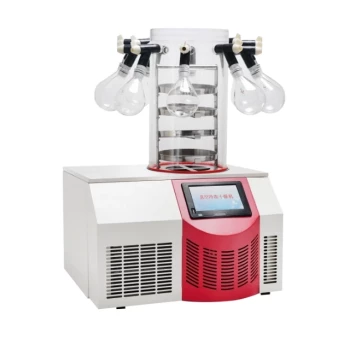
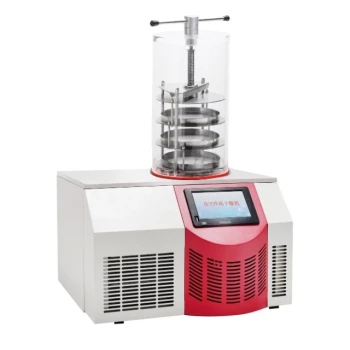
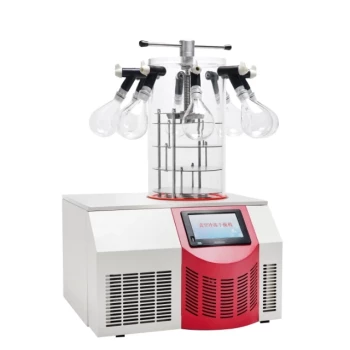
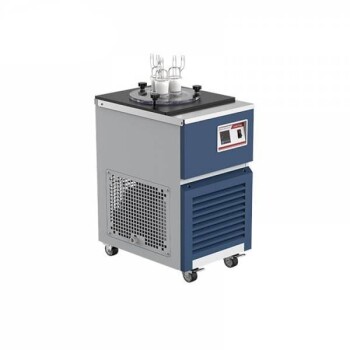
Freeze dryers play a pivotal role in enzyme catalyst preparation by removing solvents from catalyst supports or gels through sublimation rather than evaporation. This process occurs in a highly controlled, low-temperature vacuum environment designed to protect the delicate physical and chemical architecture of the material.
Core Insight: The fundamental value of freeze drying is the prevention of capillary collapse during the drying phase. By bypassing the liquid state, this method preserves the high porosity and structural integrity necessary for enzymes to retain their original bioactive spatial conformation and functionality.
The Mechanism of Preservation
Solvent Removal via Sublimation
Freeze drying facilitates the removal of solvents from catalyst supports by converting frozen solvent directly into vapor.
This process, known as sublimation, bypasses the liquid phase entirely.
The Low-Temperature Environment
The process operates within a low-temperature vacuum.
This environment is critical for shielding sensitive biological components from the thermal degradation often associated with standard heating methods.
Structural Integrity and Porosity
Preventing Capillary Collapse
The primary physical benefit of freeze drying is its ability to prevent capillary collapse.
In conventional drying, liquid surface tension can crush the delicate pore structures of gels. Freeze drying eliminates this tension, keeping the structure intact.
Maintaining High Porosity
Because the internal structure is not collapsed by surface tension, the final material retains high porosity.
This open structure provides the necessary surface area and volume to house the enzyme payload effectively.
Impact on Enzyme Functionality
Retaining Spatial Conformation
Enzymes rely on a specific 3D shape, or spatial conformation, to function.
Freeze drying ensures that the support structure does not deform, allowing the loaded enzymes to maintain this critical shape.
Ensuring Bioactivity
By preserving the spatial conformation, the process directly protects the enzyme's functionality.
The result is a catalyst that retains its intended bioactive properties, fully capable of catalyzing reactions as designed.
The Critical Contrast: Freeze Drying vs. Thermal Drying
The Risks of Thermal Drying
Conventional thermal drying relies on evaporation, which introduces significant capillary forces.
These forces frequently lead to the collapse of gel structures, reducing the available surface area for the enzyme.
The Superiority of Sublimation
By utilizing sublimation, freeze drying avoids the physical stress of evaporation.
This ensures that the "housing" for the enzyme remains robust, whereas thermal methods often result in a dense, low-porosity material that compromises enzyme performance.
Making the Right Choice for Your Goal
If you are developing high-performance enzyme catalysts, the drying method is not merely a logistical step—it is a determinant of final quality.
- If your primary focus is Structural Integrity: Choose freeze drying to prevent capillary collapse and maintain the original high porosity of your gel or support.
- If your primary focus is Bioactivity: Rely on freeze drying to ensure loaded enzymes retain the specific spatial conformation required for maximum catalytic function.
Ultimately, freeze drying is the definitive method for decoupling solvent removal from structural degradation.
Summary Table:
| Feature | Freeze Drying (Sublimation) | Thermal Drying (Evaporation) |
|---|---|---|
| Mechanism | Direct solid-to-vapor transition | Liquid-to-vapor transition |
| Temperature | Low-temperature vacuum environment | High-temperature environment |
| Structural Impact | Prevents capillary collapse; maintains porosity | Causes pore shrinkage and structure collapse |
| Bioactivity | Preserves 3D spatial conformation | High risk of thermal denaturation |
| Final Quality | High-performance, bioactive catalysts | Reduced surface area and functionality |
Elevate Your Catalyst Research with KINTEK Precision
Don’t let capillary collapse or thermal stress compromise your enzyme performance. KINTEK specializes in advanced laboratory solutions, offering a premium range of freeze dryers (lyophilizers) designed to protect delicate bioactive structures and maintain high porosity in catalyst supports.
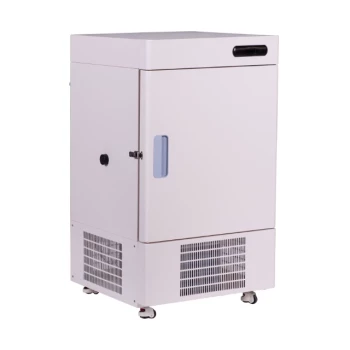
Beyond drying technology, our comprehensive portfolio supports your entire workflow—from crushing and milling systems and high-temperature furnaces for support synthesis to ULT freezers and PTFE consumables for material storage.
Ready to optimize your enzyme catalyst preparation? Contact KINTEK today to discuss your specific laboratory needs and ensure your research achieves maximum bioactivity and structural integrity.
References
- Ahmed I. Osman, Mika Sillanpää. Biofuel production, hydrogen production and water remediation by photocatalysis, biocatalysis and electrocatalysis. DOI: 10.1007/s10311-023-01581-7
This article is also based on technical information from Kintek Solution Knowledge Base .
Related Products
- High Performance Laboratory Freeze Dryer
- High Performance Laboratory Freeze Dryer for Research and Development
- Benchtop Laboratory Freeze Dryer for Lab Use
- Benchtop Laboratory Vacuum Freeze Dryer
- 108L Vertical Ultra Low Temperature ULT Freezer
People Also Ask
- What role does a laboratory freeze dryer play in the synthesis of graphene-based electrocatalysts? Preserve 3D Structures
- What are the technical advantages of using a laboratory freeze dryer for porous carbon precursors? Preserve 3D Networks
- What types of liquid samples can be processed using a laboratory freeze dryer? Preserve Your Sensitive Materials
- How do laboratory freeze dryers support scientific research? Preserve Sample Integrity for Reproducible Results
- Why is a laboratory freeze dryer preferred over traditional heating? Preserve Biochar Structure & Maximize Porosity