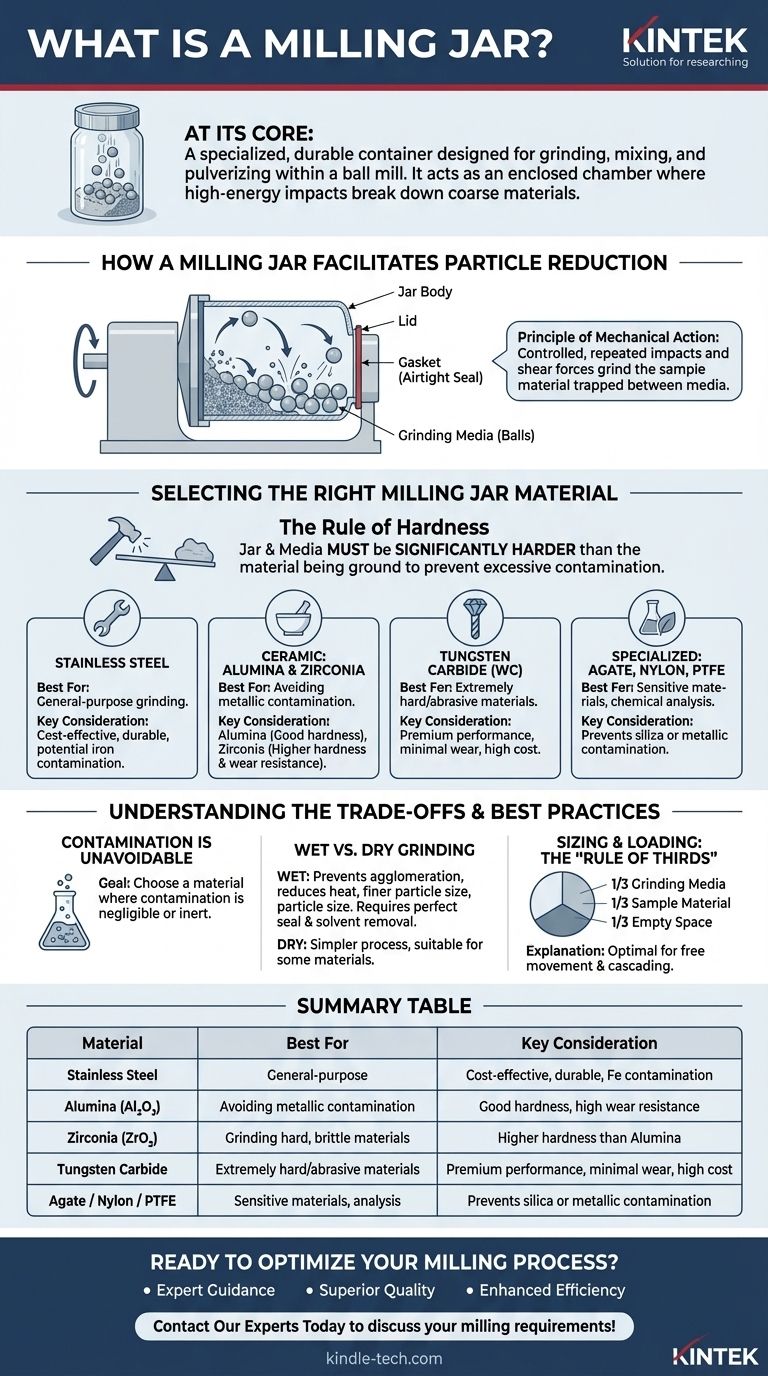
At its core, a milling jar is a specialized, durable container designed to hold material for grinding, mixing, or pulverizing within a ball mill. It acts as the enclosed chamber where high-energy impacts from grinding media, such as balls or cylinders, systematically break down coarse materials into a fine powder or a homogeneous mixture.
The function of a milling jar goes far beyond simple containment. Its material, size, and the media used within it are critical variables that directly dictate the purity, final particle size, and overall success of your materials processing.
How a Milling Jar Facilitates Particle Reduction
A milling jar is the central component of a ball milling system, a process that relies on mechanical energy to alter a material's physical state. The process is not one of simple crushing but of controlled, repeated impacts.
The Principle of Mechanical Action
The jar is loaded with the sample material and a set of grinding media (balls). It is then sealed and placed into a ball mill, which rotates, shakes, or agitates the jar at high speeds. This motion causes the grinding media to cascade and collide, creating powerful impact and shear forces that grind the sample material trapped between them.
Key Components of the System
A complete milling jar setup consists of the jar body, a matching lid, a gasket to ensure an airtight seal, and the grinding media. The media does the actual work, while the jar and lid contain the energy and prevent contamination.
Selecting the Right Milling Jar Material
The choice of jar material is the single most important decision in the milling process. It directly impacts the potential for sample contamination and the efficiency of the grind.
The Rule of Hardness
The fundamental principle is that the milling jar and grinding media must be significantly harder than the material being ground. If the sample is harder, it will abrade the jar and media, leading to excessive and unacceptable contamination of your sample.
Common Material: Stainless Steel
Stainless steel is a robust, versatile, and cost-effective choice. It is excellent for general-purpose milling of a wide range of materials and is particularly useful when iron contamination is not a concern for the final application.
Ceramic Workhorses: Alumina & Zirconia
Alumina (Al₂O₃) is a very common, high-density ceramic that offers good hardness and high resistance to wear. Zirconia (ZrO₂) is even harder, denser, and more wear-resistant than alumina, making it ideal for grinding very hard, brittle materials with minimal contamination.
The Ultimate Grinder: Tungsten Carbide
For extremely hard or abrasive samples, tungsten carbide (WC) is the premium choice. Its extreme hardness and density provide very high grinding energy, enabling rapid particle size reduction with minimal wear, though it comes at a significantly higher cost.
Specialized Materials for Sensitive Applications
For applications where even minor contamination is critical, specialized materials are used. Agate is used for soft materials to prevent silica or metallic contamination. Nylon or PTFE jars are used for soft, organic samples where metal or ceramic contamination must be avoided entirely.
Understanding the Trade-offs
Selecting a milling jar involves balancing performance, cost, and the specific requirements of your experiment or process. There is no single "best" material, only the most appropriate one for the task.
Contamination is Unavoidable
It is critical to understand that all milling introduces some level of contamination from the jar and media. The goal is to choose a material where this contamination is either negligibly small or chemically inert and irrelevant to your downstream analysis or application.
Wet Grinding vs. Dry Grinding
Grinding can be done dry or wet (by adding a liquid solvent). Wet grinding can prevent material from agglomerating, reduce heat buildup, and often results in a finer and more uniform particle size distribution. However, it requires a jar with a perfect seal and adds a solvent removal step to your process.
Sizing and Loading the Jar Correctly
The efficiency of the grind is highly dependent on how the jar is loaded. An improperly loaded jar will result in a slow, inefficient grind or may not work at all.
The "Rule of Thirds"
A widely accepted guideline for optimal grinding is the "rule of thirds." The jar volume should be filled approximately one-third with grinding media, one-third with the sample material, and the final one-third left as empty space to allow for the free movement and cascading of the media.
Making the Right Choice for Your Application
Your final decision should be guided by your sample's properties and your ultimate goal.
- If your primary focus is general-purpose grinding of soft to medium-hard materials: A stainless steel jar offers the best balance of performance, durability, and cost.
- If your primary focus is avoiding metallic contamination for sensitive analysis: Choose a high-purity ceramic jar like alumina or, for higher performance, zirconia.
- If your primary focus is grinding extremely hard or abrasive materials quickly: Invest in a tungsten carbide jar to minimize wear and contamination.
- If your primary focus is processing soft, sensitive materials for chemical analysis: An agate jar is the ideal choice to ensure the highest sample purity.
Choosing the correct milling jar transforms a routine grinding task into a precise and repeatable scientific process.
Summary Table:
| Milling Jar Material | Best For | Key Consideration |
|---|---|---|
| Stainless Steel | General-purpose grinding | Cost-effective, durable, but may cause iron contamination |
| Alumina (Al₂O₃) | Avoiding metallic contamination | Good hardness, high wear resistance |
| Zirconia (ZrO₂) | Grinding hard, brittle materials | Higher hardness and wear resistance than alumina |
| Tungsten Carbide (WC) | Extremely hard/abrasive materials | Premium performance, minimal wear, high cost |
| Agate / Nylon / PTFE | Sensitive materials, chemical analysis | Prevents silica or metallic contamination |
Ready to Optimize Your Milling Process?
Choosing the right milling jar is critical for achieving the desired particle size and sample purity. KINTEK specializes in high-quality lab equipment and consumables, including a full range of milling jars and grinding media tailored to your laboratory's specific needs.
We provide:
- Expert Guidance: Help you select the perfect jar material for your application.
- Superior Quality: Durable jars that ensure consistent, contaminant-free results.
- Enhanced Efficiency: Achieve faster grinding and more homogeneous mixtures.
Don't let the wrong jar compromise your results. Contact our experts today to discuss your milling requirements and find the ideal solution for your lab!
Visual Guide
Related Products
- Laboratory Micro Horizontal Jar Mill for Precision Sample Preparation in Research and Analysis
- Laboratory Jar Mill with Agate Grinding Jar and Balls
- Laboratory Jar Ball Mill with Alumina Zirconia Grinding Jar and Balls
- Laboratory Ball Mill Jar Mill with Metal Alloy Grinding Jar and Balls
- Laboratory Four-Body Horizontal Jar Mill
People Also Ask
- What is use for grinding in the laboratory? Select the Right Mill for Accurate Sample Prep
- What is the use of a laboratory mill? Achieve Accurate Sample Homogenization for Reliable Results
- What are the different types of laboratory mills? Choose the Right Grinder for Your Sample Material
- What are the steps involved in sample preparation? A Guide to Accurate and Reliable Analysis
- What is the purpose of sample preparation? Ensure Accurate & Reliable Analytical Results