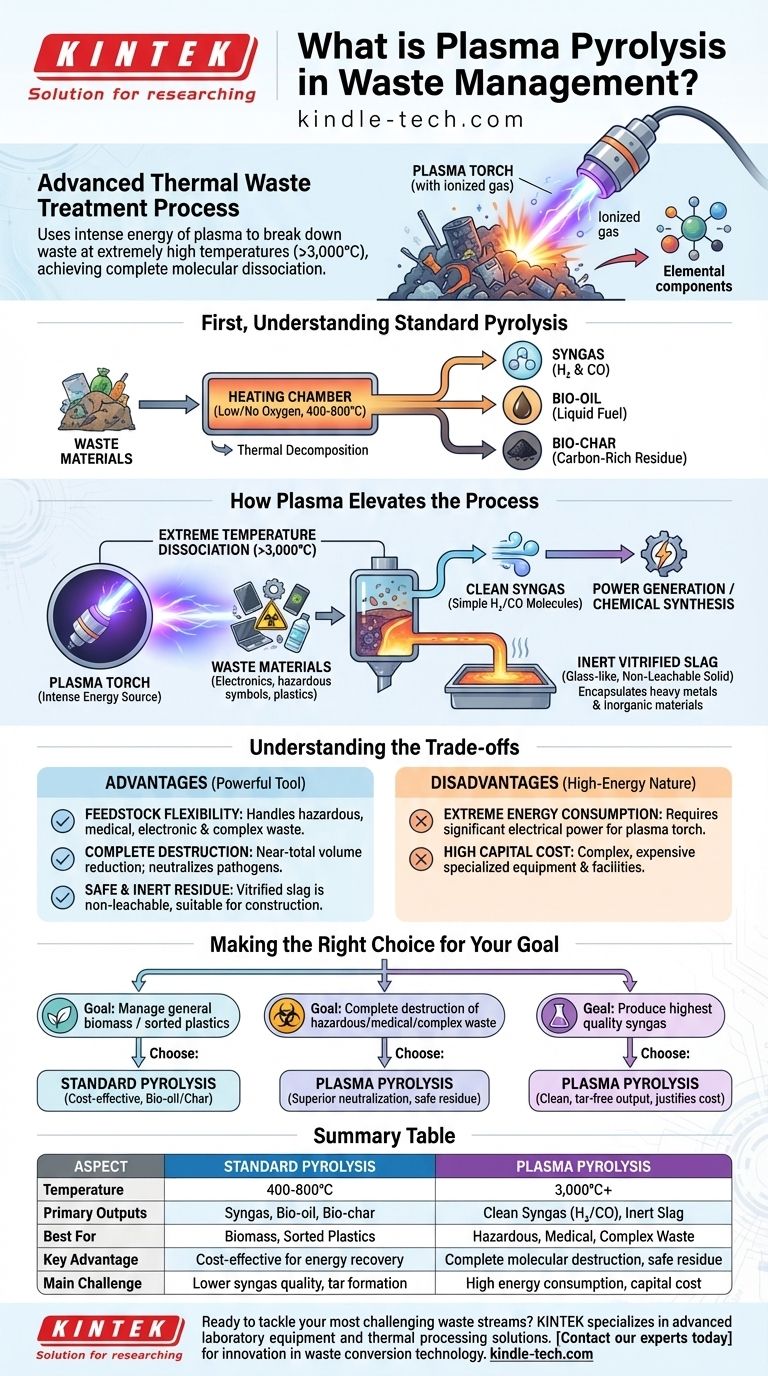
Plasma pyrolysis is an advanced thermal waste treatment process that uses the intense energy of plasma to break down waste materials at extremely high temperatures. Unlike standard pyrolysis, which heats waste in the absence of oxygen, plasma pyrolysis utilizes an electrically charged gas (plasma) to achieve temperatures often exceeding 3,000°C, dissociating complex materials like plastics, hazardous waste, or medical waste into their fundamental elemental components.
At its core, plasma pyrolysis is not just about breaking down waste; it's about complete molecular dissociation. This process excels at destroying the most challenging waste streams, producing a clean, simple syngas and an inert, non-leachable solid, but at a significantly higher energy cost and complexity than traditional methods.
First, Understanding Standard Pyrolysis
To appreciate what makes plasma pyrolysis unique, we must first understand the foundation it builds upon: standard pyrolysis.
The Basic Mechanism
Standard pyrolysis is the process of heating waste materials in an environment with little to no oxygen. This prevents combustion (burning) and instead causes the materials to thermally decompose.
The End Products
This decomposition breaks down complex organic materials into three primary products:
- Syngas: A mixture of combustible gases, primarily hydrogen and carbon monoxide.
- Bio-oil (or Pyrolysis Oil): A liquid fuel that requires further refining.
- Bio-char: A solid, carbon-rich residue similar to charcoal.
These products have value and can be used as fuel, soil amendments, or as feedstock for producing other chemicals.
How Plasma Elevates the Process
Plasma pyrolysis takes this basic concept to an extreme, using a plasma torch to create conditions far more intense than conventional heating methods can achieve.
The Role of the Plasma Torch
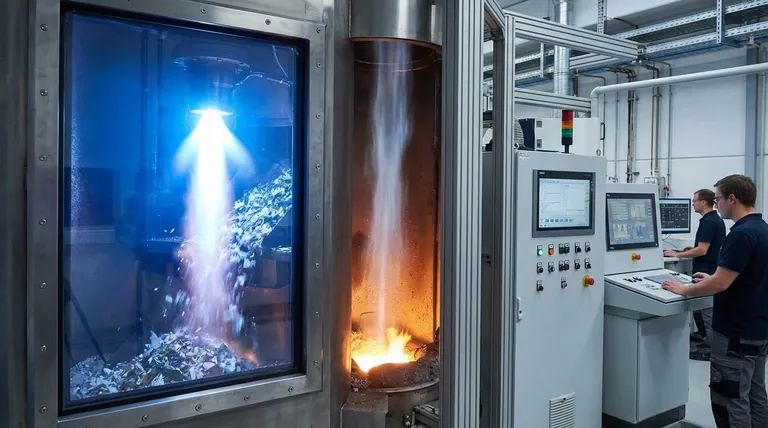
A plasma torch passes a gas (like air or argon) through an electric arc. This superheats the gas, stripping electrons from the atoms and creating an ionized, electrically conductive gas stream—the plasma.
Extreme Temperature Dissociation
This plasma torch acts as a source of intense, concentrated thermal energy, raising the temperature inside the reactor to several thousand degrees Celsius. At these temperatures, waste doesn't just decompose; its molecules are torn apart into their constituent atoms.
The Superior Output: Syngas and Slag
Because of this complete molecular dissociation, the outputs are fundamentally different from standard pyrolysis. Tars and complex oils are virtually eliminated.
The process primarily yields two things:
- A high-quality syngas composed almost entirely of simple hydrogen (H₂) and carbon monoxide (CO) molecules.
- An inert, vitrified slag, which is a glass-like, non-leachable solid material that safely encapsulates inorganic materials and heavy metals.
Understanding the Trade-offs
Choosing plasma pyrolysis involves a clear set of trade-offs defined by its high-energy nature. It is a powerful tool, but not a universal solution for all waste problems.
Advantage: Feedstock Flexibility
Plasma systems can handle nearly any type of waste, including hazardous materials, medical waste, electronics, and mixed municipal solid waste that would be problematic for other technologies. The extreme heat neutralizes pathogens and breaks down complex chemical bonds.
Advantage: Complete Destruction
The process results in near-total waste destruction and volume reduction. The final slag is typically inert and safe for use as construction aggregate, eliminating future landfill liability. The syngas produced is also cleaner and more versatile than that from standard pyrolysis.
Disadvantage: Extreme Energy Consumption
The primary drawback is the significant electrical energy required to power the plasma torch. This makes the operational cost very high and means the process may only be energy-positive if the produced syngas is used very efficiently to generate electricity.
Disadvantage: High Capital Cost
Plasma gasification plants are more complex and expensive to build than standard pyrolysis or incineration facilities. The specialized equipment, including the plasma torches and high-temperature reactor, represents a major capital investment.
Making the Right Choice for Your Goal
The decision to use plasma pyrolysis must be driven by the specific nature of the waste stream and the desired outcome.
- If your primary focus is managing general biomass or sorted plastics: Standard pyrolysis is often a more cost-effective and energy-efficient solution for producing bio-oil and char.
- If your primary focus is the complete and safe destruction of hazardous, medical, or complex industrial waste: Plasma pyrolysis is a superior technology for achieving neutralization and producing a stable, non-toxic solid residue.
- If your primary focus is producing the highest quality syngas for chemical synthesis or efficient power generation: The clean, tar-free output of plasma pyrolysis can justify its higher cost by simplifying downstream gas cleanup processes.
Ultimately, plasma pyrolysis represents the cutting edge of thermal waste conversion, offering unparalleled destruction capability for the most difficult waste streams.
Summary Table:
| Aspect | Standard Pyrolysis | Plasma Pyrolysis |
|---|---|---|
| Temperature | 400-800°C | 3,000°C+ |
| Primary Outputs | Syngas, Bio-oil, Bio-char | Clean Syngas (H₂/CO), Inert Slag |
| Best For | Biomass, Sorted Plastics | Hazardous, Medical, Complex Waste |
| Key Advantage | Cost-effective for energy recovery | Complete molecular destruction, safe residue |
| Main Challenge | Lower syngas quality, tar formation | High energy consumption, capital cost |
Ready to tackle your most challenging waste streams? KINTEK specializes in advanced laboratory equipment and thermal processing solutions. Our expertise can help you evaluate if plasma pyrolysis is the right technology for your hazardous waste management goals. Contact our experts today to discuss how we can support your lab's innovation and efficiency in waste conversion technology.
Visual Guide
Related Products
- Electric Rotary Kiln Small Rotary Furnace Biomass Pyrolysis Plant
- Chemical Vapor Deposition CVD Equipment System Chamber Slide PECVD Tube Furnace with Liquid Gasifier PECVD Machine
- Spark Plasma Sintering Furnace SPS Furnace
- Electric Rotary Kiln Pyrolysis Furnace Plant Machine Calciner Small Rotary Kiln Rotating Furnace
- Microwave Plasma Chemical Vapor Deposition MPCVD Machine System Reactor for Lab and Diamond Growth
People Also Ask
- What are the reactors for fast pyrolysis? Choosing the Right System for Maximum Bio-Oil Yield
- What is the temperature of a rotating kiln? It Depends on Your Material and Process Goal
- What are the characteristics of the slipping, slumping, and rolling modes of bed motion? Optimize Your Rotary Process
- What is the function of a rotary kiln? A Guide to Industrial Thermal Processing
- Is rotary kiln a furnace? Discover the Key Differences for Industrial Processing