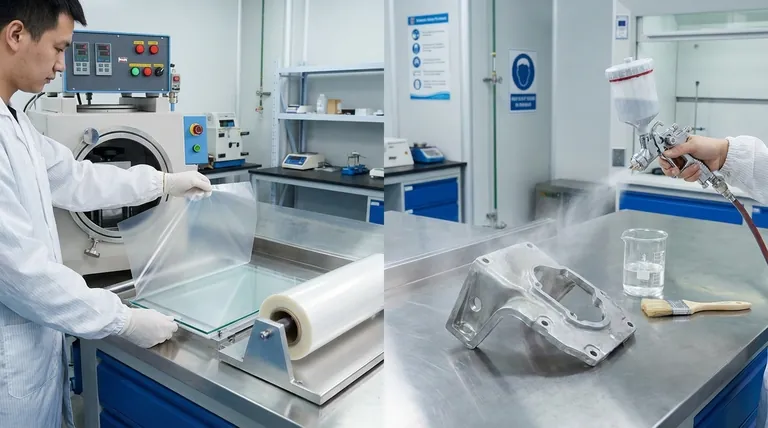
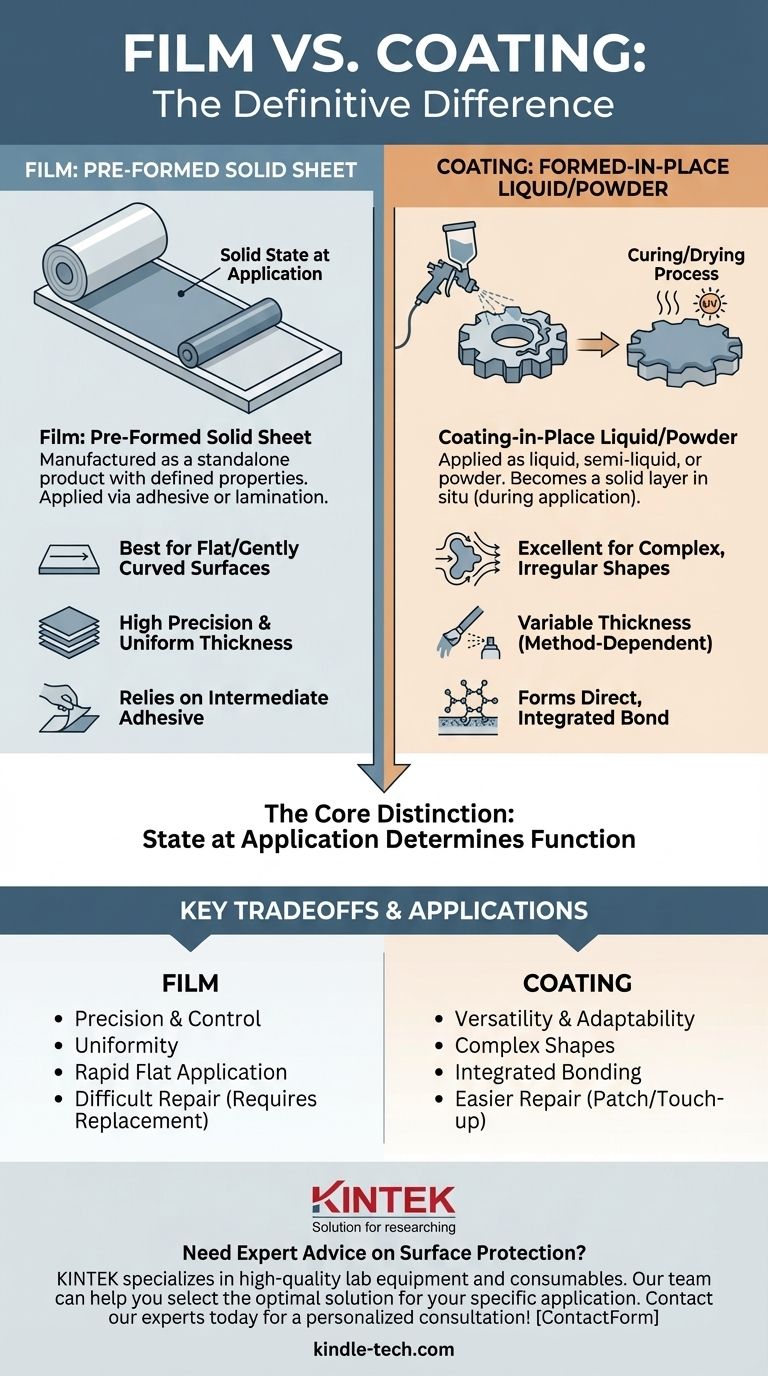
At a fundamental level, the difference between a film and a coating lies in its state at the time of application. A film is a pre-manufactured, solid sheet of material that is applied to a surface. In contrast, a coating is a liquid, semi-liquid, or powder that is applied to a surface and then cured or dried to form a solid, protective layer in situ.
The essential distinction is this: a film is a pre-formed solid layer you attach, while a coating is a substance that becomes a solid layer directly on the object you are protecting.
The Defining Difference: Pre-Formed vs. Formed-In-Place
The most critical concept to grasp is the manufacturing and application process. This single difference dictates nearly all of the performance characteristics of the final surface.
Understanding Films: The Solid Sheet Approach
A film is engineered and produced as a distinct, standalone product in a factory. It has defined properties like thickness, color, and texture before it ever reaches the final object.
Application involves adhering this pre-made sheet to a substrate, typically using pressure-sensitive adhesives or lamination processes. Think of a vinyl car wrap or a screen protector for your phone.
Understanding Coatings: The Liquid-to-Solid Transformation
A coating is a non-solid substance, like paint or a polymer resin, that is applied to an object. The final protective layer does not exist until the application is complete.
The process of solidification, known as curing, can happen through evaporation (like house paint), a chemical reaction (like an epoxy), or the application of heat or UV light. The coating conforms to the shape of the object and then becomes a solid part of its surface.
How Form Determines Function
This fundamental difference in form and application creates distinct advantages and disadvantages that will guide your choice for a specific project.
Thickness and Uniformity
Films offer exceptionally high precision and uniformity. Because they are manufactured on specialized equipment, their thickness can be controlled down to the micron level across the entire sheet.
Coatings, on the other hand, are subject to the skill of the applicator and the application method (spraying, dipping, brushing). This can result in variable thickness, which may be perfectly acceptable or a critical failure depending on the use case.
Application on Complex Shapes
Coatings excel at covering complex, irregular geometries. A liquid can flow into crevices and around curves, providing seamless protection for intricate parts like engine components or machinery.
Films are best suited for flat or gently curved surfaces. Applying a solid sheet to a complex shape can lead to wrinkles, bubbles, or stress marks, compromising both aesthetics and protective function.
Adhesion and Bonding
A coating often creates a more integrated and direct bond with the substrate. As it cures, it can form powerful chemical or mechanical bonds directly with the surface material.
A film relies on an intermediate adhesive layer. While modern adhesives are incredibly strong, this still introduces another potential point of failure between the film and the substrate.
Understanding the Trade-offs
Neither solution is inherently superior; they are simply different tools for different jobs. Understanding their trade-offs is key to making an informed decision.
The Precision of Film vs. the Versatility of Coating
The core trade-off is between control and adaptability. A film gives you a known, pre-verified product, but it is less forgiving in application. A coating offers immense flexibility for shape and in-field application but requires more process control to achieve consistent results.
Repair and Maintenance
Coatings are often much easier to repair. A scratch or chip in a painted surface can frequently be sanded and touched up in a localized area.
Damage to a film typically requires full replacement of the affected panel or section. It is very difficult to seamlessly patch a solid sheet of material.
Substrate Preparation
Both methods require a clean, properly prepared substrate for optimal performance. However, the nature of the bond can change requirements. Coatings may require primers or chemical etching to promote adhesion, while films demand a perfectly smooth, contaminant-free surface to prevent bubbling.
Making the Right Choice for Your Application
Your specific goal will determine whether a film or a coating is the appropriate solution. Evaluate your project against these key priorities.
- If your primary focus is precise, uniform thickness and pre-verified properties: A film is the superior choice, as it is manufactured under controlled conditions before application.
- If your primary focus is protecting a complex or irregular shape: A coating offers unmatched versatility, as it conforms to any geometry before curing into a seamless layer.
- If your primary focus is creating a seamless, integrated bond for maximum durability: A coating is generally more effective, as it often forms a chemical or mechanical bond as it cures directly on the surface.
- If your primary focus is rapid application over large, flat surfaces: A film applied via lamination can be a highly efficient and repeatable process.
Ultimately, understanding this core distinction moves the conversation from material preference to strategic process selection.
Summary Table:
| Feature | Film | Coating |
|---|---|---|
| Form at Application | Pre-formed solid sheet | Liquid, semi-liquid, or powder |
| Best For Surfaces | Flat or gently curved | Complex, irregular shapes |
| Thickness Uniformity | High precision, controlled | Variable, depends on application method |
| Bonding | Relies on intermediate adhesive | Direct, integrated bond with substrate |
| Repair | Typically requires full replacement | Often easier to patch or touch up |
Need expert advice on selecting the right surface protection for your lab equipment or components?
At KINTEK, we specialize in providing high-quality lab equipment and consumables. Our team can help you navigate the choice between films and coatings to ensure optimal performance, durability, and protection for your specific application. Let us help you enhance your lab's efficiency and protect your valuable investments.
Contact our experts today for a personalized consultation!
Visual Guide
Related Products
- Vacuum Hot Press Furnace Machine for Lamination and Heating
- Customer Made Versatile CVD Tube Furnace Chemical Vapor Deposition Chamber System Equipment
- Custom PTFE Teflon Parts Manufacturer for PTFE Containers
- Graphite Vacuum Continuous Graphitization Furnace
- High Temperature Muffle Oven Furnace for Laboratory Debinding and Pre Sintering
People Also Ask
- What is the main function of hot press forming? Achieve Superior Strength & Precision in Manufacturing
- What is vacuum lamination? Achieve a Flawless, Durable Finish on Complex Shapes
- What is the advantage by using hot press forming? Achieve Stronger, More Complex Parts
- What is the purpose of laminating? Protect and Enhance Your Documents for Long-Term Use
- How does hot pressing work? Achieve Maximum Density for Advanced Materials