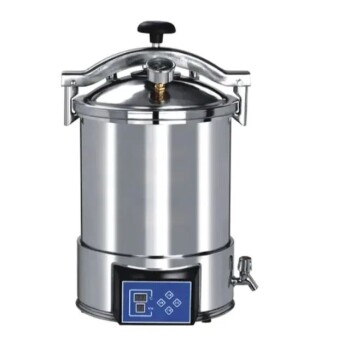
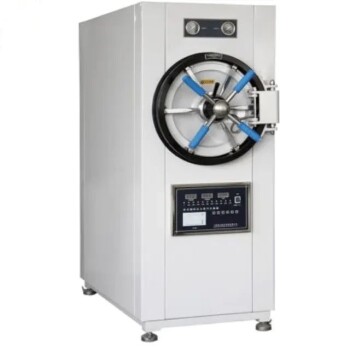
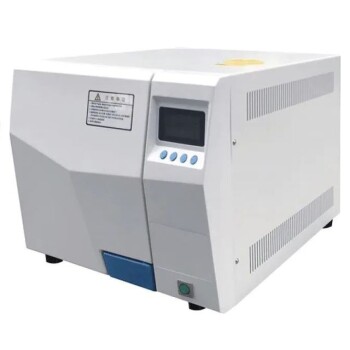
A high-pressure hydrothermal autoclave functions as a precision crystallization chamber. It creates a sealed, aqueous environment maintained at 100 °C, forcing copper salt precursors to react over a specific duration (typically 12 hours). This controlled environment is the determining factor in steering atomic assembly into two-dimensional nanoplates rather than random aggregates.
The autoclave's sealed, high-pressure environment is the critical mechanism that dictates the geometry of the copper. It enables the synthesis of high-aspect-ratio nanoplates with superior electrical conductivity, which are essential for the performance of Cu-SiOC hybrid ceramics.
The Mechanics of Hydrothermal Synthesis
The autoclave is not merely a heating vessel; it is a tool for controlling the architecture of the material at the atomic level.
Creating a Sealed Reaction Environment
The autoclave creates a closed system that traps water and reactants.
By sealing the vessel, the pressure increases as the temperature rises to 100 °C.
This prevents the loss of solvents and ensures the copper salt precursors remain in a reactive aqueous medium throughout the process.
Guiding Crystallographic Orientation
The primary function of the autoclave in this context is directional growth control.
Over a reaction period of approximately 12 hours, the high-pressure environment facilitates the arrangement of copper atoms along specific crystallographic lines.
This forces the material to grow into two-dimensional nanoplates (Cu NPLs) rather than spherical particles or amorphous blobs.
Achieving High Aspect Ratios
The ultimate goal of this synthesis is to achieve a specific geometric shape.
The hydrothermal process yields nanoplates characterized by high aspect ratios (large surface area relative to thickness).
This geometry is critical because it maximizes the contact area between the copper and the ceramic matrix (SiOC) it will eventually inhabit.
Enhancing Electrical Conductivity
The controlled growth environment directly impacts the functional properties of the copper.
By ensuring uniform crystallization, the process results in copper structures with excellent electrical conductivity.
This makes the resulting Cu-SiOC hybrid ceramic highly effective for applications requiring efficient charge transport.
Understanding the Trade-offs
While the hydrothermal autoclave is effective for producing high-quality nanoplates, it introduces specific constraints to the manufacturing workflow.
Process Duration Limitations
The synthesis requires a significant time investment, specifically noted as 12 hours in the primary data.
This long reaction time can become a bottleneck for high-throughput manufacturing compared to faster synthesis methods.
Batch Processing Constraints
Autoclaves typically operate as batch reactors due to the need for a sealed, pressurized environment.
This limits the ability to produce these nanoplates in a continuous flow, potentially complicating scalability for large industrial applications.
Making the Right Choice for Your Goal
To maximize the utility of the high-pressure hydrothermal autoclave in your Cu-SiOC project, align your parameters with your specific material requirements.
- If your primary focus is Geometric Precision: Adhere strictly to the long-duration (12-hour) sealed cycle to ensure atoms have sufficient time to align into high-aspect-ratio plates.
- If your primary focus is Electrical Performance: Prioritize the integrity of the sealed environment to prevent oxidation or contamination, ensuring the final nanoplates retain maximum conductivity.
The autoclave provides the requisite thermodynamic conditions to transform basic copper salts into highly conductive, two-dimensional architectural components.
Summary Table:
| Feature | Function in Cu NPL Synthesis |
|---|---|
| Temperature Control | Maintains constant 100 °C for stable crystallization |
| Reaction Environment | Sealed aqueous medium prevents solvent loss and oxidation |
| Pressure Mechanism | Forces copper salt precursors into 2D crystallographic orientation |
| Processing Time | 12-hour duration ensures high-aspect-ratio nanoplate growth |
| Final Outcome | Produces highly conductive Cu NPLs for SiOC ceramic integration |
Elevate Your Material Research with KINTEK Precision Engineering
Unlock the full potential of your nanostructure synthesis with KINTEK’s high-performance laboratory solutions. As experts in material science equipment, we provide the specialized high-temperature high-pressure reactors and autoclaves required to achieve the precise geometric control and electrical conductivity your Cu-SiOC hybrid ceramics demand.
Beyond synthesis, KINTEK offers a comprehensive portfolio including:
- Advanced Thermal Processing: Muffle, tube, and vacuum furnaces.
- Sample Preparation: Hydraulic pellet presses, crushing systems, and high-purity crucibles.
- Laboratory Essentials: ULT freezers, electrolytic cells, and high-durability PTFE consumables.
Ready to scale your synthesis from the lab to industrial excellence? Contact our technical specialists today to find the perfect equipment configuration for your specific research goals.
References
- Zheng Li, Shenqiang Ren. Additive Manufacturing of High‐Temperature Preceramic‐Derived SiOC Hybrid Functional Ceramics. DOI: 10.1002/adem.202300957
This article is also based on technical information from Kintek Solution Knowledge Base .
Related Products
- High Pressure Laboratory Autoclave Reactor for Hydrothermal Synthesis
- Mini SS High Pressure Autoclave Reactor for Laboratory Use
- Stainless High Pressure Autoclave Reactor Laboratory Pressure Reactor
- Automatic High Temperature Heated Hydraulic Press Machine with Heated Plates for Lab
- Customizable High Pressure Reactors for Advanced Scientific and Industrial Applications
People Also Ask
- What role does a high-pressure reactor (autoclave) play in the synthesis of NiCuFe-LDH? Master Hydrothermal Growth
- What Role Does a High-Pressure Reactor or Autoclave Play in HA Catalyst Synthesis? Achieve High Surface Area Materials
- What equipment is required for hydrothermal synthesis of Ga0.25Zn4.67S5.08? Optimize Your Semiconductor Production
- What is the function of a high-pressure reactor in the hydrothermal synthesis of boehmite? Expert Process Insights
- What role does an autoclave play in the synthesis of MnO2 nanofibers? Mastering Hydrothermal Growth