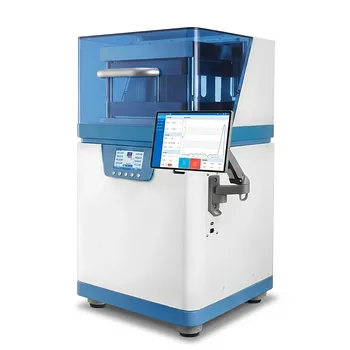
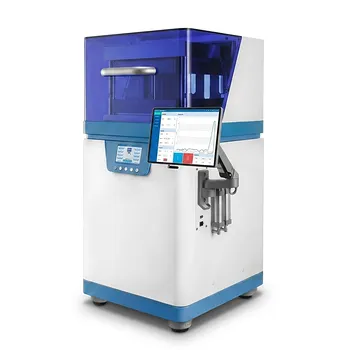
The high-temperature high-pressure (HTHP) reactor serves as the primary vessel for the hydrothermal synthesis of iron-doped titanium dioxide nanofiber (Fe-TN) precursors. It provides the necessary thermodynamic environment to transform bulk titanium dioxide powder and sodium hydroxide into one-dimensional hydrogen titanate (H2Ti3O7) nanofibers. This structural transition is the critical first step, establishing a high-aspect-ratio foundation that allows for subsequent iron doping and phase transitions.
Core Takeaway: The HTHP reactor drives the dissolution and recrystallization of raw materials into high-surface-area nanofibers, creating a stable structural template that is otherwise impossible to achieve under standard atmospheric conditions.
Driving Structural Transformation
Facilitating Dissolution and Recrystallization
In the preparation of Fe-TN precursors, the reactor enables a hydrothermal treatment where titanium dioxide powder reacts with a high-concentration sodium hydroxide solution. The intense heat and pressure cause the bulk material to dissolve and then recrystallize into a new crystalline form.
This process specifically yields hydrogen titanate (H2Ti3O7), a layered structure that naturally tends toward one-dimensional growth. This phase is the essential precursor that determines the final morphology of the iron-doped product.
Achieving High Aspect Ratios
The sealed environment of the reactor allows for the formation of nanofibers with a high aspect ratio. By controlling the internal pressure and temperature, the system forces the material to grow into long, thin fibers rather than granular particles.
These nanofibers provide a significantly increased specific surface area, often exceeding 100 m²/g. This expanded surface is vital for ensuring that subsequent iron-doping is uniform and that the material remains reactive for photocatalytic applications.
Creating the Necessary Thermodynamic Environment
Overcoming Atmospheric Pressure Limits
Standard atmospheric conditions are insufficient to drive the chemical reorganization of the anatase titanium dioxide crystal structure into titanate nanotubes or nanofibers. The HTHP reactor (or autoclave) creates a closed solvothermal system where internal pressure effectively lowers the energy barrier for these reactions.
This environment enables the precise induction of crystallization from an amorphous phase to specific crystalline phases. Without this controlled pressure, the resulting material would lack the structural regularity required for high-performance nanofibers.
Ensuring Chemical Purity and Stability
Many HTHP reactors utilize a PTFE (polytetrafluoroethylene) liner within a stainless steel shell to maintain high chemical stability. This liner is crucial because it prevents the corrosive sodium hydroxide solution from reacting with the metallic walls of the reactor.
By isolating the reaction, the system eliminates the risk of introducing metallic impurities into the precursor. This ensures that the final iron-doping process is precise and not contaminated by stray ions from the equipment itself.
Understanding the Trade-offs and Limitations
Thermal and Pressure Constraints
While HTHP reactors are essential, they have clear operational limits, particularly regarding the PTFE liners, which typically cannot exceed 220–250°C. Exceeding these temperatures can lead to liner deformation or the release of toxic vapors, compromising the experiment.
Scaling and Batch Consistency
Hydrothermal synthesis is primarily a batch process, which can lead to minor variations in nanofiber quality between different runs. Achieving perfect consistency in large-scale production requires rigorous monitoring of heat-up and cool-down rates within the reactor.
How to Apply This to Your Project
Selecting the Right Approach for Your Goal
- If your primary focus is high-purity research: Utilize a PTFE-lined stainless steel autoclave to ensure zero metallic contamination during the hydrothermal phase.
- If your primary focus is maximizing photocatalytic activity: Prioritize reactor settings that favor high-aspect-ratio growth to increase the specific surface area available for doping.
- If your primary focus is industrial scalability: Consider parallel batch processing or high-volume HTHP stirred reactors to maintain uniform temperature distribution across larger quantities.
The high-temperature high-pressure reactor is the indispensable tool that converts raw chemical inputs into the sophisticated nanofiber architecture required for advanced iron-doped titanium dioxide materials.
Summary Table:
| Key Function | Mechanism | Technical Benefit |
|---|---|---|
| Structural Transition | Hydrothermal dissolution/recrystallization | Converts bulk $TiO_2$ into 1D $H_2Ti_3O_7$ nanofibers |
| Morphology Control | High-pressure sealed environment | Achieves high aspect ratio and surface area >100 $m^2/g$ |
| Purity Protection | PTFE-lined stainless steel shell | Prevents metallic ion contamination from corrosive NaOH |
| Energy Barrier Reduction | Closed solvothermal system | Enables phase transition impossible at atmospheric pressure |
Elevate your material synthesis with KINTEK’s precision-engineered laboratory solutions. Whether you are developing Fe-TN precursors or advanced photocatalysts, our high-temperature high-pressure reactors and autoclaves provide the stable thermodynamic environment required for superior nanofiber growth.
KINTEK specializes in a comprehensive range of laboratory equipment, including muffle and vacuum furnaces, hydraulic presses, and high-purity ceramic consumables. Ready to optimize your hydrothermal research? Contact KINTEK today for expert guidance and reliable equipment tailored to your lab's needs!
References
- Xiao Wang, Dongjiang Yang. The Use of Iron-Doped Anatase TiO2 Nanofibers for Enhanced Photocatalytic Fenton-like Reaction to Degrade Tylosin. DOI: 10.3390/molecules28196977
This article is also based on technical information from Kintek Solution Knowledge Base .
Related Products
- Customizable Laboratory High Temperature High Pressure Reactors for Diverse Scientific Applications
- High Pressure Laboratory Autoclave Reactor for Hydrothermal Synthesis
- Stainless High Pressure Autoclave Reactor Laboratory Pressure Reactor
- Customizable High Pressure Reactors for Advanced Scientific and Industrial Applications
- Mini SS High Pressure Autoclave Reactor for Laboratory Use
People Also Ask
- How do high-pressure and high-temperature reactors ensure the effective treatment of lignocellulosic wastewater in WAO?
- What equipment is required for high-pressure high-temperature reactions? Master Extreme Chemistry Safely
- How do you control high pressure in a reactor? A Guide to Safe & Stable Operation
- Why is argon better than nitrogen for inert atmosphere? Ensure Absolute Reactivity & Stability
- How does initial oxygen pressure affect the wet oxidation of pharmaceutical sludge? Master Your Oxidation Depth