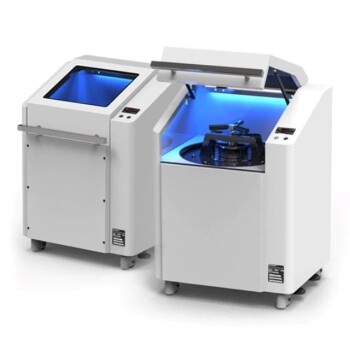
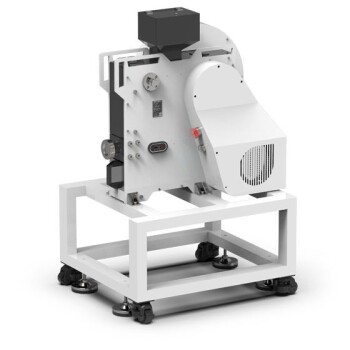
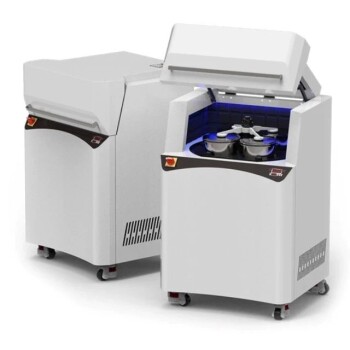
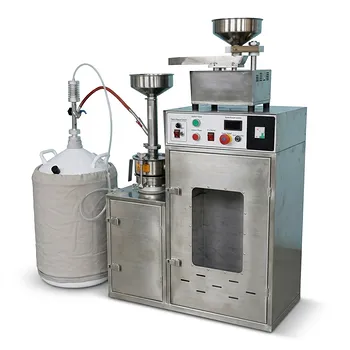
The primary function of a knife mill in wheat straw-based biochar preparation is to mechanically transform bulky, dry biomass into uniform, small particles through high-intensity cutting. This critical pretreatment increases the material's geometric surface area, which facilitates efficient mass exchange during chemical impregnation and ensures uniform heat transfer during the pyrolysis process.
Precise particle size reduction is the foundation of high-quality biochar production. By standardizing the physical dimensions of wheat straw, a knife mill ensures that thermal decomposition and chemical activations occur consistently throughout the entire batch of raw material.
Optimizing Physical Structure for Pyrolysis
Increasing Geometric Surface Area
Wheat straw is naturally fibrous and low-density, which makes it resistant to uniform processing. The knife mill uses sharp blades to shear these fibers into smaller fragments, significantly increasing the surface-area-to-volume ratio.
Ensuring Uniform Heat Transfer
During the pyrolysis stage, heat must penetrate the biomass to trigger thermal decomposition. Uniform particle sizes prevent a temperature gradient where the outside of a particle is charred while the core remains raw, leading to a more homogenous final carbon product.
Facilitating Mass Exchange
If the biochar requires chemical modification, such as leaching or impregnation with magnesium salts or phosphoric acid, the reduced particle size is essential. The increased surface area allows chemical activators to penetrate the biomass structure more deeply and rapidly.
Enhancing Product Consistency and Quality
Improving Chemical Impregnation Efficiency
For specialized biochars, physical refinement ensures that liquid reagents can uniformly coat and saturate the straw fibers. This results in a more consistent distribution of active sites or mineral additives within the final biochar matrix.
Standardizing Feed for Industrial Reactors
Continuous pyrolysis systems and laboratory analyses (like thermogravimetric analysis) require a standardized feed size, often 1 mm or less. A knife mill provides the mechanical precision needed to meet these strict particle size requirements for reliable data and stable operation.
Understanding the Trade-offs
Balancing Particle Size and Process Flow
While finer particles increase reaction rates, excessive milling can create dust that is difficult to handle in certain reactor types. Producers must find the "sweet spot" where particles are small enough for efficiency but large enough to avoid clogging or material loss.
Energy Consumption and Wear
High-intensity cutting requires significant mechanical energy, especially when processing tough, silicious materials like wheat straw. Blade maintenance is a recurring necessity, as dull knives will tear rather than cut the fibers, leading to inconsistent particle shapes and higher energy costs.
How to Apply This to Your Project
Selecting the Right Milling Parameters
- If your primary focus is maximizing chemical activation: Aim for a finer grind (e.g., <1 mm) to ensure the highest possible surface area for reagent penetration.
- If your primary focus is high-throughput pyrolysis: Utilize a coarser setting (e.g., 2 mm to 8 mm) to maintain efficient material flow through the reactor while still ensuring adequate heat transfer.
- If your primary focus is analytical accuracy: Ensure the knife mill produces a highly uniform powder to minimize sampling errors during elemental or thermogravimetric analysis.
Proper mechanical pretreatment via a knife mill is the essential first step in transforming raw wheat straw into a high-performance, consistent biochar product.
Summary Table:
| Function | Key Benefit | Impact on Biochar Quality |
|---|---|---|
| Size Reduction | Increases surface-area-to-volume ratio | Faster chemical activation & impregnation |
| Uniform Cutting | Ensures consistent particle dimensions | Homogeneous thermal decomposition |
| Fiber Shearing | Breaks down tough, fibrous biomass | Enhanced geometric surface area |
| Feed Standardization | Meets strict reactor requirements | Stable operation and reliable analytical data |
Elevate Your Biochar Research with Precision Milling
Achieving high-quality, consistent biochar starts with superior material pretreatment. KINTEK specializes in high-performance crushing and milling systems designed to transform tough biomass like wheat straw into the perfect feedstock. Whether you need fine powders for chemical activation or standardized particles for high-temperature pyrolysis, our equipment ensures the precision your lab requires.
Beyond milling, KINTEK offers a comprehensive range of laboratory solutions, including:
- High-Temperature Furnaces: Muffle, tube, and vacuum furnaces for precise pyrolysis.
- Material Processing: Hydraulic presses, sieving equipment, and specialized reactors.
- Consumables: High-quality ceramics, crucibles, and PTFE products.
Ready to optimize your lab's efficiency and product consistency? Contact our experts today to find the ideal milling and thermal processing solution for your specific application!
References
- Priyanka Priyanka, S.K. Mehta. Evaluating the pre-treatment protocol required to produce an effective carbonized waste adsorbent for organic pollution control. DOI: 10.3389/fenvs.2023.1224388
This article is also based on technical information from Kintek Solution Knowledge Base .
Related Products
- Laboratory Disc Cup Vibratory Mill for Sample Grinding
- Vibrating Disc Mill Small Laboratory Grinding Machine
- Laboratory Jar Mill with Agate Grinding Jar and Balls
- Laboratory Jaw Crusher
- Laboratory Ball Mill Jar Mill with Metal Alloy Grinding Jar and Balls
People Also Ask
- What function does a laboratory vibratory mill serve? Achieve 1–5 µm Precision for Cs-Aluminosilicate Powder
- What is the role of a laboratory vibratory sample grinder? Achieve Superior Precision in Smelting Product Analysis
- What is the function of an industrial vibratory mill? Optimize Fe-Cr-Al Alloy Powder Production
- Why use stainless steel jars and balls for solid-state battery slurries? Maximize Dispersion and Conductivity
- How does a Vibratory Mill improve niobium recovery efficiency? Optimize Waste Pre-treatment for Maximum Yield