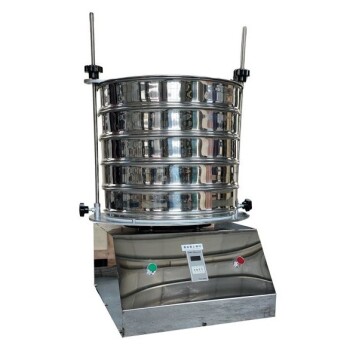
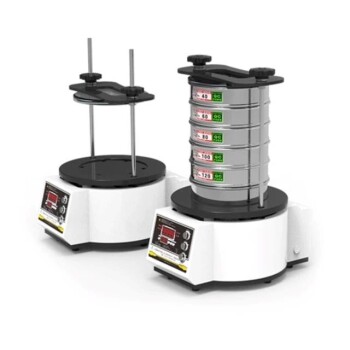
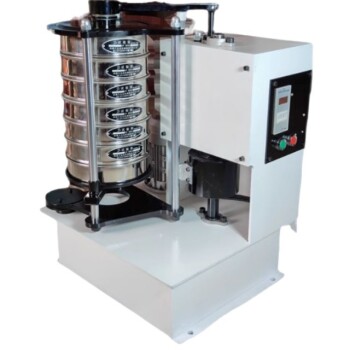
The primary purpose of using standard mesh sieves, such as 20 mesh, during the pretreatment of straw is to ensure a uniform particle size across the raw material. This uniformity is the critical foundation for achieving consistent heat conduction during the carbonization process, which directly dictates the stability of the final biochar’s physical and chemical properties.
Core Takeaway: Sieving eliminates particle size variability to ensure that heat and chemical modifiers penetrate the biomass evenly. Without this standardization, the resulting biochar would suffer from inconsistent quality, undermining its performance in adsorption, catalysis, or soil amendment.
The Critical Role of Uniform Heat Conduction
Synchronizing the Carbonization Process
During hypoxic carbonization in a muffle furnace, heat must penetrate the biomass to trigger the chemical transformation into biochar. If particle sizes vary significantly, smaller pieces may overheat or "over-cook" while larger fragments remain under-processed at the core.
Standardizing the size ensures that every particle reaches the target temperature at the same time. This leads to a homogenous substrate with predictable pore structures and surface areas.
Eliminating Experimental "Size Effects"
In a research or industrial setting, inconsistent particle sizes introduce unwanted variables. Disparate sizes can lead to unsynchronized heat conduction during thermogravimetric analysis, which obscures the actual thermal behavior of the material.
By using a standard sieve, you eliminate these "size effects." This ensures that any observed changes in the biochar's performance are due to the treatment or modification itself, rather than random variations in raw material geometry.
Enhancing Modification and Impregnation
Optimizing Chemical Penetration
When preparing modified biochar—such as copper-modified varieties—the raw material often undergoes an impregnation process with metal salts. Uniform particle sizes allow for even penetration of the modification solution throughout the biomass powder.
If particles are too large, the inner layers of the straw may not interact with the modification agents. A 20 or 40-mesh sieve ensures a high effective specific surface area, maximizing the contact between the biomass and the exogenous organic or inorganic matter.
Facilitating Homogeneous Mixtures
In processes like co-torrefaction, where straw is mixed with other materials like plastics, uniformity is essential for a homogeneous mixture. Consistent sizes prevent the materials from stratifying or separating based on weight and volume.
This homogeneity ensures that the resulting composite biochar possesses highly consistent catalytic or mechanical properties. It provides the necessary material foundation for establishing accurate predictive models for industrial applications.
Understanding the Trade-offs and Pitfalls
Material Loss and Yield Considerations
Rigorous sieving inevitably leads to the loss of "undersized" or "oversized" fractions that do not meet the mesh criteria. While this improves quality, it reduces the overall mass yield of the raw material, which can impact the cost-efficiency of large-scale production.
Dust Management and Safety
Crushing straw to pass through fine sieves (like 20 or 60 mesh) generates significant amounts of biomass dust. This requires specialized equipment for dust extraction to prevent respiratory hazards for operators and to mitigate the risk of dust explosions in dry environments.
The Risk of Over-Processing
Excessive grinding to meet very fine mesh requirements (e.g., 200 mesh) can sometimes alter the natural cellular structure of the straw. This mechanical stress may collapse certain macro-pores before carbonization even begins, potentially limiting the final product's porosity.
How to Apply This to Your Project
Selecting the Right Sieve for Your Goal
The choice of mesh size should be dictated by the specific requirements of your downstream application and the nature of your biomass.
- If your primary focus is standardizing heat transfer for basic biochar: A 20-mesh sieve is typically sufficient to ensure uniform carbonization in a muffle furnace.
- If your primary focus is chemical modification (e.g., metal salts): Use a finer sieve, such as 40 to 60 mesh, to increase the surface area for more effective impregnation.
- If your primary focus is adsorption kinetics or fluid dynamics: Utilize 150-200 mesh sieves on the finished biochar to ensure predictable mass transfer rates in liquid phases.
- If your primary focus is soil application or large-scale amendment: Standard 1 mm or 2 mm sieves are often preferred to balance material uniformity with high-volume processing needs.
Ensuring particle uniformity is the most effective way to transform raw agricultural waste into a high-performance, predictable technical material.
Summary Table:
| Aspect | Importance in Pretreatment | Key Benefit |
|---|---|---|
| Particle Uniformity | Ensures consistent heat penetration | Prevents over-processing or under-processing |
| Chemical Impregnation | Increases effective surface area | Optimizes penetration of modifiers like metal salts |
| Experimental Control | Eliminates size-related variables | Ensures data reflects treatment effects, not geometry |
| Material Homogeneity | Prevents stratification in mixtures | Facilitates accurate predictive models for industry |
Optimize Your Biochar Research with KINTEK Precision
Achieving consistent biochar properties starts with the right tools. KINTEK specializes in high-performance laboratory equipment designed for rigorous material pretreatment and carbonization. Whether you need precise sieving equipment, high-efficiency crushing and milling systems, or our industry-leading muffle and tube furnaces for uniform thermal processing, we provide the technical foundation for your innovation.
From high-temperature reactors to specialized consumables like crucibles and ceramics, KINTEK ensures your research is backed by reliability and precision. Contact KINTEK today to explore how our comprehensive range of laboratory solutions can enhance your material quality and process efficiency!
References
- Bo Tang, Zhifeng Liu. Adsorption Characteristics of Cd2+ Ions in Aqueous Solution on Modified Straw Biochar. DOI: 10.3390/su15054373
This article is also based on technical information from Kintek Solution Knowledge Base .
Related Products
- Custom PTFE Teflon Parts Manufacturer for PTFE Mesh F4 Sieve
- Mesh belt controlled atmosphere furnace
- Three-dimensional electromagnetic sieving instrument
- Laboratory Test Sieves and Sieving Machines
- Vibratory Sieve Shaker Machine Dry Three-Dimensional Vibrating Sieve
People Also Ask
- What are the primary reasons for selecting PTFE as a matrix? Enhance Composites with Carbon Nanotube Reinforcement
- How is PTFE utilized for insulation in Alloy 22 corrosion setups? Ensure Signal Purity & Accuracy
- Is PTFE corrosion resistant? Discover the Ultimate Chemical Resistance for Your Lab
- What are the specific applications of PTFE in micro-batch slug flow systems? Enhance Your Microfluidic Reaction Purity
- What is the mesh size of a sieve? A Guide to Particle Size and Sieve Selection