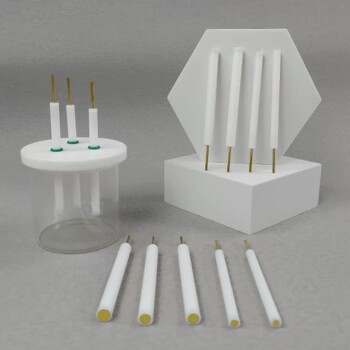
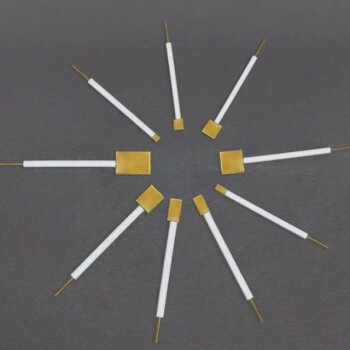
The high-purity platinum wire counter electrode is the essential "sink" or "source" for electrons that allows your photoanode measurements to remain accurate and stable. Its primary purpose is to complete the electrical circuit and facilitate a counter-reaction—typically the hydrogen evolution reaction (HER)—with minimal resistance. This ensures that the current measured is solely a reflection of the photoanode's performance, rather than being limited or distorted by the counter electrode itself.
Core Takeaway: In photoanode characterization, a platinum counter electrode provides a chemically inert and catalytically active surface that balances charge without introducing measurement errors. It isolates the working electrode’s kinetics by preventing polarization and ensuring the potential stability of the entire three-electrode system.
Completing the Electrochemical Circuit
Providing a High-Efficiency Return Path
The platinum wire serves as the primary current return path in a three-electrode cell. By carrying the experimental current, it ensures that electrons flow freely between the working electrode and the external circuit.
Protecting the Reference Electrode
By handling the entire current load, the platinum wire prevents current from flowing through the reference electrode. This is critical because any current flow through a reference electrode would cause potential polarization, destroying the accuracy of your voltage readings.
Ensuring Charge Balance
In a photoanode setup, the platinum electrode carries the counter-reaction necessitated by the working electrode. This maintains the overall charge balance within the electrolyte, allowing for the precise recording of kinetic data at various potentials.
Facilitating the Counter-Reaction
Catalyzing the Hydrogen Evolution Reaction (HER)
When a photoanode performs the oxygen evolution reaction (OER), the counter electrode must perform a balancing reduction. Platinum is used because it is a world-class catalyst for the hydrogen evolution reaction (HER), where water is reduced to hydrogen gas.
Minimizing Overpotential and Polarization
Platinum’s superior catalytic activity results in extremely low polarization resistance. This means the counter-reaction happens almost effortlessly, ensuring the counter electrode never becomes a "bottleneck" that introduces resistance into the measurement.
Eliminating Measurement Errors
The high-purity nature of the wire ensures that current measurements reflect the photogenerated charge carrier behavior of the photoanode. Without this efficiency, the measured signals could be influenced by the energy required to drive the reaction at the counter electrode.
Maintaining Chemical and System Integrity
Exceptional Chemical Inertness
Platinum remains stable in aggressive environments, such as strong alkaline (6 M KOH) or acidic electrolytes. This prevents the electrode from oxidizing or releasing impurity ions into the solution during characterization.
Preventing Electrolyte Contamination
Using high-purity platinum ensures that no foreign metal ions are introduced into the system. This guarantees that the measured activity is strictly due to the photoanode and is not influenced by interfering electrochemical reactions.
Stability Across Potentials
Because platinum does not easily oxidize, it maintains a constant surface area and activity level throughout the experiment. This stability is vital for long-term testing and ensures the scientific validity of the catalyst activity evaluation.
Understanding the Trade-offs
The Risk of Platinum Dissolution
Despite its inertness, platinum can undergo slight dissolution at certain potentials, especially in acidic or chloride-rich environments. These trace platinum ions can migrate and redeposit on the working electrode, which may artificially inflate the measured catalytic activity.
Cost vs. Surface Area
While platinum wire is effective, it is expensive. Researchers must often balance the need for a large surface area (to ensure the counter electrode is never the rate-limiting step) with the high cost of the precious metal.
Physical Configuration
The shape of the platinum (wire vs. mesh vs. sheet) matters. While a wire is standard for low-current applications, a platinum mesh is often preferred for high-current experiments to provide more active sites and further reduce polarization.
Making the Right Choice for Your Goal
How to Apply This to Your Project
- If your primary focus is high-precision kinetics: Use a high-purity platinum wire or mesh with a surface area significantly larger than your working electrode to eliminate any chance of counter-electrode limitation.
- If your primary focus is long-term stability testing: Regularly check the electrolyte for dissolved platinum and inspect the working electrode for redeposition to ensure your results are not being "helped" by migrating platinum ions.
- If your primary focus is cost-efficiency in low-current setups: A simple platinum wire is usually sufficient, provided it is cleaned regularly in acid to maintain its catalytic surface.
Choosing a high-purity platinum counter electrode ensures that your data reflects the true performance of your photoanode, free from the artifacts of system resistance or chemical interference.
Summary Table:
| Feature | Purpose in Electrochemical Cells |
|---|---|
| Circuit Completion | Acts as an electron sink/source to allow free current flow. |
| Charge Balance | Catalyzes counter-reactions (like HER) to balance photoanode OER. |
| Potential Stability | Protects the reference electrode from polarization and voltage errors. |
| Chemical Inertness | Prevents electrolyte contamination and electrode degradation in harsh pH. |
| Catalytic Activity | Minimizes overpotential and resistance for true kinetic measurements. |
Elevate Your Electrochemical Research with KINTEK
Precision in photoanode characterization starts with high-quality components. KINTEK specializes in premium laboratory equipment, offering high-purity electrolytic cells and electrodes—including platinum wire, mesh, and sheets—designed to provide the stability and catalytic efficiency your research demands.
Beyond electrodes, our comprehensive portfolio supports your entire workflow with:
- High-Temperature Reactors & Autoclaves for advanced material synthesis.
- Battery Research Tools and specialized consumables like PTFE and ceramics.
- Precision Milling & Pelleting Systems for sample preparation.
Don't let measurement errors compromise your findings. Contact KINTEK today to discuss your specific application needs and discover how our high-performance solutions can drive your scientific breakthroughs.
References
- Ahmed Chnani, Steffen Strehle. Ultrathin Hematite‐Hercynite Films for Future Unassisted Solar Water Splitting. DOI: 10.1002/admt.202300655
This article is also based on technical information from Kintek Solution Knowledge Base .
Related Products
- Platinum Auxiliary Electrode for Laboratory Use
- Platinum Sheet Electrode for Laboratory and Industrial Applications
- Rotating Platinum Disk Electrode for Electrochemical Applications
- Platinum Sheet Electrode for Battery Lab Applications
- RRDE rotating disk (ring disk) electrode / compatible with PINE, Japanese ALS, Swiss Metrohm glassy carbon platinum
People Also Ask
- What is the function of a platinum electrode as an auxiliary electrode? Ensure Precise Nickel Coating Corrosion Testing
- Why is platinum typically selected as the auxiliary electrode for electrochemical testing of oxazoline inhibitors?
- What does the auxiliary electrode do? Ensuring Accurate Electrochemical Measurements
- What are the roles of Pt counter and reference electrodes in nitrided steel testing? Optimize Your Electrochemical Data
- What are the advantages of using a platinum counter electrode? Ensure Purity in Photocatalytic Coating Deposition