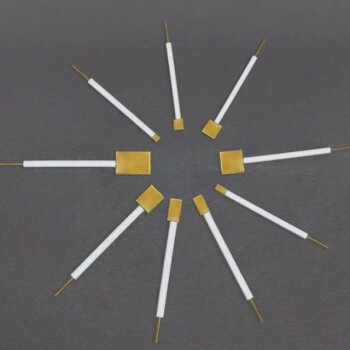
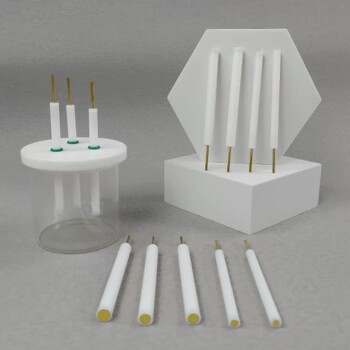
The primary advantage of using a platinum counter electrode is its ability to maintain total system purity while facilitating efficient electron flow. Because platinum is chemically inert and highly conductive, it ensures the electrodeposition process remains free from contamination, even under the aggressive electrical conditions required for coating metal substrates.
Core Takeaway Platinum serves as the bedrock for high-quality electrodeposition by combining extreme chemical stability with superior conductivity. By resisting corrosion and preventing metal ion release, it guarantees that the resulting photocatalytic layer is uniform, pure, and free from performance-degrading impurities.
Preserving Chemical Purity
The Critical Role of Inertness
The most significant benefit of platinum is its exceptional chemical inertness. In an electrochemical cell, the counter electrode must resist reacting with the electrolyte or the substrate.
Platinum does not participate in redox reactions or undergo self-dissolution. This stability is maintained even when exposed to aggressive acidic environments or chloride-rich solutions often used in electrodeposition.
Preventing Ionic Contamination
If a counter electrode corrodes, it releases metal impurity ions into the electrolyte. These impurities can co-deposit onto the substrate, ruining the photocatalytic properties of the coating.
Platinum prevents this entirely. By remaining stable, it ensures that the deposited layer—such as titanium dioxide—remains highly pure and free from foreign metal interference.
Operational Stability Under Stress
Withstanding High Voltages
Electrodeposition processes for titanium-based coatings often require significant electrical force to achieve the desired material properties.
Platinum electrodes are capable of operating under high voltage conditions, such as 200 V, without degrading. This durability allows for rigorous processing parameters without the risk of electrode failure.
Ensuring Uniform Deposition
The quality of the coating relies on a stable electrical field. Platinum’s high electrical conductivity ensures the current circuit is completed efficiently.
This facilitates a consistent flow of current through the system. Consequently, the coating is deposited uniformly across the substrate surface, preventing uneven thickness or structural defects.
Technical Accuracy in Measurement
Facilitating Hydrogen and Oxygen Evolution
Platinum is characterized by exceptional activity for hydrogen and oxygen evolution reactions.
This allows the necessary counter-reactions to occur smoothly at the counter electrode surface. It ensures the current flows through the circuit without bottlenecks, enabling the primary reaction at the working electrode (the metal substrate) to proceed efficiently.
Non-Interfering Current Response
In precise electrochemical setups, such as those using a three-electrode system, accurate data collection is paramount.
Because platinum does not dissolve or oxidize, it does not generate "noise" in the current response. This ensures that the current measured is solely the result of the reactions occurring on the stainless steel or metal substrate, providing accurate experimental data.
Understanding the Risks of Alternatives
While platinum is the standard, it is important to understand the risks associated with using inferior materials.
The Risk of Anodic Dissolution The primary trade-off in selecting a counter electrode is the balance between cost and inertness. Non-platinum metals may function temporarily but are prone to anodic dissolution (corrosion) when acting as an anode.
Compromised Coating Performance If the electrode degrades, the introduction of even trace impurities can drastically alter the electronic properties of a photocatalytic coating. Therefore, omitting platinum introduces a significant variable that can lead to inconsistent or failed coating applications.
Making the Right Choice for Your Goal
To achieve the best results in your electrodeposition project, align your electrode choice with your specific technical requirements:
- If your primary focus is Photocatalytic Efficiency: Prioritize platinum to eliminate impurity ions that would otherwise act as recombination centers and lower catalytic activity.
- If your primary focus is High-Voltage Deposition: Rely on platinum to withstand potentials up to 200 V without suffering from corrosion or structural degradation.
Summary: For professional-grade electrodeposition, the use of platinum is not a luxury but a technical necessity to ensure the chemical integrity and physical uniformity of the final coating.
Summary Table:
| Feature | Platinum Counter Electrode Benefit | Impact on Coating |
|---|---|---|
| Chemical Stability | Exceptional inertness; resists corrosion | Prevents contamination and maintains purity |
| Electrical Conductivity | Superior electron flow | Ensures uniform thickness and distribution |
| Voltage Tolerance | Functions up to 200 V without degradation | Enables rigorous high-voltage processing |
| Electrocatalytic Activity | Facilitates oxygen/hydrogen evolution | Smooth current flow without bottlenecks |
| Measurement Accuracy | No "noise" from dissolution/oxidation | Precise data for experimental monitoring |
Elevate Your Electrochemical Precision with KINTEK
Don't compromise the integrity of your photocatalytic coatings with inferior materials. KINTEK specializes in high-performance laboratory equipment, providing the platinum electrodes, electrolytic cells, and high-purity consumables necessary for sophisticated material research.
Whether you are performing high-voltage electrodeposition or developing the next generation of batteries, our comprehensive range—from muffle furnaces and vacuum systems to PTFE products and ceramics—is designed to meet the most demanding scientific standards.
Ready to optimize your lab results? Contact our technical experts today to find the perfect solution for your research needs.
References
- Elisabetta Martini, Antonio Fortuna. Reducing the pollutant load of olive mill wastewater by photocatalytic membranes and monitoring the process using both tyrosinase biosensor and COD test. DOI: 10.3389/fchem.2013.00036
This article is also based on technical information from Kintek Solution Knowledge Base .
Related Products
- Platinum Auxiliary Electrode for Laboratory Use
- Rotating Platinum Disk Electrode for Electrochemical Applications
- Platinum Sheet Electrode for Laboratory and Industrial Applications
- Platinum Sheet Electrode for Battery Lab Applications
- RRDE rotating disk (ring disk) electrode / compatible with PINE, Japanese ALS, Swiss Metrohm glassy carbon platinum
People Also Ask
- What is the function of a platinum electrode as an auxiliary electrode? Ensure Precise Nickel Coating Corrosion Testing
- Why is platinum typically selected as the auxiliary electrode for electrochemical testing of oxazoline inhibitors?
- What does the auxiliary electrode do? Ensuring Accurate Electrochemical Measurements
- What are the roles of Pt counter and reference electrodes in nitrided steel testing? Optimize Your Electrochemical Data
- What role does a platinum counter electrode play in a three-electrode cell? Ensuring Data Purity & Circuit Stability