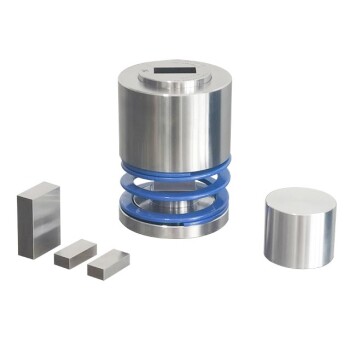
A high-pressure reactor creates a sealed, controllable system that allows solvents to be heated well above their normal boiling points, generating autogenous pressure. This specific environment is critical for regulating diffusion rates, which directly dictates the crystal structure and morphology of the synthesized particles. Ultimately, this process ensures the high uniformity required to maximize catalytic activity in heterogeneous Fenton reactions.
Core Insight: The value of a high-pressure reactor lies in its ability to decouple temperature from ambient pressure limits. By controlling diffusion through elevated pressure and temperature, you transform random precipitation into engineered crystal growth, resulting in highly uniform and active spinel ferrite catalysts.
Creating the Critical Reaction Environment
To understand the role of the reactor, one must first look at the physical conditions it enables.
Exceeding Atmospheric Limits
In a standard open vessel, reaction temperatures are capped by the solvent's boiling point. A high-pressure reactor provides a closed system that overcomes this limitation.
Generating Autogenous Pressure
As the solvent is heated within the sealed space, it vaporizes, creating autogenous pressure. This pressure is not pumped in externally but arises naturally from the thermodynamics of the heated solvent within a fixed volume.
Creating Subcritical or Supercritical Fluids
Under these conditions, the solvent can enter a subcritical or supercritical state. This drastically alters the solvent's properties, often enhancing its ability to dissolve precursors that are otherwise difficult to solubilize.
Mechanisms of Crystal Formation
The physical environment created by the reactor directly influences how the spinel ferrite crystals nucleate and grow.
Precise Control of Diffusion Rates
The primary mechanism at work here is the regulation of diffusion rates. The high-pressure environment facilitates the movement of ions through the solvent, allowing for a controlled delivery of material to the growing crystal face.
Facilitating Ion Rearrangement
The elevated temperature and pressure enhance the solubility of transition metal salts. This facilitates the rapid diffusion and rearrangement of precursor ions, ensuring they are available exactly where needed for lattice formation.
Directing Crystal Growth
By controlling diffusion, the reactor allows for the directional growth of specific crystal planes. This control is essential for defining the final morphology of the particle, such as creating specific shapes that expose active catalytic sites.
The Result: Superior Spinel Ferrite Catalysts
The ultimate goal of using this equipment is to improve the performance of the final material in Fenton reactions.
Achieving High Uniformity
The controlled environment minimizes chaotic nucleation. This results in nanocatalysts with high uniformity, meaning the particles are consistent in size and shape rather than a mix of random aggregates.
Enhancing Crystallinity
The stable heating environment promotes high crystallinity with fewer structural defects. A well-ordered crystal structure is vital for the electronic properties required in catalysis.
Maximizing Catalytic Activity
In heterogeneous Fenton reactions, surface activity is paramount. The improved morphology and uniformity achieved via high-pressure synthesis directly translate to enhanced catalytic activity, allowing for more efficient degradation of pollutants.
Understanding the Trade-offs
While high-pressure reactors offer superior catalyst quality, there are operational considerations to keep in mind.
Batch Processing Limitations
These reactors typically operate as batch systems (autoclaves). This can limit throughput compared to continuous flow systems, potentially creating bottlenecks during scale-up.
Safety and Equipment Costs
Operating at high pressures and temperatures requires robust, certified stainless steel or lined vessels. This increases the initial equipment cost and necessitates strict safety protocols compared to open-beaker synthesis.
Making the Right Choice for Your Goal
When deciding whether to employ high-pressure hydrothermal or solvothermal synthesis, consider your specific targets.
- If your primary focus is Peak Catalytic Performance: Use a high-pressure reactor to ensure the high crystallinity and specific morphology required for maximum reaction rates.
- If your primary focus is Particle Uniformity: Rely on the high-pressure environment to regulate diffusion and prevent the formation of irregular aggregates.
- If your primary focus is Novel Crystal Structures: Leverage the subcritical conditions to access crystal phases or shapes that cannot form at atmospheric pressure.
The high-pressure reactor is not just a heating vessel; it is a precision tool for engineering crystal architecture at the nanoscale.
Summary Table:
| Feature | Hydrothermal/Solvothermal Role | Impact on Spinel Ferrite Catalysts |
|---|---|---|
| Pressure Type | Autogenous (Self-generated) | Enables subcritical/supercritical fluid states |
| Mechanism | Regulated Diffusion Rates | Ensures precise ion rearrangement and lattice formation |
| Morphology | Directional Crystal Growth | Exposes active catalytic sites for higher efficiency |
| Consistency | Controlled Nucleation | Produces highly uniform particles with high crystallinity |
| Environment | Sealed Closed System | Allows temperatures well above solvent boiling points |
Elevate Your Nanomaterial Synthesis with KINTEK
Precise control over crystal morphology is the key to unlocking superior catalytic performance. KINTEK specializes in high-performance laboratory equipment, offering a premium range of high-temperature high-pressure reactors and autoclaves designed specifically for hydrothermal and solvothermal synthesis.
Whether you are developing advanced spinel ferrites for Fenton reactions or exploring novel crystal structures, our robust reactor systems provide the stability and safety required for subcritical fluid engineering. Beyond reactors, KINTEK supports your entire workflow with crushing systems, hydraulic presses, and specialized ceramics.
Ready to transform random precipitation into engineered excellence? Contact us today to find the perfect reactor for your research!
References
- Edgar Fajardo-Puerto, Francisco Carrasco‐Marín. From Fenton and ORR 2e−-Type Catalysts to Bifunctional Electrodes for Environmental Remediation Using the Electro-Fenton Process. DOI: 10.3390/catal13040674
This article is also based on technical information from Kintek Solution Knowledge Base .
Related Products
- Customizable Laboratory High Temperature High Pressure Reactors for Diverse Scientific Applications
- Customizable High Pressure Reactors for Advanced Scientific and Industrial Applications
- Stainless High Pressure Autoclave Reactor Laboratory Pressure Reactor
- Visual High-Pressure Reactor for In-Situ Observation
- Mini SS High Pressure Autoclave Reactor for Laboratory Use
People Also Ask
- How do high-pressure and high-temperature reactors ensure the effective treatment of lignocellulosic wastewater in WAO?
- What equipment is required for high-pressure high-temperature reactions? Master Extreme Chemistry Safely
- How do you control high pressure in a reactor? A Guide to Safe & Stable Operation
- Why is argon better than nitrogen for inert atmosphere? Ensure Absolute Reactivity & Stability
- How does initial oxygen pressure affect the wet oxidation of pharmaceutical sludge? Master Your Oxidation Depth