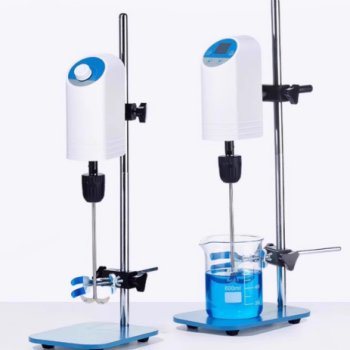
High-pressure homogenizers and ultrasonic cell disrupters act as the primary engine for fibrillation in nanocellulose production. In the mechanical processing stage, their specific role is to subject pretreated oil palm lignocellulose to extreme physical stress—specifically shear, cavitation, and impact forces. This intense energy input is required to sever the hydrogen bonds holding the material together, reducing the fiber dimensions from the microscale down to the nanoscale.
The core function of these devices is to mechanically disrupt the hydrogen-bonding network within the fiber. By doing so, they transform standard biomass into a high-performance nanomaterial characterized by high crystallinity and superior reinforcement properties.
The Mechanism of Disruption
Generating Extreme Forces
These machines do not simply cut the fiber; they subject it to a chaotic physical environment. The process relies on generating extreme mechanical shear forces alongside cavitation effects within the fluid suspension.
Breaking the Hydrogen Bond Network
The primary structural target of this mechanical energy is the hydrogen-bonding network. These bonds act as the "glue" between cellulose chains, and disrupting them is the fundamental requirement for liberating individual nanofibers.
Impact and Fibrillation
In addition to shear, the fibers are subjected to significant impact forces. This combination of forces causes the pretreated oil palm lignocellulose to fibrillate, effectively peeling apart the structure layer by layer.
The Transformation Result
Achieving Nanoscale Dimensions
The direct output of this mechanical processing is a reduction in size to the nanoscale. The process continues until the fibers are broken down into their fundamental structural components.
Enhancing Material Properties
The resulting nanocellulose is defined by a high aspect ratio (a large length-to-width ratio). This geometry is critical for its function as a nanomaterial.
Crystallinity and Strength
Despite the intense mechanical processing, the goal is to produce a material with high crystallinity. This structural integrity is what provides the nanocellulose with its excellent mechanical reinforcement properties.
Understanding the Critical Requirements
Dependence on Pretreatment
It is important to note that these machines are designed to operate on pretreated oil palm lignocellulose. The mechanical forces are most effective when the biomass structure has already been chemically or enzymatically loosened.
The Necessity of Extreme Intensity
The process relies on extreme rather than moderate forces. Achieving the necessary cavitation and impact to disrupt hydrogen bonds requires high-energy processing conditions that standard milling cannot replicate.
Making the Right Choice for Your Goal
To maximize the quality of nanocellulose derived from oil palm fiber, consider how these mechanical forces influence your final specifications:
- If your primary focus is structural reinforcement: Prioritize processing parameters that maintain high crystallinity, as this directly correlates with the material's mechanical strength.
- If your primary focus is composite integration: Ensure the shear forces are sufficient to achieve a high aspect ratio, which improves the material's interaction matrix.
By effectively leveraging these mechanical forces to disrupt the hydrogen bond network, you unlock the full reinforcing potential of the oil palm fiber.
Summary Table:
| Feature | High-Pressure Homogenizer / Ultrasonic Disrupter Role |
|---|---|
| Primary Function | Mechanical fibrillation of oil palm lignocellulose |
| Force Mechanisms | Extreme shear, cavitation, and high-velocity impact |
| Structural Goal | Disrupting the hydrogen-bonding network within fibers |
| Size Transformation | Reduction from microscale to nanoscale (nanofibers) |
| Material Outcome | High crystallinity, high aspect ratio, and superior strength |
Elevate Your Nanomaterial Research with KINTEK
Unlock the full potential of oil palm fiber and other biomass sources with precision-engineered equipment from KINTEK. Whether you are focused on achieving high crystallinity for structural reinforcement or maximizing aspect ratios for composite integration, our high-performance homogenizers and cooling solutions provide the extreme mechanical intensity required for superior fibrillation.
From high-pressure processing to essential laboratory consumables like PTFE products and ceramics, KINTEK specializes in the tools that power advanced material science. Contact us today to discuss how our laboratory solutions can enhance your nanocellulose production and mechanical processing efficiency.
References
- Mohd Nor Faiz Norrrahim, Ahmad Aiman Zulkifli. Emerging technologies for value-added use of oil palm biomass. DOI: 10.1039/d2va00029f
This article is also based on technical information from Kintek Solution Knowledge Base .
Related Products
- High Shear Homogenizer for Pharmaceutical and Cosmetic Applications
- High Performance Lab Homogenizer for Pharma Cosmetics and Food R&D
- Laboratory High Throughput Tissue Grinding Mill Grinder
- Desktop Fast High Pressure Laboratory Autoclave Sterilizer 16L 24L for Lab Use
- Portable High Pressure Laboratory Autoclave Steam Sterilizer for Lab Use
People Also Ask
- Why Use a High Shear Homogenizer for Cathode Slurries? Optimize Double-Layer Solid-State Battery Production
- What is the function of high-shear dispersion equipment in corona-resistant nanocomposites? Elevate Your Insulation
- What is the necessity of using an industrial-grade high-shear homogenizer for biomass washing? Ensure Process Efficiency
- What are the advantages of using a high-shear homogenizer for BED/GMA coatings? Achieve Superior Nano-Dispersion
- What role does a high-shear homogenizer play in ODC catalyst suspensions? Unlock Superior Electrochemical Efficiency