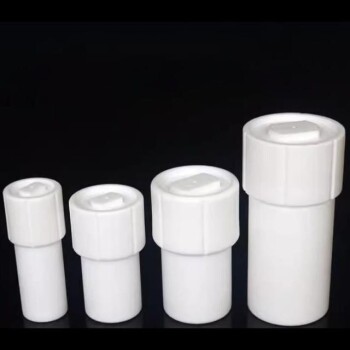
Stainless steel high-pressure reactors and PTFE (polytetrafluoroethylene) liners function as a controlled "micro-environment" that enables the precise layering required for core-shell synthesis. By providing a sealed, high-pressure vessel, these systems allow solvents to reach temperatures well above their boiling points, facilitating the controlled reduction of precursors and the directional growth of shell layers onto core templates.
Core Takeaway: The stainless steel reactor provides the structural strength to withstand high autogenous pressure, while the PTFE liner ensures chemical purity and corrosion resistance. Together, they create the stable, high-energy conditions necessary to achieve the uniform nucleation and growth required for complex core-shell nanostructures.
The Structural Role of the Stainless Steel Reactor
Maintaining High-Temperature and High-Pressure Conditions
The primary function of the stainless steel exterior is to provide a sealed environment capable of sustaining high autogenous pressure. This pressure is generated when solvents are heated beyond their boiling points within a confined space.
This high-energy state is critical for solvothermal synthesis, as it increases the solubility of organic ligands and metal salts. In the case of Pt@Pt-skin Pt3Ni nanowires, this environment allows solvents and surfactants to reach critical or near-critical states, which are essential for the gradual reduction of precursors.
Ensuring Structural Integrity During Reaction
Stainless steel is chosen for its mechanical strength and ability to resist deformation under extreme internal stress. This ensures the safety and stability of the process at temperatures reaching 210°C or higher.
The stability provided by the reactor body allows for long-term growth cycles. This is vital for the formation of well-defined core-shell structures, where the secondary "shell" material must crystallize slowly and uniformly over the primary "core."
The Protective Role of the PTFE Liner
Exceptional Chemical Inertness and Corrosion Resistance
The PTFE liner acts as a sacrificial barrier that protects the stainless steel exterior from corrosive reaction fluids. Many solvothermal reactions involve strong acids, bases, or sulfur-containing precursors that would otherwise degrade the metal reactor walls.
By isolating the reaction, the PTFE liner maintains its stability even under strong alkaline conditions. This is particularly important in the synthesis of composites like Bi2Se3/Bi2O3@Bi, where the chemical environment is highly aggressive.
Preventing Impurity Introduction and Ensuring Purity
One of the most critical roles of the PTFE liner is the prevention of metallic impurity ions from leaching into the reaction. If the reaction fluid contacted the stainless steel directly, iron, nickel, or chromium ions could contaminate the nanostructures.
Ensuring high purity is essential for the structural integrity and uniformity of the final product. In MOF synthesis, for example, the absence of impurities ensures the resulting crystals are highly ordered and chemically pure.
Controlled Growth of Core-Shell Architectures
Facilitating Nucleation and Directional Growth
The combination of heat and pressure within the reactor facilitates controlled nucleation. This allows researchers to guide the directional growth of shell materials onto the surfaces of core particles or nanowires.
In the synthesis of octahedral MnS, for instance, the reactor environment allows for the decomposition of precursors to release ions at a specific rate. This controlled release is what allows for the formation of defined crystal planes and specific intermediate structures.
Enabling Complete Precursor Coordination
The high-pressure environment forces the thorough coordination of metal ions with organic ligands. This is necessary for achieving an open porous structure or a "honeycomb-like" vertical array, as seen in SnS2 nanosheet growth.
Without the pressure provided by the stainless steel vessel, many of these precursors would remain insoluble. The reactor forces these components into a reactive state, ensuring that the shell layer fully encapsulates the core.
Understanding the Trade-offs and Limitations
Thermal Temperature Constraints
While PTFE is chemically resilient, it has a clear thermal ceiling, typically around 250°C. Operating near or above this limit can cause the liner to soften or deform, potentially compromising the seal and the safety of the reactor.
Heat Transfer and Thermal Lag
The thickness of both the stainless steel wall and the PTFE liner creates a thermal lag. It takes significant time for the internal reaction fluid to reach the set temperature of the oven or heating mantle, which must be accounted for during the synthesis of time-sensitive nanostructures.
Pressure Safety Limits
Every reactor has a maximum pressure rating that must not be exceeded. If a solvent generates more autogenous pressure than the vessel can handle—often due to overfilling the liner—the reactor may fail catastrophically, highlighting the need for precise volume calculations.
How to Apply This to Your Project
Selecting the Right Setup for Your Synthesis
To achieve the best results in solvothermal core-shell synthesis, consider the specific requirements of your precursors and solvents.
- If your primary focus is high purity and crystal integrity: Ensure your PTFE liner is pristine and free of scratches, as even minor surface defects can harbor contaminants from previous reactions.
- If your primary focus is achieving specific shell morphology: Carefully calibrate the temperature and fill-level of the reactor to control the internal autogenous pressure, which dictates the rate of shell growth.
- If your primary focus is working with aggressive alkaline or acidic solvents: Verify that the PTFE liner is thick enough and properly seated within the stainless steel sleeve to prevent any leakage to the metal exterior.
By mastering the balance between the structural strength of the reactor and the chemical protection of the liner, you can reliably produce high-quality, complex nanostructures with precise core-shell architectures.
Summary Table:
| Component | Primary Function | Material Benefit | Impact on Synthesis |
|---|---|---|---|
| Stainless Steel Reactor | Structural Integrity | High Pressure/Temp Resistance | Facilitates precursor reduction & uniform shell growth |
| PTFE Liner | Chemical Barrier | Inertness & Corrosion Resistance | Ensures high purity & prevents metallic contamination |
| Combined System | Controlled Environment | Stable "Micro-environment" | Enables precise layering of complex core-shell structures |
Elevate Your Nanotechnology Research with KINTEK
Precision is the foundation of breakthrough materials. At KINTEK, we specialize in providing high-performance laboratory equipment designed to meet the rigorous demands of solvothermal synthesis and advanced material science.
Whether you are developing complex core-shell architectures or scaling up MOF production, our portfolio offers the reliability and purity your work deserves:
- High-Temperature & High-Pressure Reactors and Autoclaves
- Muffle, Tube, Vacuum, and CVD Furnaces
- Electrolytic Cells, Electrodes, and Battery Research Tools
- Hydraulic Presses (Pellet, Hot, Isostatic) and Milling Systems
- Specialized Consumables: PTFE products, ceramics, and crucibles.
Our equipment ensures uniform heating, superior corrosion resistance, and the structural integrity needed for high-energy reactions. Ready to optimize your synthesis process? Contact KINTEK today to discover how our tailored solutions can accelerate your next discovery!
References
- Mahendra Goddati, Jaebeom Lee. Rugged Forest Morphology of Magnetoplasmonic Nanorods that Collect Maximum Light for Photoelectrochemical Water Splitting. DOI: 10.1002/smll.202302980
This article is also based on technical information from Kintek Solution Knowledge Base .
Related Products
- Stainless High Pressure Autoclave Reactor Laboratory Pressure Reactor
- Mini SS High Pressure Autoclave Reactor for Laboratory Use
- Customizable High Pressure Reactors for Advanced Scientific and Industrial Applications
- Customizable Laboratory High Temperature High Pressure Reactors for Diverse Scientific Applications
- High Pressure Laboratory Autoclave Reactor for Hydrothermal Synthesis
People Also Ask
- Why is a laboratory high-pressure reactor necessary for synthesizing fly ash-based zeolite? Achieve Pure Crystallization
- Why is a laboratory high-pressure reactor used in the hydrothermal synthesis of hydroxyapatite catalysts?
- What role does a laboratory high-pressure reactor play in the leaching process of spent cathode materials? Optimize Recovery
- What conditions do laboratory high-pressure reactors provide for HTC? Optimize Your Biochar Production Processes
- How are high-pressure reactors used to prepare metaphosphate electrocatalysts? Master In-Situ Precursor Growth