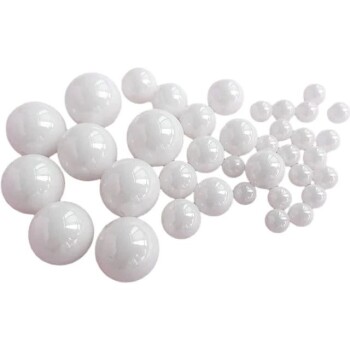
Zirconia grinding jars and balls serve as the critical mechanical interface for processing ultra-high temperature ceramics. They utilize extreme hardness and superior wear resistance to facilitate the intense ball milling required for Zirconium Diboride (ZrB2) and Silicon Carbide (SiC) composites. Their primary function is to ensure thorough particle dispersion while strictly preventing metallic contamination.
Core Takeaway The selection of zirconia media is a strategic choice to balance mechanical efficiency with chemical purity. By resisting wear against abrasive SiC particles, zirconia ensures the composite remains free of impurities that would otherwise compromise the material's thermal and mechanical integrity.
The Mechanics of Effective Dispersion
Overcoming Material Hardness
The mixing process for ZrB2-SiC involves integrating Silicon Carbide (SiC), a material known for its extreme hardness.
Zirconia balls are essential here because they possess the necessary hardness to effectively crush and de-agglomerate SiC particles.
Without media of this hardness, the SiC would wear down the grinding balls rather than being dispersed itself, leading to ineffective mixing.
Achieving Homogeneity
The goal of the ball milling process is not merely mixing, but achieving a uniform dispersion of the SiC reinforcement phase within the ZrB2 matrix.
Zirconia media delivers effective mechanical impact during the planetary motion of the jar.
This high-energy impact ensures that the two distinct powders are blended into a consistent, homogeneous mixture, which is a prerequisite for isotropic properties in the final product.
Preserving Material Purity
The Threat of Contamination
In the production of ultra-high temperature ceramics, purity is paramount. Standard grinding media, such as stainless steel, inevitably wears down during the high-energy collision process.
This wear introduces metal impurities into the powder mixture.
Such contamination can degrade the high-temperature performance and mechanical strength of the final sintered ceramic.
The Stability of Zirconia
Zirconia grinding jars and balls offer superior wear resistance and chemical stability compared to metallic alternatives.
By resisting abrasion—even against hard SiC particles—zirconia minimizes the introduction of wear byproducts.
This ensures that the final ZrB2-SiC composite retains the high purity levels necessary for its intended applications in extreme environments.
Understanding the Trade-offs
Impact Energy vs. Purity
While heavier metallic balls (like steel) might offer higher impact energy for plastic deformation, they are unsuitable for this specific application due to chemical reactivity.
Zirconia offers a balanced solution: it is dense enough to generate sufficient kinetic energy for milling, yet inert enough to maintain purity.
Media Hardness Compatibility
Using grinding media that is softer than the powder being milled is a common pitfall.
Because SiC is highly abrasive, using media softer than zirconia (such as standard alumina or steel) would result in rapid media destruction and severe powder contamination.
Making the Right Choice for Your Goal
When preparing ZrB2-SiC composite powders, your choice of milling media dictates the quality of the final ceramic.
- If your primary focus is Chemical Purity: Rely on zirconia media to eliminate the risk of metallic contamination that lowers the melting point or weakens grain boundaries.
- If your primary focus is Mechanical Performance: Use zirconia to ensure the hard SiC phase is uniformly dispersed, which is critical for achieving optimal hardness and fracture toughness in the sintered part.
The use of zirconia media is not just a processing detail; it is a fundamental requirement for achieving the high-performance standards of ultra-high temperature ceramics.
Summary Table:
| Feature | Benefit for ZrB2-SiC Processing |
|---|---|
| High Hardness | Effectively crushes and de-agglomerates abrasive SiC particles. |
| Superior Wear Resistance | Minimizes media wear, preventing impurities in the composite powder. |
| Chemical Stability | Ensures material purity by avoiding metallic contamination. |
| High-Energy Impact | Achieves uniform dispersion of SiC within the ZrB2 matrix for isotropic properties. |
| Density Optimization | Provides sufficient kinetic energy for effective milling while remaining inert. |
Elevate Your Material Research with KINTEK Precision Solutions
Don't let impurities compromise the integrity of your ultra-high temperature ceramics. KINTEK specializes in high-performance laboratory equipment designed for the most demanding applications. Whether you are processing advanced composites or conducting battery research, our comprehensive range of zirconia grinding jars and balls, crushing and milling systems, and high-temperature furnaces ensures your materials meet the highest standards of purity and performance.
From planetary ball mills to isostatic hydraulic presses and vacuum furnaces, KINTEK provides the tools needed for superior thermal and mechanical results. Contact us today to optimize your powder processing workflow!
Related Products
- Laboratory Jar Ball Mill with Alumina Zirconia Grinding Jar and Balls
- Precision Machined Zirconia Ceramic Ball for Engineering Advanced Fine Ceramics
- Laboratory Jar Mill with Agate Grinding Jar and Balls
- Laboratory Ball Mill Jar Mill with Metal Alloy Grinding Jar and Balls
- Nature Agate Mortar and Pestle for Grinding and Mixing
People Also Ask
- What are the primary functions of using a ball mill for BZCY72 powder? Achieve High Purity and Enhanced Sintering
- In what way does a laboratory ball mill affect material properties when modifying PHBV/pulp fiber composites?
- Why is a laboratory ball mill required for ultra-fine fly ash? Unlock Nano-Scale Adsorption Power
- What is the function of a laboratory ball mill in the preparation of AMMCs? Optimize Dispersion & Grain Refinement
- What is the function of a laboratory ball mill in the pretreatment of waste tire char (WTC)? Optimize Material Reactivity